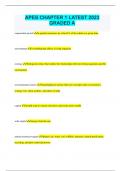
APES CHAPTER 1 LATEST 2023 GRADED A
APES CHAPTER 1 LATEST 2023 GRADED A exponential growth a quantity increases by a fixed % of the whole in a given time environment everything that effects a living organism ecology biological science that studies the relationships between living organisms and the environment environmental science interdisiplinary science that uses concepts such as economics, ecology, bio, chem, politics, and ethics to help capital wealth used to sustain a business and create more wealth solar capital energy from the sun natural resources/capital planet's air, water, soil, wildlife, minerals, natural purification, recycling, and pest control processes solar energy direct sunlight and indirect forms of solar energy: wind power, hydro power, biomass environmentally sustainable society satisfies basic needs of people without depleting its natural resources doubling time use the rule of 70 rule of 70 70/ percentage growth rate = doubling time in years economic growth an increase in their capacity to provide goods and services for people's final use Gross National Product (GNP) market value in current $ of goods and services produced within or outside a country Gross Domestic Product (GDP) market value in current $ of goods and service in a country Gross World Product (GWP) market value in current $ of goods and services in the world Per capita GNP GNP/total population economic development improvement of living standards by economic growth Developed Countries US, CA, Japan, AUS, New Zealand, Europe globalization broad process of global social, economic, and environmental change that leads to an increasingly integrated world ecological resource anything an organinsm needs for normal maintinence, growth, and reproduction perpetual resource on a human time scale it's continually renewed, expected to last 6 billion years as the sun completes its life cycle renewable resource can be replenished in hours- decades through natural processes sustainable yield the highest rate at which a renewable resource can be used identifiably without reducing avaiable supply environmental degredation exceed resources' natural replenish rate nonrenewable resources exist in a fixed quanity in the earth's crust mineral any hard, usually crystilline material that is formed naturally recycling collecting and reprocessing a resource into new products reuse using a resource over and over in its same form pollution any addition to our air water soil or food that threatens health survival or activities of humans or organisms point sources when pollutiants come from identifiable sources nonpoint sources pollutiants come form dispersed sources environmental worldviews how people think the world works and what their role should be
Written for
- Institution
- APES
- Course
- APES
Document information
- Uploaded on
- December 3, 2023
- Number of pages
- 5
- Written in
- 2023/2024
- Type
- Exam (elaborations)
- Contains
- Questions & answers
Subjects
-
apes chapter 1 latest 2023 graded a

Also available in package deal