PUBLIC LAW II CRYPT SHEET
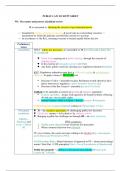
W1: The nature and process of judicial review
JR is concerned w/ checking the exercise of governmental power
® Essential for healthy separation of powers & to prevent an overreaching executive =
mechanism by which the judiciary can hold the executive to account.
® In accordance w/ the RoL, ensuring everyone is treated equally before the law
Preliminary
issues
Amenability ONLY ‘public law decisions’ are amendable to JR (Civil Procedure Rules Part
54.1(2)(a)(ii)):
© Public body carrying out a public function, through the exercise of
statutory power
© In the exercise of prerogative powers (GCHQ)
© Any body, public or private carrying out a regulatory function (Datafin)
KEY: Regulatory authorities must have a sufficiently public & governmental
character apply a form of ‘BUT FOR’ test
Decision of ASA = amenable because Parliament would otherwise have
had to intervene to regulate (ex parte Insurance Services plc)
Decision of the Bar Council = amenable (ex parte Percival)
Unlikely to be amenable in context of sporting & religious regulation:
ex parte Aga Khan - Jockey Club agreed to be bound by Rules of Racing
only give rise to public rights
Internal matters within a religion = private (ex parte Wachmann)
Contracting out: ex parte Goldmisth contrast w/ Partnerships in Care
Procedural © JR = the exclusive procedure for challenging public law decisions
exclusivity © Private law matters = to be dealt w/ by ordinary action
© Bringing a public law challenge not through JR = an abuse of process
O'Reilly v
Mackman and TWO exceptions:
Cocks v Thanet 1. Neither party objected to use of private law procedure
DC 2. Where contested decision was collateral
W/ mixed claims, the courts are more willing to be flexible (Roy v Kensington
and Chelsea and Westminster FPC)
Civil Procedure Rules: diluted strictness of approach to PE – chosen proceedings
mustn’t flout Part 1 CPR principles(Clark v Uni of Lincolnshire & Humberside)
Public law grounds = a defence in private law proceedings (Wandsworth
London BC v Winder)
, Standing KEY: Not everyone nor every organisation can make a JR application
s. 31(3) Senior IRC v National Federation of Self-Employed and Small Businesses (or ‘Fleet
Courts Act Street Casuals’): sufficient interest test
1981
© Mixed q. of law & fact: importance between applicant’s degree of interest
and the matter in contention – are they directly affected?
© Two stage approach:
o Initial permission: ‘busybodies, cranks & mischief-makers’
o Full hearing: consider in more detail whether there is a strong
enough case on the merits, taking into account the proximity of
his connection to the issue
Associations: courts will generally ALLOW the association standing to
challenge a matter in the communal interest (ex parte Liverpool Taxi Fleet
Operators' Association)
Pressure & interest groups: treated differently
Took a RESTRICTIVE view in ex parte Rose Theatre Trust Co Ltd =
seen as an artificial device to engineer standing status
Courts have since reasserted a more LIBERAL approach:
Individuals – ‘concerned citizens’: reflects liberalising trend
© ex parte Rees-Mogg: ‘sincere concern for constitutional issues’ having
written frequently about EU membership = standing
© ex parte Dixon: entitled to concern about illegality in planning permission
However, the courts will NOT necessarily allow standing if there are other better
placed challengers (R (DSD and NBV) v The Parole Board)
Time limits Short & strictly applied – time limit factors can affect whether and what relief is
granted by the court
MUST be filed promptly & no later than 3 months after (CPR Part 54.5(1))
Where there is undue delay, JR will be refused even if it is within 3-
, month period (Senior Courts Act 1981 s. 31(6))
Court can extend the time period under CPR Part 3.1(2)(a) but parties
themselves cannot extend by agreement (CPR Part 54.5(2))
Civil Procedure (Amendment No 4) Rules 2013: shorter time limits for
1) Planning decisions = 6 weeks
2) Public procurement decisions = 30 days
Ouster clauses Courts are hostile – adopt strong presumption Parliament did not intend to
exclude JR (Anisminic, Privacy International)
BUT if a partial/time limit ouster clause, the courts will take them at face value
+ enforce (Smith v East Elloe RDC, ex parte Ostler)
CPR 54.5(3): normal time limit does not apply where there is shorter time limit
‘Not substantially different test’: must REFUSE to grant relief where the outcome for
applicant would NOT have been substantially different (s. 31(2A) Senior Courts Act 1981)
Procedure
In JR, the court considers whether the PL decision has been correctly made & implemented
according to law (R (Cowl) v Plymouth City Council).
© NOT concerned w/ merits of the decision + do NOT remake the decision (like an appeal
court does). No absolute right = must bring a JR claim in the Administrative Court.
JR = ONLY appropriate where no suitable alternative
remedy/alternative remedies exhausted.
Alternatives: statutory right of appeal; internal
complaints or appeal procedures; or a complaint to an
ombudsman. Will impact on remedies.
Remedies
Prerogative powers
Remedy Effect
– specific toQuashing
JR order Most common remedy. Invalidates the impugned decision remake
Prohibitory order Prevents a public body from acting or continuing to act unlawfully.
Mandatory order Compels the public body to perform a public law duty imposed by law.
Declaration Declares what the legal position is, or what the rights of the parties are.
Does not question the public body’s exercise of the power.
Injunction Orders a party to perform/refrain from performing, a specific act. Rare.
Sometimes granted at the permission stage of the proceedings as a form
of interim relief - either before or after permission is granted
Damages ONLY if court is satisfied damages could have been awarded in a
W1: The nature and process of judicial review
JR is concerned w/ checking the exercise of governmental power
® Essential for healthy separation of powers & to prevent an overreaching executive =
mechanism by which the judiciary can hold the executive to account.
® In accordance w/ the RoL, ensuring everyone is treated equally before the law
Preliminary
issues
Amenability ONLY ‘public law decisions’ are amendable to JR (Civil Procedure Rules Part
54.1(2)(a)(ii)):
© Public body carrying out a public function, through the exercise of
statutory power
© In the exercise of prerogative powers (GCHQ)
© Any body, public or private carrying out a regulatory function (Datafin)
KEY: Regulatory authorities must have a sufficiently public & governmental
character apply a form of ‘BUT FOR’ test
Decision of ASA = amenable because Parliament would otherwise have
had to intervene to regulate (ex parte Insurance Services plc)
Decision of the Bar Council = amenable (ex parte Percival)
Unlikely to be amenable in context of sporting & religious regulation:
ex parte Aga Khan - Jockey Club agreed to be bound by Rules of Racing
only give rise to public rights
Internal matters within a religion = private (ex parte Wachmann)
Contracting out: ex parte Goldmisth contrast w/ Partnerships in Care
Procedural © JR = the exclusive procedure for challenging public law decisions
exclusivity © Private law matters = to be dealt w/ by ordinary action
© Bringing a public law challenge not through JR = an abuse of process
O'Reilly v
Mackman and TWO exceptions:
Cocks v Thanet 1. Neither party objected to use of private law procedure
DC 2. Where contested decision was collateral
W/ mixed claims, the courts are more willing to be flexible (Roy v Kensington
and Chelsea and Westminster FPC)
Civil Procedure Rules: diluted strictness of approach to PE – chosen proceedings
mustn’t flout Part 1 CPR principles(Clark v Uni of Lincolnshire & Humberside)
Public law grounds = a defence in private law proceedings (Wandsworth
London BC v Winder)
, Standing KEY: Not everyone nor every organisation can make a JR application
s. 31(3) Senior IRC v National Federation of Self-Employed and Small Businesses (or ‘Fleet
Courts Act Street Casuals’): sufficient interest test
1981
© Mixed q. of law & fact: importance between applicant’s degree of interest
and the matter in contention – are they directly affected?
© Two stage approach:
o Initial permission: ‘busybodies, cranks & mischief-makers’
o Full hearing: consider in more detail whether there is a strong
enough case on the merits, taking into account the proximity of
his connection to the issue
Associations: courts will generally ALLOW the association standing to
challenge a matter in the communal interest (ex parte Liverpool Taxi Fleet
Operators' Association)
Pressure & interest groups: treated differently
Took a RESTRICTIVE view in ex parte Rose Theatre Trust Co Ltd =
seen as an artificial device to engineer standing status
Courts have since reasserted a more LIBERAL approach:
Individuals – ‘concerned citizens’: reflects liberalising trend
© ex parte Rees-Mogg: ‘sincere concern for constitutional issues’ having
written frequently about EU membership = standing
© ex parte Dixon: entitled to concern about illegality in planning permission
However, the courts will NOT necessarily allow standing if there are other better
placed challengers (R (DSD and NBV) v The Parole Board)
Time limits Short & strictly applied – time limit factors can affect whether and what relief is
granted by the court
MUST be filed promptly & no later than 3 months after (CPR Part 54.5(1))
Where there is undue delay, JR will be refused even if it is within 3-
, month period (Senior Courts Act 1981 s. 31(6))
Court can extend the time period under CPR Part 3.1(2)(a) but parties
themselves cannot extend by agreement (CPR Part 54.5(2))
Civil Procedure (Amendment No 4) Rules 2013: shorter time limits for
1) Planning decisions = 6 weeks
2) Public procurement decisions = 30 days
Ouster clauses Courts are hostile – adopt strong presumption Parliament did not intend to
exclude JR (Anisminic, Privacy International)
BUT if a partial/time limit ouster clause, the courts will take them at face value
+ enforce (Smith v East Elloe RDC, ex parte Ostler)
CPR 54.5(3): normal time limit does not apply where there is shorter time limit
‘Not substantially different test’: must REFUSE to grant relief where the outcome for
applicant would NOT have been substantially different (s. 31(2A) Senior Courts Act 1981)
Procedure
In JR, the court considers whether the PL decision has been correctly made & implemented
according to law (R (Cowl) v Plymouth City Council).
© NOT concerned w/ merits of the decision + do NOT remake the decision (like an appeal
court does). No absolute right = must bring a JR claim in the Administrative Court.
JR = ONLY appropriate where no suitable alternative
remedy/alternative remedies exhausted.
Alternatives: statutory right of appeal; internal
complaints or appeal procedures; or a complaint to an
ombudsman. Will impact on remedies.
Remedies
Prerogative powers
Remedy Effect
– specific toQuashing
JR order Most common remedy. Invalidates the impugned decision remake
Prohibitory order Prevents a public body from acting or continuing to act unlawfully.
Mandatory order Compels the public body to perform a public law duty imposed by law.
Declaration Declares what the legal position is, or what the rights of the parties are.
Does not question the public body’s exercise of the power.
Injunction Orders a party to perform/refrain from performing, a specific act. Rare.
Sometimes granted at the permission stage of the proceedings as a form
of interim relief - either before or after permission is granted
Damages ONLY if court is satisfied damages could have been awarded in a