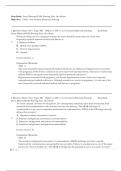
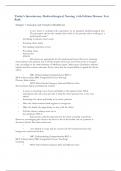
TEST BANK WONG'S ESSENTIALS OF PEDIATRIC NURSING 10TH EDITION
TEST BANK WONG'S ESSENTIALS OF PEDIATRIC NURSING 10TH EDITIONTable of Contents CH 01: Perspectives of Pediatric Nursing ................................................................................................................. 2 CH 02: Community-Based Nurs Care the Child & Fam ......................................................................................19 CH 03: Fam Influences on Child Health Promotion .............................................................................................26 CH 04: Soc Cultural & Religious Influences Child ................................................................................................45 CH 05: Developmental & Genetic Influences on Child ........................................................................................66 CH 06: Communication & Physical Assessment Child ...................................................................................... 100 CH 07: Pain Assessment & Management in Children ....................................................................................... 163 CH 08: Health Promotion of the Newborn and Family .................................................................................... 178 CH 09: Health Problems of Newborns .................................................................................................................. 222 CH 10: Health Promotion of the Infant and Family .......................................................................................... 297 CH 11: Health Problems of Infants ........................................................................................................................ 341 CH 12: Health Promotion of the Toddler and Family ....................................................................................... 367 CH 13: Health Promotion of the Preschooler and Fam .................................................................................... 402 CH 14: Health Problems of Toddlers and Preschooler ..................................................................................... 426 CH 15: Health Promotion of the School-Age Child ........................................................................................... 456 CH 16: Health Promotion of the Adolescent and Fam ...................................................................................... 480 CH 17: Hlth Problems of School-Age Children & Adol .................................................................................... 501 CH 18: QOL Children Living with Chronic or Complex .................................................................................. 545 CH 19: Impact of Cognitive or Sensory Impairment ......................................................................................... 585 CH 20: Family-Centered Home Care .................................................................................................................... 625 CH 21: Family-Centered Care of Child During Illnes ....................................................................................... 642 CH 22: Pediatric Variations of Nursing Interventio .......................................................................................... 671 CH 23: The Child with Respiratory Dysfunction ............................................................................................... 715 CH 24: The Child with Gastrointestinal Dysfunction ....................................................................................... 763 CH 25: The Child with Cardiovascular Dysfunction ......................................................................................... 818 CH 26: Child with Hematologic or Immunologic Dys ...................................................................................... 868 CH 27: Child with Genitourinary Dysfunction ................................................................................................... 916 CH 28: The Child with Cerebral Dysfunction ..................................................................................................... 956 CH 29: The Child with Endocrine Dysfunction ................................................................................................ 1005 CH 30: Child with Integumentary Dysfunction ................................................................................................ 1045 CH 31: Child with Musculoskeletal or Articular Dys ...................................................................................... 1103 CH 32: Child with Neuromuscular or Muscular Dysfun ................................................................................ 1140 Item Bank: Hockenberry Wong Essentials of Pediatric Nurs 19Ed 1 | P a g eCH 01: Perspectives of Pediatric Nursing 1. Question Name: 0001 Type: MC Objective: CH 01: Perspectives of Pediatric Nursing Item Bank: Hockenberry Wong Essentials of Pediatric Nurs 19Ed A nurse is planning a teaching session for parents of preschool children. Which statement explains why the nurse should include information about morbidity and mortality? A. Life-span statistics are included in the data. B. It explains effectiveness of treatment. C. Cost-effective treatment is detailed for the general population. * D. High-risk age groups for certain disorders or hazards are identified. Correct Answer: D Explanation/Ratio nale: ANS: D Analysis of morbidity and mortality data provides the parents with information about which groups of individuals are at risk for which health problems. Life-span statistics is a part of the mortality data. Treatment modalities and cost are not included in morbidity and mortality data. PTS: 1 DIF: Cognitive Level: Apply REF: 6-8 TOP: Integrated Process: Nursing Process: Planning MSC: Area of Client Needs: Health Promotion and Maintenance Reference/Notes: Keywords: Points: 1.00 Active Date Created: Penalty: 0.00 03/17/13 17:03:50 03/17/13 17:03:50 Score Mode: Date Modified: Date Used: Difficulty: Discrimination: Item Analysis: Last No. of Students Responded: Responded: 0 Correct Responses (%): Total Group: 0.00 Upper 27% of Group: 0.00 Lower 27% of Group: 0.00 Point Biserial: Response Frequencies (%) A B Last: 0.00 Cumulative: 0.00 2 | P a g e 0.00 0.00 0.00 C 0.00 0.00 D 0.0 0 0.0 0 Correct Responses (%): Total Group: Upper 27% of Group: Lower 27% of Group: Point Biserial: 0.00 0.00 0.00 0.00 Low Item Analysis: Cumulative 0 No. of Students Easy2. Question Name: 0002 Type: MC Objective: CH 01: Perspectives of Pediatric Nursing Item Bank: Hockenberry Wong Essentials of Pediatric Nurs 19Ed A clinic nurse is planning a teaching session about childhood obesity prevention for parents of school-age children. The nurse should include which associated risk of obesity in the teaching plan? A. Type I diabetes B. Respiratory disease C. Celiac disease * D. Type II diabetes Correct Answer: D Explanation/Ratio nale: ANS: D Childhood obesity has been associated with the rise of type II diabetes in children. Type I diabetes is not associated with obesity and has a genetic component. Respiratory disease is not associated with obesity, and celiac disease is the inability to metabolize gluten in foods and is not associated with obesity. PTS: 1 DIF: Cognitive Level: Apply REF: 3 TOP: Integrated Process: Nursing Process: Planning MSC: Area of Client Needs: Health Promotion and Maintenance Reference/Notes: Keywords: Points: 1.00 Active Date Created: Penalty: 0.00 03/17/13 17:03:50 03/17/13 17:03:50 Score Mode: Date Modified: Date Used: Difficulty: Discrimination: Item Analysis: Last No. of Students Responded: Responded: 0 Correct Responses (%): Total Group: 0.00 Upper 27% of Group: 0.00 Lower 27% of Group: 0.00 Point Biserial: Response Frequencies (%) A B Last: 0.00 Cumulative: 0.00 0.00 0.00 0.00 C 0.00 0.00 D 0.0 0 0.0 0 Correct Responses (%): Total Group: Upper 27% of Group: Lower 27% of Group: Point Biserial: 0.00 0.00 0.00 0.00 Low Item Analysis: Cumulative 0 No. of Students Easy 3 | P a g e3. Question Name: 0003 Type: MC Objective: CH 01: Perspectives of Pediatric Nursing Item Bank: Hockenberry Wong Essentials of Pediatric Nurs 19Ed Which is the leading cause of death in infants younger than 1 year? * A. Congenital anomalies B. Sudden infant death syndrome C. Respiratory distress syndrome D. Bacterial sepsis of the newborn Correct Answer: A Explanation/Ratio nale: ANS: A Congenital anomalies account for 20.1% of deaths in infants younger than 1 year. Sudden infant death syndrome accounts for 8.2% of deaths in this age group. Respiratory distress syndrome accounts for 3.4% of deaths in this age group. Infections specific to the perinatal period account for 2.7% of deaths in this age group. PTS: 1 DIF: Cognitive Level: Remember REF: 7 TOP: Integrated Process: Nursing Process: Assessment MSC: Area of Client Needs: Health Promotion and Maintenance Reference/Notes: Keywords: Points: 1.00 Active Date Created: Penalty: 0.00 03/17/13 17:03:50 03/17/13 17:03:50 Score Mode: Date Modified: Date Used: Difficulty: Discrimination: Item Analysis: Last No. of Students Responded: Responded: 0 Correct Responses (%): Total Group: 0.00 Upper 27% of Group: 0.00 Lower 27% of Group: 0.00 Point Biserial: Response Frequencies (%) A B Last: 0.00 Cumulative: 0.00 0.00 0.00 0.00 C 0.00 0.00 D 0.0 0 0.0 0 Correct Responses (%): Total Group: Upper 27% of Group: Lower 27% of Group: Point Biserial: 0.00 0.00 0.00 0.00 Low Item Analysis: Cumulative 0 No. of Students Easy 4. Question Name: 0004 4 | P a g e Type: MC Objective: CH 01:Perspectives of Pediatric Nursing Item Bank: Hockenberry Wong Essentials of Pediatric Nurs 19Ed Which leading cause of death topic should the nurse emphasize to a group of African-American boys ranging in ages 15 to 19 years? A. Suicide B. Cancer * C. Firearm homicide D. Occupational injuries Correct Answer: C Explanation/Ratio nale: ANS: C Firearm homicide is the second overall cause of death in this age group and the leading cause of death in African-American males. Suicide is the third-leading cause of death in this population. Cancer, although a major health problem, is the fourth-leading cause of death in this age group. Occupational injuries do not contribute to a significant death rate for this age group. PTS: 1 DIF: Cognitive Level: Understand REF: 5 | 8 TOP: Integrated Process: Nursing Process: Planning MSC: Area of Client Needs: Health Promotion and Maintenance Reference/Notes: Keywords: Points: 1.00 Active Date Created: Penalty: 0.00 03/17/13 17:03:50 03/17/13 17:03:50 Score Mode: Date Modified: Date Used: Difficulty: Discrimination: Item Analysis: Last No. of Students Responded: Responded: 0 Correct Responses (%): Total Group: 0.00 Upper 27% of Group: 0.00 Lower 27% of Group: 0.00 Point Biserial: Response Frequencies (%) A B Last: 0.00 Cumulative: 0.00 0.00 0.00 0.00 C 0.00 0.00 D 0.0 0 0.0 0 Correct Responses (%): Total Group: Upper 27% of Group: Lower 27% of Group: Point Biserial: 0.00 0.00 0.00 0.00 Low Item Analysis: Cumulative 0 No. of Students Easy 5. Question Name: 0005 Type: MC Objective: CH 01: Perspectives of Pediatric Nursing Item Bank: Hockenberry Wong Essentials of Pediatric Nurs 19Ed 5 | P a g eWhich is the major cause of death for children older than 1 year? A. Cancer B. Heart disease * C. Unintentional injuries D. Congenital anomalies Correct Answer: C Explanation/Ratio nale: ANS: C Unintentional injuries (accidents) are the leading cause of death after age 1 year through adolescence. Congenital anomalies are the leading cause of death in those younger than 1 year. Cancer ranks either second or fourth, depending on the age group, and heart disease ranks fifth in the majority of the age groups. PTS: 1 DIF: Cognitive Level: Remember REF: 8 TOP: Integrated Process: Nursing Process: Planning MSC: Area of Client Needs: Health Promotion and Maintenance Reference/Notes: Keywords: Points: 1.00 Active Date Created: Penalty: 0.00 03/17/13 17:03:50 03/17/13 17:03:50 Score Mode: Date Modified: Date Used: Difficulty: Discrimination: Item Analysis: Last No. of Students Responded: Responded: 0 Correct Responses (%): Total Group: 0.00 Upper 27% of Group: 0.00 Lower 27% of Group: 0.00 Point Biserial: Response Frequencies (%) A B Last: 0.00 Cumulative: 0.00 0.00 0.00 0.00 C 0.00 0.00 D 0.0 0 0.0 0 Correct Responses (%): Total Group: Upper 27% of Group: Lower 27% of Group: Point Biserial: 0.00 0.00 0.00 0.00 Low Item Analysis: Cumulative 0 No. of Students Easy 6. Question Name: 0006 Type: MC Objective: CH 01: Perspectives of Pediatric Nursing Item Bank: Hockenberry Wong Essentials of Pediatric Nurs 19Ed Which is the leading cause of death from unintentional injuries for females ranging in age from 1 to 14? A. Mechanical suffocation 6 | P a g eB. Drowning * C. Motor-vehicle-related fatalities D. Fire- and burn-related fatalities Correct Answer: C Explanation/Ratio nale: ANS: C Motor-vehicle-related fatalities are the leading cause of death for females ranging in age from 1 to 14, either as passengers or as pedestrians. Mechanical suffocation is fourth or fifth, depending on the age. Drowning is the second- or third-leading cause of death, depending on the age. Fire- and burn-related fatalities are the second-leading cause of death. PTS: 1 DIF: Cognitive Level: Remember REF: 4 TOP: Integrated Process: Nursing Process: Assessment MSC: Area of Client Needs: Health Promotion and Maintenance Reference/Notes: Keywords: Points: 1.00 Active Date Created: Penalty: 0.00 03/17/13 17:03:50 03/17/13 17:03:50 Score Mode: Date Modified: Date Used: Difficulty: Discrimination: Item Analysis: Last No. of Students Responded: Responded: 0 Correct Responses (%): Total Group: 0.00 Upper 27% of Group: 0.00 Lower 27% of Group: 0.00 Point Biserial: Response Frequencies (%) A B Last: 0.00 Cumulative: 0.00 0.00 0.00 0.00 C 0.00 0.00 D 0.0 0 0.0 0 Correct Responses (%): Total Group: Upper 27% of Group: Lower 27% of Group: Point Biserial: 0.00 0.00 0.00 0.00 Low Item Analysis: Cumulative 0 No. of Students Easy 7. Question Name: 0007 Type: MC Objective: CH 01: Perspectives of Pediatric Nursing Item Bank: Hockenberry Wong Essentials of Pediatric Nurs 19Ed Which factor most impacts the type of injury a child is susceptible to, according to the child’s age? A. Physical health of the child * B. Developmental level of the child C. Educational level of the child D. Number of responsible adults in the home 7 | P a g eCorrect Answer: B Explanation/Ratio nale: ANS: B The child’s developmental stage determines the type of injury that is likely to occur. The child’s physical health may facilitate the child’s recovery from an injury but does not impact the type of injury. Educational level is related to developmental level, but it is not as important as the child’s developmental level in determining the type of injury. The number of responsible adults in the home may affect the number of unintentional injuries, but the type of injury is related to the child’s developmental stage. PTS: 1 DIF: Cognitive Level: Understand REF: 3-4 TOP: Integrated Process: Nursing Process: Planning MSC: Area of Client Needs: Health Promotion and Maintenance Reference/Notes: Keywords: Points: 1.00 Active Date Created: Penalty: 0.00 03/17/13 17:03:50 03/17/13 17:03:50 Score Mode: Date Modified: Date Used: Difficulty: Discrimination: Item Analysis: Last No. of Students Responded: Responded: 0 Correct Responses (%): Total Group: 0.00 Upper 27% of Group: 0.00 Lower 27% of Group: 0.00 Point Biserial: Response Frequencies (%) A B Last: 0.00 Cumulative: 0.00 0.00 0.00 0.00 C 0.00 0.00 D 0.0 0 0.0 0 Correct Responses (%): Total Group: Upper 27% of Group: Lower 27% of Group: Point Biserial: 0.00 0.00 0.00 0.00 Low Item Analysis: Cumulative 0 No. of Students Easy 8. Question Name: 0008 Type: MC Objective: CH 01: Perspectives of Pediatric Nursing Item Bank: Hockenberry Wong Essentials of Pediatric Nurs 19Ed Which is now referred to as the “new morbidity”? A. Limitations in the major activities of daily living B. Unintentional injuries that cause chronic health problems C. Discoveries of new therapies to treat health problems * D. Behavioral, social, and educational problems that alter health Correct Answer: D 8 | P a g eExplanation/Rationale: ANS: D The new morbidity reflects the behavioral, social, and educational problems that interfere with the child’s social and academic development. It is currently estimated that the incidence of these issues is from 5% to 30%. Limitations in major activities of daily living and unintentional injuries that result in chronic health problems are included in morbidity data. Discovery of new therapies would be reflected in changes in morbidity data over time. PTS: 1 DIF: Cognitive Level: Remember REF: 3 TOP: Integrated Process: Nursing Process: Assessment MSC: Area of Client Needs: Health Promotion and Maintenance Reference/Notes: Keywords: Points: 1.00 Active Date Created: Penalty: 0.00 03/17/13 17:03:50 03/17/13 17:03:50 Score Mode: Date Modified: Date Used: Difficulty: Discrimination: Item Analysis: Last No. of Students Responded: Responded: 0 Correct Responses (%): Total Group: 0.00 Upper 27% of Group: 0.00 Lower 27% of Group: 0.00 Point Biserial: Response Frequencies (%) A B Last: 0.00 Cumulative: 0.00 0.00 0.00 0.00 C 0.00 0.00 D 0.0 0 0.0 0 Correct Responses (%): Total Group: Upper 27% of Group: Lower 27% of Group: Point Biserial: 0.00 0.00 0.00 0.00 Low Item Analysis: Cumulative 0 No. of Students Easy 9. Question Name: 0009 Type: MC Objective: CH 01: Perspectives of Pediatric Nursing Item Bank: Hockenberry Wong Essentials of Pediatric Nurs 19Ed A nurse on a pediatric unit is practicing family-centered care. Which is most descriptive of the care the nurse is delivering? A. Taking over total care of the child to reduce stress on the family B. Encouraging family dependence on health care systems * C. Recognizing that the family is the constant in a child’s life D. Excluding families from the decision-making process Correct Answer: C Explanation/Ratio nale: ANS: C 9 | P a g eThe three key components of family-centered care are respect, collaboration, and support. Family-centered care recognizes the family as the constant in the child’s life. Taking over total care does not include the family in the process and may increase stress instead of reducing stress. The family should be enabled and empowered to work with the health care system. The family is expected to be part of the decision-making process. PTS: 1 DIF: Cognitive Level: Remember REF: 8 TOP: Integrated Process: Nursing Process: Implementation MSC: Area of Client Needs: Health Promotion and Maintenance Reference/Notes: Keywords: Points: 1.00 Active Date Created: Penalty: 0.00 03/17/13 17:03:50 03/17/13 17:03:50 Score Mode: Date Modified: Date Used: Difficulty: Discrimination: Item Analysis: Last No. of Students Responded: Responded: 0 Correct Responses (%): Total Group: 0.00 Upper 27% of Group: 0.00 Lower 27% of Group: 0.00 Point Biserial: Response Frequencies (%) A B Last: 0.00 Cumulative: 0.00 0.00 0.00 0.00 C 0.00 0.00 D 0.0 0 0.0 0 Correct Responses (%): Total Group: Upper 27% of Group: Lower 27% of Group: Point Biserial: 0.00 0.00 0.00 0.00 Low Item Analysis: Cumulative 0 No. of Students Easy 10. Question Name: 0010 Type: MC Objective: CH 01: Perspectives of Pediatric Nursing Item Bank: Hockenberry Wong Essentials of Pediatric Nurs 19Ed The nurse is preparing an in-service education to staff about atraumatic care for pediatric patients. Which intervention should the nurse include? A. Prepare the child for separation from parents during hospitalization by reviewing a video. * B. Prepare the child before any unfamiliar treatment or procedure by demonstrating on a stuffed animal. C. Help the child accept the loss of control associated with hospitalization. D. Help the child accept pain that is connected with a treatment or procedure. Correct Answer: B Explanation/Ratio nale: ANS: B 10 | P a g ePreparing the child for any unfamiliar treatments, controlling pain, allowing privacy, providing play activities for expression of fear and aggression, providing choices, and respecting cultural differences are components of atraumatic care. In the provision of atraumatic care, the separation of child from parents during hospitalization is minimized. The nurse should promote a sense of control for the child. Preventing and minimizing bodily injury and pain are major components of atraumatic care. PTS: 1 DIF: Cognitive Level: Understand REF: 9 TOP: Integrated Process: Nursing Process: Implementation MSC: Area of Client Needs: Psychosocial Integrity Reference/Notes: Keywords: Points: 1.00 Active Date Created: Penalty: 0.00 03/17/13 17:03:50 03/17/13 17:03:50 Score Mode: Date Modified: Date Used: Difficulty: Discrimination: Item Analysis: Last No. of Students Responded: Responded: 0 Correct Responses (%): Total Group: 0.00 Upper 27% of Group: 0.00 Lower 27% of Group: 0.00 Point Biserial: Response Frequencies (%) A B Last: 0.00 Cumulative: 0.00 0.00 0.00 0.00 C 0.00 0.00 D 0.0 0 0.0 0 Correct Responses (%): Total Group: Upper 27% of Group: Lower 27% of Group: Point Biserial: 0.00 0.00 0.00 0.00 Low Item Analysis: Cumulative 0 No. of Students Easy 11. Question Name: 0011 Type: MC Objective: CH 01: Perspectives of Pediatric Nursing Item Bank: Hockenberry Wong Essentials of Pediatric Nurs 19Ed Which is most suggestive that a nurse has a nontherapeutic relationship with a patient and family? * A. Staff is concerned about the nurse’s actions with the patient and family. B. Staff assignments allow the nurse to care for same patient and family over an extended time. C. Nurse is able to withdraw emotionally when emotional overload occurs but still remains committed. D. Nurse uses teaching skills to instruct patient and family rather than doing everything for them. Correct Answer: A Explanation/Ratio 11 | P a g enale: ANS: A An important clue to a nontherapeutic staff-patient relationship is concern of other staff members. Allowing the nurse to care for the same patient over time would be therapeutic for the patient and family. Nurses who are able to somewhat withdraw emotionally can protect themselves while providing therapeutic care. Nurses using teaching skills to instruct patient and family will assist in transitioning the child and family to self-care. PTS: 1 DIF: Cognitive Level: Analyze REF: 9 TOP: Integrated Process: Nursing Process: Assessment MSC: Area of Client Needs: Psychosocial Integrity Reference/Notes: Keywords: Points: 1.00 Active Date Created: Penalty: 0.00 03/17/13 17:03:50 03/17/13 17:03:50 Score Mode: Date Modified: Date Used: Difficulty: Discrimination: Item Analysis: Last No. of Students Responded: Responded: 0 Correct Responses (%): Total Group: Upper 27% of Group: Lower 27% of Group: Point Biserial: R esponse Freque ncies (%) A Last: Cumulative: 0.00 0.00 B 0.00 0.00 0.00 0.00 0.00 0.00 C 0.00 0.00 D 0.00 0.00 Correct Responses (%): Total Group: Upper 27% of Group: Lower 27% of Group: Point Biserial: 0.00 0.00 0.00 0.00 Low Item Analysis: Cumulative 0 No. of Students Easy 12. Question Name: 0012 Type: MC Objective: CH 01: Perspectives of Pediatric Nursing Bank: Hockenberry Wong Essentials of Pediatric Nurs 19Ed Which is most descriptive of clinical reasoning? A. A simple developmental process * B. Purposeful and goal-directed C. Based on deliberate
Written for
- Institution
-
Chamberlian School Of Nursing
- Course
- Unknown
Document information
- Uploaded on
- December 2, 2023
- Number of pages
- 1165
- Written in
- 2023/2024
- Type
- Exam (elaborations)
- Contains
- Unknown
Subjects
-
test bank