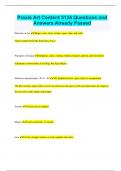
Praxis Art Content 5134 Questions and Answers Already Passed
Praxis Art Content 5134 Questions and Answers Already Passed Elements of Art Shape, color, form, texture, space, line, and value (Sam Couldn't Find The Small Lily Vase) Principles of design Emphasis, unity, contrast, rhythm, balance, pattern, and movement (Elephants Unfortunately Can't Rap, But Pigs Might) Elements and principles: 2D vs. 3D 2D: Implied texture, space refers to composition 3D: Real texture, space refers to how the artist uses the space in 3D, form describes the shape of the artwork (width, depth, and height) Texture Can be real or implied Shapes Can be geometric or organic Line Can be straight, broken, curved, implied, free-form Space Can refer to foreground, middle ground, background, positive space (subject), negative space (area around subject) Form Used in 3D art to describe the shape of the artwork Balance Can be symmetrical or asymmetrical Contrast When elements are juxtaposed to create interesting differences (not just color) Movement Uses elements to lead viewer throughout the piece Emphasis Creates a focal point Pattern Repeats elements in the same order Rhythm Repeats elements without a specific order Unity Harmony created by elements working together Example Piet Mondrian mainly uses color, line, and shape in Composition with Red, Yellow, and Blue (1927). The Starry Night by van Gogh uses several principles, including contrast, emphasis, balance, and movement. Relationship of elements to principles The elements are the building blocks of visual art, and the principles are ways to organize those elements. Artists can use some or all to create their artwork, explain their artistic decisions, or analyze another artist's artwork. These are "established criteria that are used to objectively judge artwork." Golden mean/ golden ratio Term used to describe how elements within a piece of art can be placed in the most aesthetically pleasing way, based on math Approximately 1 to 1.618 Hierarchical organization artist uses unnatural proportion or scale to depict the relative importance of the figures in the artwork Perspective art technique for creating an illusion of 3D (depth and space) on a 2D (flat) surface Viewpoint The position from where you view the scene Horizon Line The imaginary horizontal line in the distance that is eye level Vanishing Lines Lines that come together (converge) at the vanishing point. One point perspective One vanishing point along the horizon line Two point perspective Two vanishing points on the horizon line Foreshortening Use of distortion to create the illusion of an object extending into space Atmospheric Perspective The effect of distance or atmosphere shown through haziness or changes in color Juxtaposition
Written for
- Institution
- Praxis Art Content 5134
- Course
- Praxis Art Content 5134
Document information
- Uploaded on
- December 1, 2023
- Number of pages
- 52
- Written in
- 2023/2024
- Type
- Exam (elaborations)
- Contains
- Questions & answers
Subjects
-
praxis art content 5134 questions and answers alre

Also available in package deal