100% de satisfacción garantizada Inmediatamente disponible después del pago Tanto en línea como en PDF No estas atado a nada 4.2 TrustPilot
logo-home
Examen

TESTBANK Beckmann and Ling’s Obstetrics and Gynecology 8th Edition Casanova

Puntuación
-
Vendido
-
Páginas
368
Grado
A+
Subido en
01-12-2023
Escrito en
2023/2024

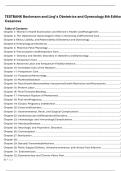
TESTBANK Beckmann and Ling’s Obstetrics and Gynecology 8th Edition CasanovaTable of Contents Chapter 1: Women’s Health Examination and Women’s Health Care Management ................................. 2 Chapter 2: The Obstetrician–Gynecologist’s Role in Screening and Preventive Care ............................... 10 Chapter 3: Ethics, Liability, and Patient Safety in Obstetrics and Gynecology ............................................. 15 Chapter 4: Embryology and Anatomy ......................................................................................................... 20 Chapter 5: Maternal–Fetal Physiology ........................................................................................................ 27 Chapter 6: Preconception and Antepartum Care ......................................................................................... 36 Chapter 7: Genetics and Genetic Disorders in Obstetrics and Gynecology .............................................. 46 Chapter 8: Intrapartum Care........................................................................................................................ 55 Chapter 9: Abnormal Labor and Intrapartum Fetal Surveillance ................................................................. 64 Chapter 10: Immediate Care of the Newborn ............................................................................................. 74 Chapter 11: Postpartum Care ..................................................................................................................... 82 Chapter 12: Postpartum Hemorrhage .......................................................................................................... 90 Chapter 13: Multifetal Gestation ................................................................................................................... 95 Chapter 14: Fetal Growth Abnormalities: Intrauterine Growth Restriction and Macrosomia .................... 102 Chapter 15: Preterm Labor ......................................................................................................................... 111 Chapter 16: Third-Trimester Bleeding ......................................................................................................... 119 Chapter 17: Premature Rupture of Membranes ....................................................................................... 125 Chapter 18: Post-term Pregnancy ............................................................................................................... 132 Chapter 19: Ectopic Pregnancy and Abortion ............................................................................................ 139 Chapter 20: Endocrine Disorders ............................................................................................................... 149 Chapter 21: Gastrointestinal, Renal, and Surgical Complications .......................................................... 151 Chapter 22: Cardiovascular and Respiratory Disorders ........................................................................... 157 Chapter 23: Hematologic and Immunologic Complications .................................................................... 166 Chapter 24: Infectious Diseases ................................................................................................................ 173 Chapter 25: Neurologic and Psychiatric Disorders .................................................................................. 183 Chapter 26: Contraception ........................................................................................................................ 185 Chapter 27: Sterilization ............................................................................................................................. 191 Chapter 28: ................................................................................................................................................. 199 Chapter 29: Sexually Transmitted Infections ............................................................................................. 208 Chapter 30: Pelvic Support Defects, Urinary Incontinence, and Urinary Tract Infection ........................... 220 Chapter 31: Endometriosis ....................................................................................................................... 228 Chapter 32: Dysmenorrhea and Chronic Pelvic Pain ............................................................................... 235 1 | P a g eChapter 33: Disorders of the Breast .......................................................................................................... 245 Chapter 34: Gynecologic Procedures ....................................................................................................... 253 Chapter 35: Human Sexuality .................................................................................................................... 259 Chapter 36: Sexual Assault and Domestic Violence ................................................................................ 264 Chapter 37: Reproductive Cycles ............................................................................................................. 268 Chapter 38: Puberty ................................................................................................................................... 274 Chapter 39: Amenorrhea and Abnormal Uterine Bleeding ...................................................................... 283 Chapter 40: Hirsutism and Virilization ....................................................................................................... 290 Chapter 41: Menopause ............................................................................................................................ 298 Chapter 42: ................................................................................................................................................. 306 Chapter 43: Premenstrual Syndrome and Premenstrual Dysphoric Disorder ........................................ 312 Chapter 44: Cell Biology and Principles of Cancer Therapy ..................................................................... 318 Chapter 45: Gestational Trophoblastic Neoplasia ..................................................................................... 323 Chapter 46: Vulvar and Vaginal Disease and Neoplasia .......................................................................... 330 Chapter 47: Cervical Neoplasia and Carcinoma ..................................................................................... 338 Chapter 48: Uterine Leiomyoma and Neoplasia ....................................................................................... 348 Chapter 49: Cancer of the Uterine Corpus ................................................................................................. 353 Chapter 50: Ovarian and Adnexal Disease ............................................................................................... 359 Chapter 1: Women’s Health Examination and Women’s Health Care Management 1: Elevating the head of the examining table approximately 30 degrees facilitates a: the observation of the patient's responses b: the ability of the patient to comfortably look around to distract her from the examination c: the contraction of the abdominal wall muscle groups, making the examination easier d: comfortable blood pressure measurement e: the physician not being distracted by eye contact with the patient 2: Which of the following uterine positions is most associated with dyspareunia? a: Midposition, retroflexed 2 | P a g eb: Retroverted, anteflexed c: Anteverted, anteflexed d: Retroverted, retroflexed e: Midpostion, anteflexed 3: Inquiry concerning adult and child history of sexual abuse should be included in the sexual history a: if time permits b: in visits where there are suspicious physical findings but not otherwise c: in visits where sufficient time is allotted d: in all new patient visits e: in visits where a specific indication is noted 4: Peau d'orange change in the breast is associated with a: edema of the lymphatics b: jaundice c: too vigorous breastfeeding d: overly tight undergarments e: galactorrhea 5: 3 | P a g eWhich kind of speculum is often most suitable for examination of the nulliparous patient? a: Morgan's speculum b: Endoscopic speculum c: Ling speculum d: Graves speculum e: Pederson speculum 6: Which uterine configuration is most difficult to assess for size, shape, configuration, and mobility? a: Midposition b: Anteverted c: There is no difference in difficulty d: Retroverted 7: Which type of speculum is most appropriate for the examination of a parous menstrual woman? a: Ling speculum b: Graves speculum c: Pederson speculum d: Endoscopic speculum 4 | P a g ee: Morgan's speculum 8: Menopause is defined as the cessation of menses for greater than e: 24 months 9: In a woman describing sufficiently frequent sexual encounters, infertility typically is described as a failure to conceive after a: 3 months b: 9 months c: 12 months d: 18 months e: 6 months 10: During bimanual examination of the adnexa in normal premenopausal women, the ovaries are palpable e: about one-quarter of the time 11: If a patient becomes uncomfortable with a topic during a history-taking session, the best response of the physician is to a: address the patient's discomfort in a positive and supportive manner b: discontinue discussion of the topic to avoid further patient discomfort c: discontinue discussion to avoid damage to the patient-physician relationship d: continue after making a joke to relieve tension e: 5 | P a g eignore the discomfort and proceed with questioning 12: Which of the following statements about the steps in the breast examination is correct? e: Inspection is done first 13: Questions that promote the physician's fullest understanding of the patient's situation are best characterized as a: compassionate b: chronological c: sympathetic d: emphatic e: evidence based 14: The last menstrual period is dated from the 15: The passage of clots during menstruation a: is always abnormal b: may be either normal or abnormal c: is always normal d: is extremely rare 16: 6 | P a g eIn the abbreviation of the obstetric history-G[1] P[2] [3] [4] [5]-"1" stands for the number of a: living children b: pregnancies c: term pregnancies d: preterm pregnancies e: abortions 17: a: living children b: pregnancies c: term pregnancies d: preterm pregnancies e: abortions 18: In the abbreviation of the obstetric history-G[1] P[2] [3] [4] [5]-"3" stands for the number of a: living children b: pregnancies c: term pregnancies d: 7 | P a g epreterm pregnancies e: abortions 19: a: living children b: pregnancies c: term pregnancies d: preterm pregnancies e: abortions 20: In the abbreviation of the obstetric history-G[1] P[2] [3] [4] [5]-"5" stands for the number of a: living children b: pregnancies c: term pregnancies d: preterm pregnancies e: abortions 21: Tanner's classification with respect to the breast relates to changes in the breast before and after lactation b: associated with malignancy c: 8 | P a g eassociated with maturation d: associated with galactorrhea e: associated with fibrocystic changes 22: The rectovaginal examination should be performed a: after 52 years of age b: at the initial patient visit c: only for the evaluation of chronic pelvic pain d: only when there are symptoms of pelvic relaxation e: at intervals of 5 years 23: In the gynecologic history, it is often possible to distinguish between vaginitis and pelvic inflammatory disease by inquiring about the duration of the pain b: the symptoms present (fever/chills, itching) c: the timing of pain in relation to menses d: the association of pain with body position e: the use of topical medications 24: The most common reason for failure to visualize the cervix during the speculum examination is a: failure to use lubricant b: a full bladder c: 9 | P a g efailure to fully insert the speculum d: use of a speculum that has not been warmed e: use of the wrong speculum 25: Prehypertension is defined as a blood pressure range of a: 80-90/120-139 b: 90-100/120-139 c: 80-90/110-129 d: 70-80/110-129 e: 70-80/120-139 ANS: 1-25. [A, D, D, A, E, D, B, C,C,C,A,E,D,A,B,B,C,D,E,A,C,B,E,C,A] Chapter 2: The Obstetrician–Gynecologist’s Role in Screening and Preventive Care 1: The sensitivity of a screening test is defined as the proportion of a: unaffected individuals that test positive b: affected individuals that test positive c: unaffected individuals that test negative d: affected individuals that test negative 2: The specificity of a screening test is defined as the proportion of 10 | P a g ea: affected individuals that test negative b: unaffected individuals that test positive c: affected individuals that test positive d: unaffected individuals that test negative 3: Counseling an obese patient to lose weight is an example of a: secondary prevention b: primary prevention c: empathy d: engagement 4: In women, the thyroid-stimulating hormone screening test should be performed at what interval? a: Every 1-2 years from age 40 years, then yearly after age 50 years b: Every 5 years after age 50 years c: Annually from puberty or from the onset of sexual activity d: Every 5 years from age 19 years, then every 3-5 years after age 65 years 5: The Pap smear for cervical dysplasia should be performed at what interval? a: Every 2-3 years after age 30 years if three consecutive annual tests are negative b: Every 5 years from age 19 years, then every 3-5 years after age 65 years c: Every 1-2 years beginning at age 65 years d: 11 | P a g eEvery 1-2 years from age 40 years, then yearly after age 50 years 6: A cholesterol/lipid profile should be performed for women without risk factors at what interval? a: Every other year from age 40 years, then yearly after age 50 years b: Every 5 years after age 45 years c: Every 3-5 years after age 65 years d: Every 5 years from age 19 years, then every 3-4 years after age 65 years 7: A mammography to detect breast cancer should be performed at what interval in women at average risk? a: Every 1-2 years after age 65 years b: Every 5 years after age 19 years, then every 3-4 years after age 65 years c: Every other year from age 40 years, then yearly after age 50 years d: Every 3-5 years after age 45 years 8: A colonoscopy to detect colorectal cancer should be performed at what interval for women at average risk? a: Every 10 years starting at age 50 years b: Every 1-2 years starting at age 40 years c: Every 10 years starting at age 65 years d: Every 10 years from age 19 years, then every 3-4 years after age 65 years 9: Which of the following is the most appropriate screening mechanism for cervical dysplasia? a: Pap smear 12 | P a g eb: Serum HPV titer c: HPV-DNA testing d: Colposcopy of suspicious lesions 10: Which of the following is the most appropriate screening mechanism for colorectal cancer? a: Hemogram b: Colonoscopy c: Physical examination of suspicious lesions d: CT scan 11: Which of the following is the most appropriate screening mechanism for thyroid disease? a: Thyroid-stimulating hormone b: Free thyroxine c: Yearly physician examination d: Thyroid-binding globulin 12: What is the appropriate interval for Pap testing in women who have had a total hysterectomy for reasons other than cervical dysplasia? a: 13 | P a g eEvery 2 years following the hysterectomy b: Every 5 years following the hysterectomy c: No additional Pap testing is needed d: Every year following the hysterectomy 13: In sexually active women age 25 or younger, regular screening for Chlamydia should occur a: only if the woman is at high risk for infection b: every 3-5 years c: annually d: every 2 years 14: Bone mineral density testing is recommended for women without risk factors for osteoporosis beginning at what age? a: 40 years b: 65 years c: 50 years Testing is not recommended for women with no risk factors 15: A 40-year-old woman comes for an initial visit. Her BMI is 30 and she had previously given birth to an infant weighing 9.5lb. Which of the following initial screening tests is indicated for this patient? a: Fasting blood glucose b: 14 | P a g eColonoscopy c: TSH level d: Bone mineral density testing ANS: [b,d,b,b,a,b,c,a,a,b,a,c,c,b,a] Chapter 3: Ethics, Liability, and Patient Safety in Obstetrics and Gynecology 1: The principle that the patient should be given what is "due" most closely matches the principle of a: justice b: nonmaleficence c: beneficence d: autonomy 2: The principle that there should be respect for the patient's right to make choices based on her beliefs and values best matches the principle of a: beneficence b: nonmaleficence c: justice autonomy 3: 15 | P a g eThe principle that there is a duty not to inflict harm or injury best matches the principle of a: nonmaleficence b: autonomy c: justice d: beneficence 4: The principle that there is a duty to promote the well-being of the patient best matches the principle of a: justice b: autonomy c: beneficence d: nonmaleficence 5: A 32-year-old patient has delivered at 23 weeks of gestation, 3 days after premature rupture of the membranes. She has discussed the circumstances with her obstetrician and requests that no attempts at resuscitation should be made. At delivery there are rare gasping, breathing movements. The pediatrician recommends that intubation be done. In this case, the individual with the clearest primary responsibility for this decision is the a: obstetrician b: pediatrician c: hospital risk manager 16 | P a g ed: mother e: hospital attorney 6: Respect for patient wishes (autonomy) primarily requires that there be assessment of which of the following? a: Cost of the proposed treatment b: The legal risk to the physician and hospital c: Patient's ability to consider information d: Physician's concurrence with the patient's wishes e: Standards of care 7: A 62-year-old woman with newly diagnosed stage III ovarian cancer refuses chemotherapy. She wants to "go home to die." The next step in evaluating this patient is to a: determine insurance coverage for this action b: call the family for a conference c: accept the patient's wishes and discharge her from the hospital d: call the state medical licensing board and hospital attorney e: assess the patient's comprehension and look for evidence of impaired decision making 8: If a pregnant woman rejects medical recommendations, relying on care given in similar cases would be an example of a: principle-based ethics b: virtue-based ethics 17 | P a g ec: feminist ethics d: communication-based ethics e: case-based ethics 9: The concept of informed consent best relates to the principle of a: autonomy b: justice c: beneficence d: nonmaleficence 10: Paternalism violates the ethical principle of a: nonmaleficence b: beneficence c: standard of care d: justice e: autonomy 11: The person with primary responsibility to providing informed consent is 18 | P a g ea: the person or physician's staff assigned the task b: the patient c: the social worker assigned to the patient d: the hospital administrator e: the physician 12: In medical liability cases the complaint comes from the a: defendant b: judge c: jury d: attorney e: plaintiff 13: Most medical errors are associated with a: the use of care guidelines b: the use of medications c: the use of standards of care d: the use of hospital regulations e: the use of improper surgical technique 19 | P a g eANS:[a,d,a,c,d,c,e,e,a,e,e,e,b] Chapter 4: Embryology and Anatomy 1: The genital system develops from the embryonic a: yolk sac b: endoderm c: mesoderm d: ectoderm e: cytotrophoblast 2: The urogenital ridges give rise to elements of the a: cardiovascular system b: reproductive system c: muscular system d: skeletal system e: gastrointestinal system 20 | P a g e3: Congenital adrenal hyperplasia ultimately affects the development of the genitalia of female fetuses through the a: stimulation of cortisol production b: stimulation of cortisone production c: stimulation of androgen production d: inhibition of the SRY gene e: inhibition of the WNT4 gene 4: Primary oocytes first appear at what stage of development a: In the primordial follicles b: At puberty c: In the primary sex cords d: At birth e: In the embryonic yolk sac 5: Primordial germ cells can be identified during the third week of development in the a: vaginal plate b: 21 | P a g eurogenital sinus c: cortical cords d: gonadal ridge e: yolk sac 6: In the female, which of the following persists to form the major parts of the reproductive tract? a: Mesonephric (wolffian) ducts b:

Mostrar más Leer menos


Ups! No podemos cargar tu documento ahora. Inténtalo de nuevo o contacta con soporte.

Información del documento

Subido en
1 de diciembre de 2023
Número de páginas
368
Escrito en
2023/2024
Tipo
Examen
Contiene
Preguntas y respuestas
$17.99
Accede al documento completo:

100% de satisfacción garantizada
Inmediatamente disponible después del pago
Tanto en línea como en PDF
No estas atado a nada

Conoce al vendedor
Seller avatar
Quill

Conoce al vendedor

Seller avatar
Quill Harvard College
Ver perfil
Seguir Necesitas iniciar sesión para seguir a otros usuarios o asignaturas
Vendido
1
Miembro desde
2 año
Número de seguidores
0
Documentos
103
Última venta
10 meses hace
Quill

On this page, you find all documents, package deals, and flashcards offered by seller Quill. All the testbanks are 100% complete with all chapters and all the exam documents have questions and answers graded A or A+. ALL THE BEST!!!!

0.0

0 reseñas

5
0
4
0
3
0
2
0
1
0

Recientemente visto por ti

Por qué los estudiantes eligen Stuvia

Creado por compañeros estudiantes, verificado por reseñas

Calidad en la que puedes confiar: escrito por estudiantes que aprobaron y evaluado por otros que han usado estos resúmenes.

¿No estás satisfecho? Elige otro documento

¡No te preocupes! Puedes elegir directamente otro documento que se ajuste mejor a lo que buscas.

Paga como quieras, empieza a estudiar al instante

Sin suscripción, sin compromisos. Paga como estés acostumbrado con tarjeta de crédito y descarga tu documento PDF inmediatamente.

Student with book image

“Comprado, descargado y aprobado. Así de fácil puede ser.”

Alisha Student

Preguntas frecuentes