Introduction 08-11-2017
Deel 1: Operationeel Management & Logistiek
Primaire processen
Creatie van waarde voor klanten en de organisatie
Het kloppend hart van organisaties
Een stille en vaak onzichtbare werkende kracht
Leveren de grootste bijdrage aan kwaliteitsverbeteringen
Dragen bij aan
o Competitive advantage
o Tevreden en loyale klanten
o Integratie van de productie- en distributieketens
o Verminderen impact op milieu
Wat is operationeel management?
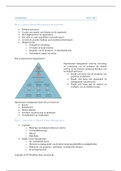
Operationeel management: ontwerp, uitvoering
en verbetering van de systemen die waarde
creëren en de primaire producten/diensten van
het bedrijf opleveren.
Houdt zich bezig met de productie van
goederen en diensten.
Houdt zich bezig met organisatie en
management van processen.
Houdt zich bezig met de analyse en
evaluatie van de bedrijfsvoering.
Operationeel management heeft direct invloed op:
Kosten
Rentabiliteit
Milieu-effecten
Kwaliteit van processen en producten
Tevredenheid van werknemers
Deel 2: Logistiek en Supply Chain Management:
Logistiek
o Planning van transport (intern en extern)
o Voorraadbeheersing
o Inkoop
o Distributie
Supply Chain Management
o De verbindende factor
o Ontwerp en management van de keten tussen grondstoffen en eindgebruiker
o Beheersen van goederen-, informatie- en financiële stromen
o Systeemperspectief
Logistiek en SCM hebben direct invloed op:
, Kosten
Flexibiliteit van de keten (adaptiveness)
Klanttevredenheid (waarderealisatie). De klant werkt onmiddellijk of de logistiek goed werkt.
Milieu-effecten
Relaties met ketenpartners (stakeholders)
Competitiviteit van de keten als geheel.
Project Management
Uitdagingen in Operationeel Management & Logistiek
o Noodzaak van kostenbeheersing (efficiëntie)
o Noodzaak van flexibiliteit
o Noodzaak klanttevredenheid te verhogen (kwaliteit, effectiviteit)
o Noodzaak energieverbruik en milieueffecten te verminderen
Oplossing: Projecten
o Beperkt in tijd (deadline) en middelen (budget)
o Duidelijke, unieke doelstelling (specificaties). Worden gebruikt om problemen op te
lossen.
o Projectleider (plannen, organiseren, etc.)
o Teams, multifunctioneel
Operationeel management en logistiek als een bedrijfskundige discipline
Logistiek: begint in het leger met verplaatsingen van goederen en troepen
o Voedsel, munitie, soldaten
o Slachtoffers, verlof, afval –reverse logistics
Begin 20e eeuw: ‘Business Logistics’ wordt een bedrijfskundige discipline:
o Fysieke distributie
o Aanvoer van grondstoffen en componenten
o Productie & operationeel management
o Distributie & transport netwerken. Hiervoor is logistiek nodig.
o Netwerken van leveranciers
Grote uitdagingen van de 21e eeuw:
o Business: toegenomen concurrentie en druk op kostenreductie
Logistiek is verantwoordelijk voor een groot percentage van de kosten
o Klanten zijn veeleisender geworden: snelheid, kwaliteit en betrouwbaarheid, waar
voor je geld.
Logistiek is een belangrijke bron van ontevredenheid.
o Toegenomen belang van innovatie: kortere PLC, toegenomen gebruik van ICT,
complexiteit en behoefte aan samenwerking.
Logistiek faciliteert flexibiliteit en samenwerking.
What is Operations and Supply chain management?
The design, operation, and improvement of the systems that create and deliver the firm’s
primary products and services
Operations and Supply Chain Management (OSCM) is
o A functional field of business
o Concerned with the management of the entire production/delivery system
Strategy, processes and analytics:
Operations and supply chain management involves
o Product design
, o Purchasing
o Manufacturing
o Service operations
o Logistics
o Distribution
How to manage the firm?
o Operations Strategy
o Processes to deliver products and
services
o Analytics to support decisions
Supply Chain Management focuses more and more
on services instead of products (stations, airports,
etc).
Important processes: transport, fulfilment, distribution, sales management, production logistics, stock
management, materials handling (for example: IKEA). We focus on the chain approach of logistics:
Global optimalisation instead of local optimalisation, through: information, coordination,
collaboration, partnerships, alliances.
Less autonomy for the players in the chain.
Instead of competition between organizations we speak of competition between chains.
Managing effective projects 09-11-2017
Process improvement is more successful if
treated as:
Temporary
At one time, unique activity (not a
routine)
Having a clear start and an end
Clear objectives (smart)
Clear responsibilities
Clear budget
What is a project?
• A project is an interrelated set of
activities with a definite starting and ending point, which
results in a unique outcome from a specific allocation of
resources.
• Projects are common in everyday life (festival, birthday,
etc.).
• The three main objectives of Project Management are to:
- Complete the project on time
- Not exceed the budget
- Meet the specifications to the satisfaction of the
customer
• This results in the iron triangle. If one of the aspects changes, the other aspects also change.
Project management is a systemized, phased approach to:
1) defining,
2) organizing,
3) planning,
4) monitoring, and
5) controlling projects
, • Projects often require resources from many different parts of the organization
• Each project is unique
• Projects are temporary
• A collection of projects is called a program
• Companies use programs to achieve strategic change. This is not possible with one project.
Defining and organizing projects:
• Define the scope, time frame, and resources of the project. This is one of the most difficult
part of the project.
• Select the project manager and team
• Good project managers must be
- Facilitators
- Communicators
- Decision makers
- Discipline
• Project team members must have
- Technical competences
- Sensitivity
- Dedication
Organizational structure
• Different structures have different implications for project management
• Common structures are
- Functional
- Pure project: everybody in the project is dedicated to the project. Inclusive real project
manager.
- Matrix: normal functions and project teams are working on the same time.
Five steps to plan projects:
1. Defining the work breakdown structure (WBS): categorize and organize the work in different
activities.
A statement of all the tasks that must be completed as part of the project.
An activity is the smallest unit of work effort consuming both time and resources that
the project manager can schedule and control
Each activity must have an owner who is responsible for doing the work. This can be
the same person as the one who does it, but that isn’t necessary.
2. Diagramming the network:
Network diagrams use nodes and arrows to depict the dependencies between activities
Benefits of using networks include
o Networks force project teams to identify and organize data to identify
dependencies between activities
o Networks enable the estimation of completion time
o Crucial activities are highlighted
o Cost and time trade-offs can be analyzed
o Dependencies determine the sequence for undertaking activities
o Activity times must be estimated using historical information, statistical
analysis, learning curves, or informed estimates
o In the activity-on-node (AoN) approach, nodes represent activities and arrows
represent the dependencies between activities
3. Developing the schedule
Schedules can help managers achieve the objectives of the project
Managers can
Deel 1: Operationeel Management & Logistiek
Primaire processen
Creatie van waarde voor klanten en de organisatie
Het kloppend hart van organisaties
Een stille en vaak onzichtbare werkende kracht
Leveren de grootste bijdrage aan kwaliteitsverbeteringen
Dragen bij aan
o Competitive advantage
o Tevreden en loyale klanten
o Integratie van de productie- en distributieketens
o Verminderen impact op milieu
Wat is operationeel management?
Operationeel management: ontwerp, uitvoering
en verbetering van de systemen die waarde
creëren en de primaire producten/diensten van
het bedrijf opleveren.
Houdt zich bezig met de productie van
goederen en diensten.
Houdt zich bezig met organisatie en
management van processen.
Houdt zich bezig met de analyse en
evaluatie van de bedrijfsvoering.
Operationeel management heeft direct invloed op:
Kosten
Rentabiliteit
Milieu-effecten
Kwaliteit van processen en producten
Tevredenheid van werknemers
Deel 2: Logistiek en Supply Chain Management:
Logistiek
o Planning van transport (intern en extern)
o Voorraadbeheersing
o Inkoop
o Distributie
Supply Chain Management
o De verbindende factor
o Ontwerp en management van de keten tussen grondstoffen en eindgebruiker
o Beheersen van goederen-, informatie- en financiële stromen
o Systeemperspectief
Logistiek en SCM hebben direct invloed op:
, Kosten
Flexibiliteit van de keten (adaptiveness)
Klanttevredenheid (waarderealisatie). De klant werkt onmiddellijk of de logistiek goed werkt.
Milieu-effecten
Relaties met ketenpartners (stakeholders)
Competitiviteit van de keten als geheel.
Project Management
Uitdagingen in Operationeel Management & Logistiek
o Noodzaak van kostenbeheersing (efficiëntie)
o Noodzaak van flexibiliteit
o Noodzaak klanttevredenheid te verhogen (kwaliteit, effectiviteit)
o Noodzaak energieverbruik en milieueffecten te verminderen
Oplossing: Projecten
o Beperkt in tijd (deadline) en middelen (budget)
o Duidelijke, unieke doelstelling (specificaties). Worden gebruikt om problemen op te
lossen.
o Projectleider (plannen, organiseren, etc.)
o Teams, multifunctioneel
Operationeel management en logistiek als een bedrijfskundige discipline
Logistiek: begint in het leger met verplaatsingen van goederen en troepen
o Voedsel, munitie, soldaten
o Slachtoffers, verlof, afval –reverse logistics
Begin 20e eeuw: ‘Business Logistics’ wordt een bedrijfskundige discipline:
o Fysieke distributie
o Aanvoer van grondstoffen en componenten
o Productie & operationeel management
o Distributie & transport netwerken. Hiervoor is logistiek nodig.
o Netwerken van leveranciers
Grote uitdagingen van de 21e eeuw:
o Business: toegenomen concurrentie en druk op kostenreductie
Logistiek is verantwoordelijk voor een groot percentage van de kosten
o Klanten zijn veeleisender geworden: snelheid, kwaliteit en betrouwbaarheid, waar
voor je geld.
Logistiek is een belangrijke bron van ontevredenheid.
o Toegenomen belang van innovatie: kortere PLC, toegenomen gebruik van ICT,
complexiteit en behoefte aan samenwerking.
Logistiek faciliteert flexibiliteit en samenwerking.
What is Operations and Supply chain management?
The design, operation, and improvement of the systems that create and deliver the firm’s
primary products and services
Operations and Supply Chain Management (OSCM) is
o A functional field of business
o Concerned with the management of the entire production/delivery system
Strategy, processes and analytics:
Operations and supply chain management involves
o Product design
, o Purchasing
o Manufacturing
o Service operations
o Logistics
o Distribution
How to manage the firm?
o Operations Strategy
o Processes to deliver products and
services
o Analytics to support decisions
Supply Chain Management focuses more and more
on services instead of products (stations, airports,
etc).
Important processes: transport, fulfilment, distribution, sales management, production logistics, stock
management, materials handling (for example: IKEA). We focus on the chain approach of logistics:
Global optimalisation instead of local optimalisation, through: information, coordination,
collaboration, partnerships, alliances.
Less autonomy for the players in the chain.
Instead of competition between organizations we speak of competition between chains.
Managing effective projects 09-11-2017
Process improvement is more successful if
treated as:
Temporary
At one time, unique activity (not a
routine)
Having a clear start and an end
Clear objectives (smart)
Clear responsibilities
Clear budget
What is a project?
• A project is an interrelated set of
activities with a definite starting and ending point, which
results in a unique outcome from a specific allocation of
resources.
• Projects are common in everyday life (festival, birthday,
etc.).
• The three main objectives of Project Management are to:
- Complete the project on time
- Not exceed the budget
- Meet the specifications to the satisfaction of the
customer
• This results in the iron triangle. If one of the aspects changes, the other aspects also change.
Project management is a systemized, phased approach to:
1) defining,
2) organizing,
3) planning,
4) monitoring, and
5) controlling projects
, • Projects often require resources from many different parts of the organization
• Each project is unique
• Projects are temporary
• A collection of projects is called a program
• Companies use programs to achieve strategic change. This is not possible with one project.
Defining and organizing projects:
• Define the scope, time frame, and resources of the project. This is one of the most difficult
part of the project.
• Select the project manager and team
• Good project managers must be
- Facilitators
- Communicators
- Decision makers
- Discipline
• Project team members must have
- Technical competences
- Sensitivity
- Dedication
Organizational structure
• Different structures have different implications for project management
• Common structures are
- Functional
- Pure project: everybody in the project is dedicated to the project. Inclusive real project
manager.
- Matrix: normal functions and project teams are working on the same time.
Five steps to plan projects:
1. Defining the work breakdown structure (WBS): categorize and organize the work in different
activities.
A statement of all the tasks that must be completed as part of the project.
An activity is the smallest unit of work effort consuming both time and resources that
the project manager can schedule and control
Each activity must have an owner who is responsible for doing the work. This can be
the same person as the one who does it, but that isn’t necessary.
2. Diagramming the network:
Network diagrams use nodes and arrows to depict the dependencies between activities
Benefits of using networks include
o Networks force project teams to identify and organize data to identify
dependencies between activities
o Networks enable the estimation of completion time
o Crucial activities are highlighted
o Cost and time trade-offs can be analyzed
o Dependencies determine the sequence for undertaking activities
o Activity times must be estimated using historical information, statistical
analysis, learning curves, or informed estimates
o In the activity-on-node (AoN) approach, nodes represent activities and arrows
represent the dependencies between activities
3. Developing the schedule
Schedules can help managers achieve the objectives of the project
Managers can