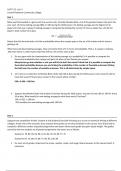
1. Which of the following is the monomer that gives the polymer shown below?
A. A
B. B
C. C
D. D
Accessibility: Keyboard Navigation
Bloom's Level: 4. Analyze
Chapter:01
Difficulty: Medium
Gradable: automatic
Section: 28.02
Subtopic: Classes of synthetic polymers
Topic: Synthetic polymers
28-1
Copyright © 2016 McGraw-Hill Education. All rights reserved. No reproduction or distribution without the prior written consent of
McGraw-Hill Education.
,2. Which of the following is the repeating unit in poly(vinyl chloride) (PV) ?
A. A
B. B
C. C
D. D
Accessibility: Keyboard Navigation
Bloom's Level: 1. Remember
Chapter:01
Difficulty: Medium
Gradable: automatic
Section: 28.02
Subtopic: Classes of synthetic polymers
Topic: Synthetic polymers
3. Which of the following are addition polymers? I. polypropylene II. Teflon III. Nylon
A. only I
B. only II
C. only III
D. both I and II
Accessibility: Keyboard Navigation
Bloom's Level: 1. Remember
Chapter:01
Difficulty: Easy
Gradable: automatic
Section: 28.03
Subtopic: Classes of synthetic polymers
Subtopic: Polymerization methods (mechanisms)
Topic: Synthetic polymers
28-2
Copyright © 2016 McGraw-Hill Education. All rights reserved. No reproduction or distribution without the prior written consent of
McGraw-Hill Education.
, 4. Which of the following are condensation polymers? I. polypropylene II. Teflon III. Nylon
A. only I
B. only II
C. only III
D. both II and III
Accessibility: Keyboard Navigation
Bloom's Level: 1. Remember
Chapter:01
Difficulty: Easy
Gradable: automatic
Section: 28.03
Subtopic: Classes of synthetic polymers
Subtopic: Polymerization methods (mechanisms)
Topic: Synthetic polymers
5. Which one of the following monomers undergoes cationic polymerization most readily?
A. H2C=CH2
B. H2C=CHCH3
C. H2C=C(CH3)2
D. H2C=CHCN
Accessibility: Keyboard Navigation
Bloom's Level: 4. Analyze
Chapter:01
Difficulty: Hard
Gradable: automatic
Section: 28.10
Subtopic: Polymerization methods (mechanisms)
Topic: Synthetic polymers
6. Which one of the following monomers undergoes anionic polymerization most readily?
A. H2C=CH2
B. H2C=CHCH3
C. H2C=C(CH3)2
D. H2C=CHCN
Accessibility: Keyboard Navigation
Bloom's Level: 4. Analyze
Chapter:01
Difficulty: Medium
Gradable: automatic
Section: 28.09
Subtopic: Polymerization methods (mechanisms)
Topic: Synthetic polymers
28-3
Copyright © 2016 McGraw-Hill Education. All rights reserved. No reproduction or distribution without the prior written consent of
McGraw-Hill Education.
A. A
B. B
C. C
D. D
Accessibility: Keyboard Navigation
Bloom's Level: 4. Analyze
Chapter:01
Difficulty: Medium
Gradable: automatic
Section: 28.02
Subtopic: Classes of synthetic polymers
Topic: Synthetic polymers
28-1
Copyright © 2016 McGraw-Hill Education. All rights reserved. No reproduction or distribution without the prior written consent of
McGraw-Hill Education.
,2. Which of the following is the repeating unit in poly(vinyl chloride) (PV) ?
A. A
B. B
C. C
D. D
Accessibility: Keyboard Navigation
Bloom's Level: 1. Remember
Chapter:01
Difficulty: Medium
Gradable: automatic
Section: 28.02
Subtopic: Classes of synthetic polymers
Topic: Synthetic polymers
3. Which of the following are addition polymers? I. polypropylene II. Teflon III. Nylon
A. only I
B. only II
C. only III
D. both I and II
Accessibility: Keyboard Navigation
Bloom's Level: 1. Remember
Chapter:01
Difficulty: Easy
Gradable: automatic
Section: 28.03
Subtopic: Classes of synthetic polymers
Subtopic: Polymerization methods (mechanisms)
Topic: Synthetic polymers
28-2
Copyright © 2016 McGraw-Hill Education. All rights reserved. No reproduction or distribution without the prior written consent of
McGraw-Hill Education.
, 4. Which of the following are condensation polymers? I. polypropylene II. Teflon III. Nylon
A. only I
B. only II
C. only III
D. both II and III
Accessibility: Keyboard Navigation
Bloom's Level: 1. Remember
Chapter:01
Difficulty: Easy
Gradable: automatic
Section: 28.03
Subtopic: Classes of synthetic polymers
Subtopic: Polymerization methods (mechanisms)
Topic: Synthetic polymers
5. Which one of the following monomers undergoes cationic polymerization most readily?
A. H2C=CH2
B. H2C=CHCH3
C. H2C=C(CH3)2
D. H2C=CHCN
Accessibility: Keyboard Navigation
Bloom's Level: 4. Analyze
Chapter:01
Difficulty: Hard
Gradable: automatic
Section: 28.10
Subtopic: Polymerization methods (mechanisms)
Topic: Synthetic polymers
6. Which one of the following monomers undergoes anionic polymerization most readily?
A. H2C=CH2
B. H2C=CHCH3
C. H2C=C(CH3)2
D. H2C=CHCN
Accessibility: Keyboard Navigation
Bloom's Level: 4. Analyze
Chapter:01
Difficulty: Medium
Gradable: automatic
Section: 28.09
Subtopic: Polymerization methods (mechanisms)
Topic: Synthetic polymers
28-3
Copyright © 2016 McGraw-Hill Education. All rights reserved. No reproduction or distribution without the prior written consent of
McGraw-Hill Education.