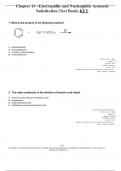
1. What is the product of the following reaction?
A. isobutylbenzene
B. sec-butylbenzene
C. 2-methyl-1-phenylpropene
D. tert-butylbenzene
Bloom's Level: 3. Apply
Chapter: 13
Difficulty: Hard
Gradable: automatic
Section: 13.06
Subtopic: Electrophilic aromatic substitution (EAS) reactions
Topic: Aromatic Compounds
2. The major product(s) in the nitration of benzoic acid is(are)
A. mixture of ortho and para-nitrobenzoic acid.
B. nitrobenzene.
C. meta-nitrobenzoic acid.
D. nitrobenzene and para-nitrobenzoic acid.
Accessibility: Keyboard Navigation
Bloom's Level: 3. Apply
Chapter: 13
Difficulty: Medium
Gradable: automatic
Section: 13.13
Subtopic: Electrophilic aromatic substitution (EAS) reactions
Topic: Aromatic Compounds
13-1
Copyright © 2016 McGraw-Hill Education. All rights reserved. No reproduction or distribution without the prior written consent of
McGraw-Hill Education.
,3. Which of the following aromatic compounds reacts faster than benzene in electrophilic
aromatic bromination?
A. A
B. B
C. C
D. D
Bloom's Level: 4. Analyze
Chapter: 13
Difficulty: Medium
Gradable: automatic
Section: 13.12
Subtopic: Electrophilic aromatic substitution (EAS) reactions
Topic: Aromatic Compounds
4. Nitration of benzoic acid has a reaction rate which is __________ than the nitration rate
of benzene and gives primarily the _____________ product(s).
A. slower, meta
B. faster, ortho, para
C. slower, ortho, para
D. faster, meta
Accessibility: Keyboard Navigation
Bloom's Level: 2. Understand
Chapter: 13
Difficulty: Medium
Gradable: automatic
Section: 13.13
Subtopic: Electrophilic aromatic substitution (EAS) reactions
Topic: Aromatic Compounds
13-2
Copyright © 2016 McGraw-Hill Education. All rights reserved. No reproduction or distribution without the prior written consent of
McGraw-Hill Education.
,5. Which one of the following is the electrophile in the reaction shown below?
A. benzene
B. NO3¯
C. NO2+
D. H2SO4
Bloom's Level: 1. Remember
Chapter: 13
Difficulty: Easy
Gradable: automatic
Section: 13.03
Subtopic: Electrophilic aromatic substitution (EAS) reactions
Topic: Aromatic Compounds
6. What is the electrophile in the Friedel-Crafts alkylation reaction below?
A. AlCl3
B. Cl¯
C. benzene
+
D. (CH3)3C
Bloom's Level: 2. Understand
Chapter: 13
Difficulty: Easy
Gradable: automatic
Section: 13.06
Subtopic: Electrophilic aromatic substitution (EAS) reactions
Topic: Aromatic Compounds
13-3
Copyright © 2016 McGraw-Hill Education. All rights reserved. No reproduction or distribution without the prior written consent of
McGraw-Hill Education.
, 7. Which point on the potential energy diagram corresponds to the species shown to the
right for the electrophilic bromination of benzene with Br 2/FeBr3?
A. A
B. B
C. C
D. D
Bloom's Level: 2. Understand
Chapter: 13
Difficulty: Medium
Gradable: automatic
Section: 13.05
Subtopic: Electrophilic aromatic substitution (EAS) reactions
Topic: Aromatic Compounds
8. Which species below best depicts the electrophile in the FeBr 3-catalyzed bromination of
benzene?
A. Br2
B. FeBr4-
C.
D. FeBr3
Bloom's Level: 1. Remember
Chapter: 13
Difficulty: Easy
Gradable: automatic
Section: 13.05
Subtopic: Electrophilic aromatic substitution (EAS) reactions
Topic: Aromatic Compounds
13-4
Copyright © 2016 McGraw-Hill Education. All rights reserved. No reproduction or distribution without the prior written consent of
McGraw-Hill Education.
A. isobutylbenzene
B. sec-butylbenzene
C. 2-methyl-1-phenylpropene
D. tert-butylbenzene
Bloom's Level: 3. Apply
Chapter: 13
Difficulty: Hard
Gradable: automatic
Section: 13.06
Subtopic: Electrophilic aromatic substitution (EAS) reactions
Topic: Aromatic Compounds
2. The major product(s) in the nitration of benzoic acid is(are)
A. mixture of ortho and para-nitrobenzoic acid.
B. nitrobenzene.
C. meta-nitrobenzoic acid.
D. nitrobenzene and para-nitrobenzoic acid.
Accessibility: Keyboard Navigation
Bloom's Level: 3. Apply
Chapter: 13
Difficulty: Medium
Gradable: automatic
Section: 13.13
Subtopic: Electrophilic aromatic substitution (EAS) reactions
Topic: Aromatic Compounds
13-1
Copyright © 2016 McGraw-Hill Education. All rights reserved. No reproduction or distribution without the prior written consent of
McGraw-Hill Education.
,3. Which of the following aromatic compounds reacts faster than benzene in electrophilic
aromatic bromination?
A. A
B. B
C. C
D. D
Bloom's Level: 4. Analyze
Chapter: 13
Difficulty: Medium
Gradable: automatic
Section: 13.12
Subtopic: Electrophilic aromatic substitution (EAS) reactions
Topic: Aromatic Compounds
4. Nitration of benzoic acid has a reaction rate which is __________ than the nitration rate
of benzene and gives primarily the _____________ product(s).
A. slower, meta
B. faster, ortho, para
C. slower, ortho, para
D. faster, meta
Accessibility: Keyboard Navigation
Bloom's Level: 2. Understand
Chapter: 13
Difficulty: Medium
Gradable: automatic
Section: 13.13
Subtopic: Electrophilic aromatic substitution (EAS) reactions
Topic: Aromatic Compounds
13-2
Copyright © 2016 McGraw-Hill Education. All rights reserved. No reproduction or distribution without the prior written consent of
McGraw-Hill Education.
,5. Which one of the following is the electrophile in the reaction shown below?
A. benzene
B. NO3¯
C. NO2+
D. H2SO4
Bloom's Level: 1. Remember
Chapter: 13
Difficulty: Easy
Gradable: automatic
Section: 13.03
Subtopic: Electrophilic aromatic substitution (EAS) reactions
Topic: Aromatic Compounds
6. What is the electrophile in the Friedel-Crafts alkylation reaction below?
A. AlCl3
B. Cl¯
C. benzene
+
D. (CH3)3C
Bloom's Level: 2. Understand
Chapter: 13
Difficulty: Easy
Gradable: automatic
Section: 13.06
Subtopic: Electrophilic aromatic substitution (EAS) reactions
Topic: Aromatic Compounds
13-3
Copyright © 2016 McGraw-Hill Education. All rights reserved. No reproduction or distribution without the prior written consent of
McGraw-Hill Education.
, 7. Which point on the potential energy diagram corresponds to the species shown to the
right for the electrophilic bromination of benzene with Br 2/FeBr3?
A. A
B. B
C. C
D. D
Bloom's Level: 2. Understand
Chapter: 13
Difficulty: Medium
Gradable: automatic
Section: 13.05
Subtopic: Electrophilic aromatic substitution (EAS) reactions
Topic: Aromatic Compounds
8. Which species below best depicts the electrophile in the FeBr 3-catalyzed bromination of
benzene?
A. Br2
B. FeBr4-
C.
D. FeBr3
Bloom's Level: 1. Remember
Chapter: 13
Difficulty: Easy
Gradable: automatic
Section: 13.05
Subtopic: Electrophilic aromatic substitution (EAS) reactions
Topic: Aromatic Compounds
13-4
Copyright © 2016 McGraw-Hill Education. All rights reserved. No reproduction or distribution without the prior written consent of
McGraw-Hill Education.