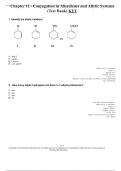
1. Identify the allylic halide(s).
A. only II
B. I and II
C. I and IV
D. I, III, and IV
Bloom's Level: 2. Understand
Chapter: 11
Difficulty: Easy
Gradable: automatic
Section: 11.01
Subtopic: Classify as primary, secondary, or tertiary alkyl halides
Topic: Alkyl Halides
2. How many allylic hydrogens are there in 1-ethylcyclohexene?
A. one
B. two
C. four
D. six
Accessibility: Keyboard Navigation
Bloom's Level: 2. Understand
Chapter: 11
Difficulty: Medium
Gradable: automatic
Section: 11.01
Subtopic: IUPAC Nomenclature of alkenes
Topic: Alkenes
11-1
Copyright © 2016 McGraw-Hill Education. All rights reserved. No reproduction or distribution without the prior written consent of
McGraw-Hill Education.
,3. Which of the following carbocations is the most stable?
A. A
B. B
C. C
D. D
Bloom's Level: 4. Analyze
Chapter: 11
Difficulty: Easy
Gradable: automatic
Section: 11.02
Subtopic: Carbocations
Topic: Substitution and Elimination Reactions
11-2
Copyright © 2016 McGraw-Hill Education. All rights reserved. No reproduction or distribution without the prior written consent of
McGraw-Hill Education.
,4. What is(are) the expected product(s) of the following reaction?
A. only II
B. only III
C. I and III
D. II and IV
Bloom's Level: 3. Apply
Chapter: 11
Difficulty: Medium
Gradable: automatic
Section: 11.03
Subtopic: Allylic and benzylic halogenation
Topic: Radical Reactions
5. What is the IUPAC name of the following diene?
A. 3-chloro-2,5-dimethyl-2,6-heptadiene
B. 3-chloro-2,5-dimethyl-1,5-heptadiene
C. 5-chloro-3,5-dimethyl-1,6-heptadiene
D. 5-chloro-3,6-dimethyl-1,5-heptadiene
Bloom's Level: 3. Apply
Chapter: 11
Difficulty: Medium
Gradable: automatic
Section: 11.05
Subtopic: IUPAC Nomenclature of alkenes
Topic: Alkenes
11-3
Copyright © 2016 McGraw-Hill Education. All rights reserved. No reproduction or distribution without the prior written consent of
McGraw-Hill Education.
, 6. Which of the following are conjugated dienes?
I. 1,2-octadiene II. 1,3-octadiene III. 2,5-octadiene IV. 1,7-octadiene
A. only I
B. only II
C. I and II
D. II and III
Accessibility: Keyboard Navigation
Bloom's Level: 2. Understand
Chapter: 11
Difficulty: Easy
Gradable: automatic
Section: 11.05
Subtopic: Properties of dienes
Topic: Conjugated Dienes and Pericyclic Reactions
14
7. Chlorination of C-labeled propene (H214C=CHCH3) with Cl2 at high temperature
would give which of the following chloropropenes?
A. only I
B. only II
C. I and II
D. I and III
Bloom's Level: 3. Apply
Chapter: 11
Difficulty: Hard
Gradable: automatic
Section: 11.05
Subtopic: Allylic and benzylic halogenation
Topic: Radical Reactions
8. Which compound below has the lowest heat of hydrogenation?
A. 1,5-hexadiene
B. 3,4-hexadiene
C. (E)-1,4-hexadiene
D. (E,E)-2,4-hexadiene
Accessibility: Keyboard Navigation
Bloom's Level: 2. Understand
Chapter: 11
Difficulty: Medium
Gradable: automatic
Section: 11.06
Subtopic: Stability of alkenes
Topic: Alkenes
11-4
Copyright © 2016 McGraw-Hill Education. All rights reserved. No reproduction or distribution without the prior written consent of
McGraw-Hill Education.
A. only II
B. I and II
C. I and IV
D. I, III, and IV
Bloom's Level: 2. Understand
Chapter: 11
Difficulty: Easy
Gradable: automatic
Section: 11.01
Subtopic: Classify as primary, secondary, or tertiary alkyl halides
Topic: Alkyl Halides
2. How many allylic hydrogens are there in 1-ethylcyclohexene?
A. one
B. two
C. four
D. six
Accessibility: Keyboard Navigation
Bloom's Level: 2. Understand
Chapter: 11
Difficulty: Medium
Gradable: automatic
Section: 11.01
Subtopic: IUPAC Nomenclature of alkenes
Topic: Alkenes
11-1
Copyright © 2016 McGraw-Hill Education. All rights reserved. No reproduction or distribution without the prior written consent of
McGraw-Hill Education.
,3. Which of the following carbocations is the most stable?
A. A
B. B
C. C
D. D
Bloom's Level: 4. Analyze
Chapter: 11
Difficulty: Easy
Gradable: automatic
Section: 11.02
Subtopic: Carbocations
Topic: Substitution and Elimination Reactions
11-2
Copyright © 2016 McGraw-Hill Education. All rights reserved. No reproduction or distribution without the prior written consent of
McGraw-Hill Education.
,4. What is(are) the expected product(s) of the following reaction?
A. only II
B. only III
C. I and III
D. II and IV
Bloom's Level: 3. Apply
Chapter: 11
Difficulty: Medium
Gradable: automatic
Section: 11.03
Subtopic: Allylic and benzylic halogenation
Topic: Radical Reactions
5. What is the IUPAC name of the following diene?
A. 3-chloro-2,5-dimethyl-2,6-heptadiene
B. 3-chloro-2,5-dimethyl-1,5-heptadiene
C. 5-chloro-3,5-dimethyl-1,6-heptadiene
D. 5-chloro-3,6-dimethyl-1,5-heptadiene
Bloom's Level: 3. Apply
Chapter: 11
Difficulty: Medium
Gradable: automatic
Section: 11.05
Subtopic: IUPAC Nomenclature of alkenes
Topic: Alkenes
11-3
Copyright © 2016 McGraw-Hill Education. All rights reserved. No reproduction or distribution without the prior written consent of
McGraw-Hill Education.
, 6. Which of the following are conjugated dienes?
I. 1,2-octadiene II. 1,3-octadiene III. 2,5-octadiene IV. 1,7-octadiene
A. only I
B. only II
C. I and II
D. II and III
Accessibility: Keyboard Navigation
Bloom's Level: 2. Understand
Chapter: 11
Difficulty: Easy
Gradable: automatic
Section: 11.05
Subtopic: Properties of dienes
Topic: Conjugated Dienes and Pericyclic Reactions
14
7. Chlorination of C-labeled propene (H214C=CHCH3) with Cl2 at high temperature
would give which of the following chloropropenes?
A. only I
B. only II
C. I and II
D. I and III
Bloom's Level: 3. Apply
Chapter: 11
Difficulty: Hard
Gradable: automatic
Section: 11.05
Subtopic: Allylic and benzylic halogenation
Topic: Radical Reactions
8. Which compound below has the lowest heat of hydrogenation?
A. 1,5-hexadiene
B. 3,4-hexadiene
C. (E)-1,4-hexadiene
D. (E,E)-2,4-hexadiene
Accessibility: Keyboard Navigation
Bloom's Level: 2. Understand
Chapter: 11
Difficulty: Medium
Gradable: automatic
Section: 11.06
Subtopic: Stability of alkenes
Topic: Alkenes
11-4
Copyright © 2016 McGraw-Hill Education. All rights reserved. No reproduction or distribution without the prior written consent of
McGraw-Hill Education.