Liver
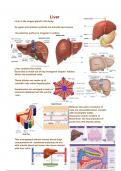
Liver is the largest gland in the body.
Its upper and anterior surfaces are smooth and convex
Its posterior surface is irregular in outline
.
Liver contains four lobes.
Each lobe is made out of tiny hexagonal shaped lobules
which are functional units.
These lobules are made up of
cuboidal cells called hepatocytes.
Hepatocytes are arranged in pairs of
columns radiating from the central
vein.
Between two pairs of column of
cells are sinusoids( blood vessels
with incomplete walls).
Sinusoids contain mixture of
blood from the tiny branches of
portal vein and hepatic artery.
This arrangement allows venous blood (high
concentration of nutritional materials) to mix
with arterial blood and come into close contact
with liver cells.
Liver is the largest gland in the body.
Its upper and anterior surfaces are smooth and convex
Its posterior surface is irregular in outline
.
Liver contains four lobes.
Each lobe is made out of tiny hexagonal shaped lobules
which are functional units.
These lobules are made up of
cuboidal cells called hepatocytes.
Hepatocytes are arranged in pairs of
columns radiating from the central
vein.
Between two pairs of column of
cells are sinusoids( blood vessels
with incomplete walls).
Sinusoids contain mixture of
blood from the tiny branches of
portal vein and hepatic artery.
This arrangement allows venous blood (high
concentration of nutritional materials) to mix
with arterial blood and come into close contact
with liver cells.