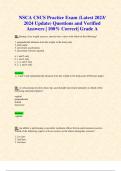
NSCA CSCS Practice Exam (Latest 2023/ 2024 Update) Questions and Verified Answers | 100% Correct| Grade A
NSCA CSCS Practice Exam (Latest 2023/ 2024 Update) Questions and Verified Answers | 100% Correct| Grade A Q: During a free weight exercise, muscle force varies with which of the following? 1. perpendicular distance from the weight to the body joint 2. joint angle 3. movement acceleration 4. movement velocity squared a. 1 and 2 only b. 1 and 4 only c. 1, 2, and 3 only d. 2, 3, and 4 only Answer: a. 1 and 2 only (perpendicular distance from the weight to the body joint AND joint angle) Q: A vertical jump involves knee, hip, and shoulder movement primarily in which of the following anatomical planes? sagittal perpendicular frontal transverse Answer: sagittal Q: An athlete is performing a concentric isokinetic elbow flexion and extension exercise. Which of the following type(s) of lever occur(s) at the elbow during this exercise? 1. 1st class 2. 2nd class 3. 3rd class a. 1 only b. 2 only c. 1 and 3 only d. 2 and 3 only Answer: c. 1 and 3 only Q: Which of the following substances can be metabolized anaerobically? glycerol glucose amino acids free fatty acids Answer: glucose Q: Which of the following reactions is the primary cause of metabolic acidosis (decrease in intramuscular pH during high-intensity, fatiguing exercise)? ATP = ADP + Pi + H+ pyruvate + NADH = lactate + NAD+ ADP + creatine phosphate = ATP + creatine fructose-6-phosphate = fructose-1,6-biphosphate Answer: ATP = ADP + Pi + H+ Q: Which of the following energy systems produces ATP at the quickest rate? phosphagen aerobic glycolysis fat oxidation fast glycolysis Answer: phosphagen Q: Approximately how many net ATP are produced via the oxidative energy system from the metabolism of one molecule? 27 34 38 41 Answer: 38 Q: Which of the following energy substrates cannot be depleted during extreme exercise intensities or durations? creatine phosphate glycogen water ATP Answer: ATP Q: After a bout of resistance training, acute hormonal secretions provide all of the following information to the body EXCEPT amount of physiological stress metabolic demands of exercise type of physiological stress energy expended Answer: energy expended Q: Which of the following hormones enhance(s) muscle tissue growth? 1. growth hormone 2. cortisol 3. IGF-1 4. progesterone a. 1 and 3 only b. 2 and 4 only c. 1, 2, and 3 only d. 2, 3, and 4 only Answer: a. 1 and 3 only Q: Which of the following is NOT a function of growth hormone? increase lipolysis decrease collagen synthesis increase amino acid transport decrease glucose regulation Answer: decrease collagen synthesis Q: Which of the following hormones has the greatest influence on neural change? growth hormone testosterone cortisol IGF Answer: testosterone
Geschreven voor
- Instelling
- NSCA CSCS
- Vak
- NSCA CSCS
Documentinformatie
- Geüpload op
- 25 november 2023
- Aantal pagina's
- 39
- Geschreven in
- 2023/2024
- Type
- Tentamen (uitwerkingen)
- Bevat
- Vragen en antwoorden
Onderwerpen
- nsca cscs
-
nsca certified strength and conditioning specialis
-
nsca cscs practice exam latest update
-
which of the following hormones has the greatest i
-
during a free weight exercise muscle force varies
Ook beschikbaar in voordeelbundel