Human Resources Management IIA by ProfessorBurgerQueen
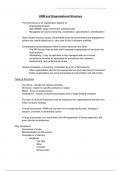
HRM and Organisational Structure
- The dimensions of an organisation depend on
- Organisational goals
- Size (SMME, large commercial, public/private)
- Managerial structures (hierarchy, coordination, specialisation, centralisation)
- Tasks divided among a group of individuals must be synchronised and integrated to
achieve the overall objectives ie. jobs must fit into a coherent workflow
- Centralisation/decentralisation refers to where decisions are taken
- The HR function may be held within separate headquarters or devolved into
local sections
- Alternatively, it may be allocated to line managers with an in-house
consultancy provided by specialists for procedures like selection,
development, and performance review
- Vertical complexity, in hierarchy, is indicated by a tall or flat hierarchy
- Taller organisations tend to be bureaucratic but have clear lines of command
- Flatter organisations are more demanding of responsibility and self-control
Types of Structures
- Functional - divided into defined activities
- Divisional - based on specific products or ranges
- Matrix - focus on project teams
- Federations - loosely connected businesses with a single holding company
- The type of structure employed must be congruent with organisational direction and
follow company strategy
- In small businesses, HRM may not even be a recognised function, strategy is
reactive, and there is centralised control
- In large businesses, you would find a full HR department, in-house agencies, and
even internal consultancies
Why Centralise?
- Economies of scale
- Standardisation of HR process
- Consistency of delivery
- Negatives
- Too rigid
- Slow
- Complex
- Bureaucratic
HRM and Organisational Structure
- The dimensions of an organisation depend on
- Organisational goals
- Size (SMME, large commercial, public/private)
- Managerial structures (hierarchy, coordination, specialisation, centralisation)
- Tasks divided among a group of individuals must be synchronised and integrated to
achieve the overall objectives ie. jobs must fit into a coherent workflow
- Centralisation/decentralisation refers to where decisions are taken
- The HR function may be held within separate headquarters or devolved into
local sections
- Alternatively, it may be allocated to line managers with an in-house
consultancy provided by specialists for procedures like selection,
development, and performance review
- Vertical complexity, in hierarchy, is indicated by a tall or flat hierarchy
- Taller organisations tend to be bureaucratic but have clear lines of command
- Flatter organisations are more demanding of responsibility and self-control
Types of Structures
- Functional - divided into defined activities
- Divisional - based on specific products or ranges
- Matrix - focus on project teams
- Federations - loosely connected businesses with a single holding company
- The type of structure employed must be congruent with organisational direction and
follow company strategy
- In small businesses, HRM may not even be a recognised function, strategy is
reactive, and there is centralised control
- In large businesses, you would find a full HR department, in-house agencies, and
even internal consultancies
Why Centralise?
- Economies of scale
- Standardisation of HR process
- Consistency of delivery
- Negatives
- Too rigid
- Slow
- Complex
- Bureaucratic