
GNE2601 SUMMARY | Fransché Beukes
GNE2601
Learning Unit 1: Basic concepts in genetics
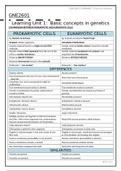
COMPARISON BETWEEN PROKARYOTIC AND EUKARYOTIC CELLS
PROKARYOTIC CELLS EUKARYOTIC CELLS
Eg. Bacteria & Archaea Eg. Animals and plants (Yeast/Fungi)
Simplest cellular organisms. Unicellular/Multicellular
Genetic material found in a single circular DNA Genetic material inside nucleus, bound by a double
molecule. membrane.
Genetic material NOT separated from the rest of the Genetic material complexed with proteins and
cell by a nuclear membrane. organized into chromosomes.
Divide by BINARY FISSION Divide by MITOSIS/MEIOSIS
Bacterial chromosome found in the nucleoid.
Prokaryote = “pre-nuclear” Eukaryote = “true nucleus”
DIFFERENCES
Nucleus absent. Nucleus present.
One chromosome only, but it is not a true chromosome
More than one chromosome.
– plasmids.
Unicellular, but some cyanobacteria might be
Unicellular/Multicellular.
multicellular.
True membrane bound nucleus is absent. True membrane nucleus is present.
Genetic recombination by partial, unidirectional Genetic recombination by meiosis and fusion of
transfers of DNA. gametes.
Microtubules absent/rare. Microtubules present.
Endoplasmic reticulum absent. Endoplasmic reticulum present.
Mitochondria absent. Mitochondria present.
Cytoskeleton may be absent. Cytoskeleton present.
Smaller ribosomes. Larger ribosomes.
Multiple proteins act together to fold and condense
the DNA. DNA is then organized into conformations Wrap DNA around proteins called histones.
that are wound around tetramers of HU proteins.
Golgi apparatus absent. Golgi apparatus present.
Chloroplasts scattered in the cytoplasm. Chloroplasts on present in plant cells.
Flagella is submicroscopic in size and consist of one Flagella is microscopic, membrane bound and arranged
fibre only. as nine doublets surrounding two singlets.
Nuclear membrane permeability is not present. Nuclear membrane permeability is selective.
Plasma membrane contains a steroid. Plasma membrane without steroid.
Has chemically complexed cell walls. Only plant cells/fungi has cell walls.
SIMILARITIES
Vesicles are present Vesicles are present.
Vacuoles are present. Vacuoles are present.
1|Page
, GNE2601 SUMMARY | Fransché Beukes
Genes, DNA and Traits
Genes AND TRAITS
Genetics: The branch of biology that deals
with heredity and variation.
Genes: Units of heredity which contribute to
cell structure and function.
Gene: A segment of DNA that produces a
functional product, e.g. a polypeptide.
Traits: Characteristics of an organism.
Proteome: All the proteins that a cell makes
at a given time.
Enzymes: Accelerate chemical reactions, are particularly important category of proteins.
Catabolic enzymes: important in the utilization of energy.
Anabolic enzymes: Synthesis of molecules and macromolecules.
Myosin: Protein involved in contraction of muscles.
The role of dna
Nucleic acids, proteins and carbohydrates form macromolecules.
Genetic material of cells is made of DNA – it stores the information needed for the synthesis of
cellular proteins.
DNA composed of a linear sequence of FIG. 1: Gene Expression
nucleotides.
4 Types of nucleotides:
Adenine (A) Thiamine (T)
Guanine (G) Cytosine (C)
Order of nucleotides along the DNA
molecules, contains info that can lead to
the formation of a polypeptide. (Sequence
of amino acids)
A cell must be able to access the
information stored in DNA to be able to
synthesize the protein.
GENE EXPRESSION: The
process of using a gene sequence to affect
the characteristics of a cell/organism.
(Refer to Fig. 1)
o Transcription: DNA sequence of a
gene is converted into an RNA
sequence.
o Translation: RNA sequence is then converted into the amino acid sequence of a
polypeptide.
2|Page
GNE2601
Learning Unit 1: Basic concepts in genetics
COMPARISON BETWEEN PROKARYOTIC AND EUKARYOTIC CELLS
PROKARYOTIC CELLS EUKARYOTIC CELLS
Eg. Bacteria & Archaea Eg. Animals and plants (Yeast/Fungi)
Simplest cellular organisms. Unicellular/Multicellular
Genetic material found in a single circular DNA Genetic material inside nucleus, bound by a double
molecule. membrane.
Genetic material NOT separated from the rest of the Genetic material complexed with proteins and
cell by a nuclear membrane. organized into chromosomes.
Divide by BINARY FISSION Divide by MITOSIS/MEIOSIS
Bacterial chromosome found in the nucleoid.
Prokaryote = “pre-nuclear” Eukaryote = “true nucleus”
DIFFERENCES
Nucleus absent. Nucleus present.
One chromosome only, but it is not a true chromosome
More than one chromosome.
– plasmids.
Unicellular, but some cyanobacteria might be
Unicellular/Multicellular.
multicellular.
True membrane bound nucleus is absent. True membrane nucleus is present.
Genetic recombination by partial, unidirectional Genetic recombination by meiosis and fusion of
transfers of DNA. gametes.
Microtubules absent/rare. Microtubules present.
Endoplasmic reticulum absent. Endoplasmic reticulum present.
Mitochondria absent. Mitochondria present.
Cytoskeleton may be absent. Cytoskeleton present.
Smaller ribosomes. Larger ribosomes.
Multiple proteins act together to fold and condense
the DNA. DNA is then organized into conformations Wrap DNA around proteins called histones.
that are wound around tetramers of HU proteins.
Golgi apparatus absent. Golgi apparatus present.
Chloroplasts scattered in the cytoplasm. Chloroplasts on present in plant cells.
Flagella is submicroscopic in size and consist of one Flagella is microscopic, membrane bound and arranged
fibre only. as nine doublets surrounding two singlets.
Nuclear membrane permeability is not present. Nuclear membrane permeability is selective.
Plasma membrane contains a steroid. Plasma membrane without steroid.
Has chemically complexed cell walls. Only plant cells/fungi has cell walls.
SIMILARITIES
Vesicles are present Vesicles are present.
Vacuoles are present. Vacuoles are present.
1|Page
, GNE2601 SUMMARY | Fransché Beukes
Genes, DNA and Traits
Genes AND TRAITS
Genetics: The branch of biology that deals
with heredity and variation.
Genes: Units of heredity which contribute to
cell structure and function.
Gene: A segment of DNA that produces a
functional product, e.g. a polypeptide.
Traits: Characteristics of an organism.
Proteome: All the proteins that a cell makes
at a given time.
Enzymes: Accelerate chemical reactions, are particularly important category of proteins.
Catabolic enzymes: important in the utilization of energy.
Anabolic enzymes: Synthesis of molecules and macromolecules.
Myosin: Protein involved in contraction of muscles.
The role of dna
Nucleic acids, proteins and carbohydrates form macromolecules.
Genetic material of cells is made of DNA – it stores the information needed for the synthesis of
cellular proteins.
DNA composed of a linear sequence of FIG. 1: Gene Expression
nucleotides.
4 Types of nucleotides:
Adenine (A) Thiamine (T)
Guanine (G) Cytosine (C)
Order of nucleotides along the DNA
molecules, contains info that can lead to
the formation of a polypeptide. (Sequence
of amino acids)
A cell must be able to access the
information stored in DNA to be able to
synthesize the protein.
GENE EXPRESSION: The
process of using a gene sequence to affect
the characteristics of a cell/organism.
(Refer to Fig. 1)
o Transcription: DNA sequence of a
gene is converted into an RNA
sequence.
o Translation: RNA sequence is then converted into the amino acid sequence of a
polypeptide.
2|Page


