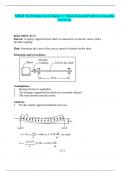
MECH 344 Problem Set 8-Chapter 17_Shafts-Selected Problems Concordia
University
SOLUTION (17.3)
Known: A simply supported steel shaft is connected to an electric motor with a
flexible coupling.
Find: Determine the value of the critical speed of rotation for the shaft.
Schematic and Given Data:
Flexible
Motor Coupling 0.25 in. dia. shaft
20 in.
Assumptions:
1. Bearing friction is negligible.
2. The bearings supporting the shafts are accurately aligned.
3. The shaft remains linearly elastic.
Analysis:
1. For the simply supported uniform load case:
w
st
wL/2 wL/2
w = A = d where = 0. 28 lb for steel
2
4 in. 3
(0. 25)2
w= (0. 28) = 0. 0137 lb
4 in.
17-4
,2. From Appendix D-2,
4
st = 5wL for a uniform load distribution
384EI
where E = 30 106 psi (Appendix C-1)
17-5
, (0. 25)4
I = d =
4
= 1. 92 10-4 in. 4 (Appendix B-1)
64 64
5(0. 0137)(20)4
st = = 4. 98 10-3 in.
384(30 10 )(1. 92 10 )
6 -4
3. Using Fig. 17.5(c), to find the shaft critical speed
5(32. 2 ft)(12 in. )
5g
nc = s2 ft
4st 4(4. 98 10 in. )
-3
nc 311 rpm ■
17-6
, SOLUTION (17.10)
Known: The dimensions of a steel shaft are given.
Find: Determine the critical speed of rotation for the steel shaft.
Schematic and Given Data:
25 mm dia.
50 kg
600 mm 600 mm
Assumptions:
1. Bearing friction is negligible.
2. The bearings supporting the shafts are accurately aligned.
3. The shaft remains linearly elastic.
4. The shaft is simply supported.
5. The mass of the shaft is negligible.
Analysis:
P
L/2
L
st
P/2 P/2
1. Using Appendix D-2, for a concentrated center load on a simply supported beam
3
we have st = PL where
48EI
E = 207 109 Pa (Appendix C-1) and
I = d (Appendix B-1)
4
64
(0. 025)4
= = 19. 2 10-9 m4
64
17-20
University
SOLUTION (17.3)
Known: A simply supported steel shaft is connected to an electric motor with a
flexible coupling.
Find: Determine the value of the critical speed of rotation for the shaft.
Schematic and Given Data:
Flexible
Motor Coupling 0.25 in. dia. shaft
20 in.
Assumptions:
1. Bearing friction is negligible.
2. The bearings supporting the shafts are accurately aligned.
3. The shaft remains linearly elastic.
Analysis:
1. For the simply supported uniform load case:
w
st
wL/2 wL/2
w = A = d where = 0. 28 lb for steel
2
4 in. 3
(0. 25)2
w= (0. 28) = 0. 0137 lb
4 in.
17-4
,2. From Appendix D-2,
4
st = 5wL for a uniform load distribution
384EI
where E = 30 106 psi (Appendix C-1)
17-5
, (0. 25)4
I = d =
4
= 1. 92 10-4 in. 4 (Appendix B-1)
64 64
5(0. 0137)(20)4
st = = 4. 98 10-3 in.
384(30 10 )(1. 92 10 )
6 -4
3. Using Fig. 17.5(c), to find the shaft critical speed
5(32. 2 ft)(12 in. )
5g
nc = s2 ft
4st 4(4. 98 10 in. )
-3
nc 311 rpm ■
17-6
, SOLUTION (17.10)
Known: The dimensions of a steel shaft are given.
Find: Determine the critical speed of rotation for the steel shaft.
Schematic and Given Data:
25 mm dia.
50 kg
600 mm 600 mm
Assumptions:
1. Bearing friction is negligible.
2. The bearings supporting the shafts are accurately aligned.
3. The shaft remains linearly elastic.
4. The shaft is simply supported.
5. The mass of the shaft is negligible.
Analysis:
P
L/2
L
st
P/2 P/2
1. Using Appendix D-2, for a concentrated center load on a simply supported beam
3
we have st = PL where
48EI
E = 207 109 Pa (Appendix C-1) and
I = d (Appendix B-1)
4
64
(0. 025)4
= = 19. 2 10-9 m4
64
17-20