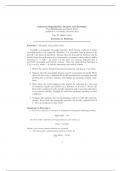
Industrial Organization: Markets and Strategies Paul Belleáamme and Martin Peitz published by Cambridge University Press Part II. Market power Exercises & Solutions
Industrial Organization: Markets and Strategies Paul Belleáamme and Martin Peitz published by Cambridge University Press Part II. Market power Exercises & Solutions Industrial Organization: Markets and Strategies Paul Belleáamme and Martin Peitz published by Cambridge University Press Part II. Market power Exercises & Solutions Exercise 1 Monopoly with quality choice Consider a monopolist who sells batteries. Each battery works for h hours and then needs to be replaced. Therefore, if a consumer buys q batteries, he gets H = qh hours of operation. Assume that the demand for batteries can be derived from the preferences of a representative consumer whose indirect utility function is v = u(H) pq, where p is the price of a battery. Suppose that u is strictly increasing and strictly concave. The cost of producing batteries is C(q) = qc(h), where c is strictly increasing and strictly convex. 1. Derive the inverse demand function for batteries and denote it by P(q). 2. Suppose that the monopolist chooses q and h to maximize his proÖt. Write down the Örst-order conditions for proÖt maximization assuming that the problem has an interior solution, and explain the meaning of these conditions. 3. Write down the total surplus in the market for batteries (i.e., the sum of consumer surplus and proÖts) as a function of H and h. Derive the Örst-order conditions for the socially optimal q and h assuming that there is an interior solution. Explain in words the economic meaning of these conditions. 4. Compare the solution that the monopolists arrives at with the social optimum. Prove that the monopolist provides the socially optimal level of h. Give an intuition for this result. Solutions to Exercise 1 1. The inverse demand for batteries is obtained by solving the following problem: max q u(qh) pq: The Örst-order conditions for this problem can be written as P(q) = hu0 (qh) which is the inverse demand function for batteries. 2. The monopolistís maximization problem is given by max q;h qP(q) qc(h);
Document information
- Uploaded on
- November 23, 2023
- Number of pages
- 27
- Written in
- 2023/2024
- Type
- Exam (elaborations)
- Contains
- Questions & answers