TEAMWORK AND CONFLICT MANAGEMENT
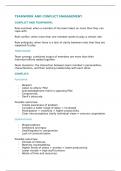
CONFLICT AND TEAMWORK:
Role overload: when a member of the team takes on more than they can
cope with.
Role conflict: when more than one member wants to play a certain role.
Role ambiguity: when there is a lack of clarity between roles that they are
supposed to play.
TEAM ROLES:
Team synergy: combined output of members are more than their
individual efforts added together.
Team dynamics: the interaction between team member’s personalities,
characteristics, and their working relationship with each other.
CONFLICT:
Functional:
- Respect
- Listen to others’ POV.
- Acknowledgement merit in opposing POV.
- Compromise.
- Devil’s advocate.
Possible outcomes:
- Create awareness of problem.
- Consider a wider range of ideas = increased.
- Participation + creativity = higher productivity.
- Clear misconceptions clarify individual views = ensures cooperation.
Dysfunctional:
- Misperceptions
- Ambitions and egos.
- Unwillingness to compromise.
- Lack of communication.
Possible outcomes:
- Climate of mistrust.
- Blaming, backstabbing.
- Higher levels of stress + anxiety = lower productivity.
- Lower morale = high staff turnover.
- Waste of time and resources.
, - Violence.
Reasons for conflict:
1. Different personalities, goals, and egos.
Problem Solving: assess situation, intervene, focus on business
before promoting own agendas.
2. Different background, cultures, and values
P.S: sensitivity training and developing skills.
- time keeping.
Respecting interpersonal space.
Emotional intelligence.
3. Lack/poor communication.
P.S: remove barriers to communication such as:
- poorly phrased messages.
-Poor use of language.
-Disturbance and noise.
4. Change.
- Uncertainty = resistance to change.
P.S: employees need to understand why there is change
(transformational leadership), a 2-way communication strategy =
buy-in, identify leader as they will influence other employees.
5. Limited resources (skills, materials, technology)
P.S: constantly remind members to contribute to overall success.
6. Previously unresolved issues
P.S: deal with conflict as it arises.
7. Inclusivity and cultural diversity
P.S: sensitivity workshop and team building.
8. Inner conflict
-past experiences, belief, morals.
-our perception = reality?
-issues of jealousy, inferiority, need to control and impress people.
-oversensitivity.
RECOMMENDATIONS TO MANAGE CONFLICT:
Ability to deal with change.
- Managers should encourage change and motivate employees.
- Initial reaction to change is resistance.
- Communication of change
Tolerance regarding inclusivity and cultural diversion.
- Expose and education regarding diversity.
- Background info on employees are important so that conflict can be
dealt with appropriately.
CONFLICT AND TEAMWORK:
Role overload: when a member of the team takes on more than they can
cope with.
Role conflict: when more than one member wants to play a certain role.
Role ambiguity: when there is a lack of clarity between roles that they are
supposed to play.
TEAM ROLES:
Team synergy: combined output of members are more than their
individual efforts added together.
Team dynamics: the interaction between team member’s personalities,
characteristics, and their working relationship with each other.
CONFLICT:
Functional:
- Respect
- Listen to others’ POV.
- Acknowledgement merit in opposing POV.
- Compromise.
- Devil’s advocate.
Possible outcomes:
- Create awareness of problem.
- Consider a wider range of ideas = increased.
- Participation + creativity = higher productivity.
- Clear misconceptions clarify individual views = ensures cooperation.
Dysfunctional:
- Misperceptions
- Ambitions and egos.
- Unwillingness to compromise.
- Lack of communication.
Possible outcomes:
- Climate of mistrust.
- Blaming, backstabbing.
- Higher levels of stress + anxiety = lower productivity.
- Lower morale = high staff turnover.
- Waste of time and resources.
, - Violence.
Reasons for conflict:
1. Different personalities, goals, and egos.
Problem Solving: assess situation, intervene, focus on business
before promoting own agendas.
2. Different background, cultures, and values
P.S: sensitivity training and developing skills.
- time keeping.
Respecting interpersonal space.
Emotional intelligence.
3. Lack/poor communication.
P.S: remove barriers to communication such as:
- poorly phrased messages.
-Poor use of language.
-Disturbance and noise.
4. Change.
- Uncertainty = resistance to change.
P.S: employees need to understand why there is change
(transformational leadership), a 2-way communication strategy =
buy-in, identify leader as they will influence other employees.
5. Limited resources (skills, materials, technology)
P.S: constantly remind members to contribute to overall success.
6. Previously unresolved issues
P.S: deal with conflict as it arises.
7. Inclusivity and cultural diversity
P.S: sensitivity workshop and team building.
8. Inner conflict
-past experiences, belief, morals.
-our perception = reality?
-issues of jealousy, inferiority, need to control and impress people.
-oversensitivity.
RECOMMENDATIONS TO MANAGE CONFLICT:
Ability to deal with change.
- Managers should encourage change and motivate employees.
- Initial reaction to change is resistance.
- Communication of change
Tolerance regarding inclusivity and cultural diversion.
- Expose and education regarding diversity.
- Background info on employees are important so that conflict can be
dealt with appropriately.