Lecture 1 – Intro
Stress: force/area
Strain: change in length / original length
Strength: max stress before failure
S-ffness: Young’s mod, E = stress/strain in elas:c region
Toughness: measure of energy required for crack propaga:on
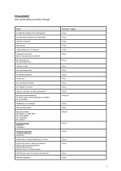
Key Proper-es
Metals Polymers Ceramics Composites
Density HIGH LOW LOW LOW
S-ffness HIGH LOW HIGH HIGH
Fracture toughness HIGH LOW LOW HIGH
Strength HIGH LOW HIGH HIGH
Cost HIGH
Disloca-ons
= imperfec:ons which allow planes of atoms to slip.
Best in crystalline structures with no imperfec:ons.
Yield = movement of disloca:ons in the structure = plas-c deforma-on
Increase strength by preven:ng movement of disloca:ons.
How? - something to act as obstacle to disloca:on mo:on:
• Other disloca:ons – can mul:ply through work hardening.
• Alloying elements disrupt crystalline structure
• Grain boundaries
• Precipita-on strengthening (small par:cles in structure)
Disrupt crystal laEce à difficult for disloca-ons to move à increased yield strength
= more stress required to move disloca:ons. Also, no change to s:ffness (same elas:c
gradient).
Phase: physically dis:nct form of maQer, can have mul:ple solid phases.
Grain: an individual crystal (usually metals have millions of grains).
Precipitate: a different phase that forms within the main material due to alloying addi:ons.
Solu-on: mixture of alloying addi:ons (not formed precipitates) and main material.
Manufacturing terms:
Cas-ng: molten metal into mould. Complex geometries possible and thermal history can be
varied to vary proper:es (heat treatment)
Forging: hea:ng and bashing metal to deform to desired shape.
Extruding: duc:le material heated and forced through a die to make long and thin strip.
Welding: parts fused by heat. Some materials cannot be welded without detrimental effect
– i.e. hot so also addi:onal heat trea:ng.
Machining: removing material to form shape or surface finish.
, Lecture 2 – Aluminium Alloys
• Majority of airframe weight in civil aircraW (80% 747)
• Major structural components (wings, fuselage)
• Majority are wrought heat treatable alloys (strength can be controlled by
mechanical processing and heat treatment). Also, age hardenable alloys (ppt
strengthening) due to higher yield strengths.
Advantages Disadvantages
Low density Max opera:ng T low (150°c)
Low cost Welding problems
Good specific proper:es Corrosion (salt)
Range of manufacturing techniques
Proper:es tailored by heat treatment
Naming conven-ons
1xxx (no-dot) = wrought
1xx.x (dot) = cast
Popular in aerospace (and main alloying element):
2xxx = copper = high strength, fa:gue resistance, toughness, duc:lity
(i.e. fuselage skin of B777)
7xxx = zinc = higher strength
(i.e. wing spars)
Alloy vs aluminium – higher yield stress and ul:mate tensile strength
Precipitate strengthening
= precipitates provide obstacles to disloca:on mo:on (yield). Increase yield strength and
hardness.
• Can move between single- and two-phase regions by changing temperature (heat
treatment).
• Effec:veness varies with distribu:on (volume frac:on, fine is beQer).
Microstructure:
Single phase region – looks like scales.
Two phase region – looks like scales but with small circles of precipitate.
Heat treatment
Solu-onising: hea:ng alloy and holding at temperature within solid region of phase
diagram. Ppts dissolve.
Quenching: rapid cooling. To form ppts, atoms must diffuse towards each other and
accumulate (during slower cooling). Rapid cooling ‘freezes’ structure in single phase. Slower
cooling = coarser ppts.
Ageing: hea:ng within two phase region and holding. Providing thermal ac:va:on energy
for diffusion. Ppts nucleate (forma:on of new phase) à grow à coarsening (combining and
grow).
Stress: force/area
Strain: change in length / original length
Strength: max stress before failure
S-ffness: Young’s mod, E = stress/strain in elas:c region
Toughness: measure of energy required for crack propaga:on
Key Proper-es
Metals Polymers Ceramics Composites
Density HIGH LOW LOW LOW
S-ffness HIGH LOW HIGH HIGH
Fracture toughness HIGH LOW LOW HIGH
Strength HIGH LOW HIGH HIGH
Cost HIGH
Disloca-ons
= imperfec:ons which allow planes of atoms to slip.
Best in crystalline structures with no imperfec:ons.
Yield = movement of disloca:ons in the structure = plas-c deforma-on
Increase strength by preven:ng movement of disloca:ons.
How? - something to act as obstacle to disloca:on mo:on:
• Other disloca:ons – can mul:ply through work hardening.
• Alloying elements disrupt crystalline structure
• Grain boundaries
• Precipita-on strengthening (small par:cles in structure)
Disrupt crystal laEce à difficult for disloca-ons to move à increased yield strength
= more stress required to move disloca:ons. Also, no change to s:ffness (same elas:c
gradient).
Phase: physically dis:nct form of maQer, can have mul:ple solid phases.
Grain: an individual crystal (usually metals have millions of grains).
Precipitate: a different phase that forms within the main material due to alloying addi:ons.
Solu-on: mixture of alloying addi:ons (not formed precipitates) and main material.
Manufacturing terms:
Cas-ng: molten metal into mould. Complex geometries possible and thermal history can be
varied to vary proper:es (heat treatment)
Forging: hea:ng and bashing metal to deform to desired shape.
Extruding: duc:le material heated and forced through a die to make long and thin strip.
Welding: parts fused by heat. Some materials cannot be welded without detrimental effect
– i.e. hot so also addi:onal heat trea:ng.
Machining: removing material to form shape or surface finish.
, Lecture 2 – Aluminium Alloys
• Majority of airframe weight in civil aircraW (80% 747)
• Major structural components (wings, fuselage)
• Majority are wrought heat treatable alloys (strength can be controlled by
mechanical processing and heat treatment). Also, age hardenable alloys (ppt
strengthening) due to higher yield strengths.
Advantages Disadvantages
Low density Max opera:ng T low (150°c)
Low cost Welding problems
Good specific proper:es Corrosion (salt)
Range of manufacturing techniques
Proper:es tailored by heat treatment
Naming conven-ons
1xxx (no-dot) = wrought
1xx.x (dot) = cast
Popular in aerospace (and main alloying element):
2xxx = copper = high strength, fa:gue resistance, toughness, duc:lity
(i.e. fuselage skin of B777)
7xxx = zinc = higher strength
(i.e. wing spars)
Alloy vs aluminium – higher yield stress and ul:mate tensile strength
Precipitate strengthening
= precipitates provide obstacles to disloca:on mo:on (yield). Increase yield strength and
hardness.
• Can move between single- and two-phase regions by changing temperature (heat
treatment).
• Effec:veness varies with distribu:on (volume frac:on, fine is beQer).
Microstructure:
Single phase region – looks like scales.
Two phase region – looks like scales but with small circles of precipitate.
Heat treatment
Solu-onising: hea:ng alloy and holding at temperature within solid region of phase
diagram. Ppts dissolve.
Quenching: rapid cooling. To form ppts, atoms must diffuse towards each other and
accumulate (during slower cooling). Rapid cooling ‘freezes’ structure in single phase. Slower
cooling = coarser ppts.
Ageing: hea:ng within two phase region and holding. Providing thermal ac:va:on energy
for diffusion. Ppts nucleate (forma:on of new phase) à grow à coarsening (combining and
grow).