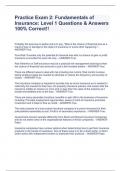
Practice Exam 2: Fundamentals of Insurance: Level 1 Questions & Answers 100% Correct!!
Probably the best way to define risk is to say, "Risk is the chance of financial loss as a result of loss or damage to the object of insurance or some other happening." - ANSWER-True. Pure Risk: Provides only the potential for financial loss with no chance of gain or profit. Insurance is provided for pure risk only. - ANSWER-True. Risk Retention or Self-insurance may be a practical risk management technique when the chance of financial loss amounts to just a few hundred dollars. - ANSWER-True. There are different ways to deal with risk including risk control. Risk control involves taking whatever steps are needed to eliminate or reduce the frequency and severity of losses. - ANSWER-True. The insurance company is required to provide only as much insurance as is needed to indemnify the insured for their loss. On property insurance policies, that means that the insured is entitles to receive no more and no less than the value of the property as it existed immediately prior to the loss. - ANSWER-True. There are many secondary functions, benefits or spin-offs to the business of insurance including: Provides employment opportunities, peace of mind of insurance promotes investment and it helps to free up credit. - ANSWER-True. The main purpose of a true mutual insurance company is to prove insurance for their policyholders essentially at cost. Profit is of secondary importance. - ANSWER-True. Government insurers operate differently from Stock and Mutual Insurance Companies and do not share many of the organizational features of those companies. - ANSWER-False. Insurance companies have various options when determining how to get their insurance products in the hands of customers. One of these ways is to be a direct writer. A direct writer works with independent brokers to distribute their products. - ANSWER-False. A captive or exclusive agents is someone who sells the products of one insurance company only. For this reason they are not required to be licensed in their province. - ANSWER-False. Insurance agents and brokers are intermediaries between the applicant for insurance and the insurance company. They are not a party to the insurance contract. - ANSWER-True. Insurance brokers have a primary duty to ensure that they act ethically at all times in any dealing with an insurance company. An integral part of this duty is to ensure that they always tell the truth about the applicant and/or risk being submitted for insurance; and they must not withhold any information that the insurance company would consider important in making the decision whether to provide the applicant with insurance. - ANSWER-True. The applicant for insurance requested a policy with a $500 deductible. Today the insurance company advised the applicant t
Written for
- Institution
- Fundamentals of Insurance
- Module
- Fundamentals of Insurance
Document information
- Uploaded on
- November 19, 2023
- Number of pages
- 7
- Written in
- 2023/2024
- Type
- Exam (elaborations)
- Contains
- Questions & answers
Subjects
-
practice exam 2 fundamentals of insurance level
-
practice exam 2 fundamentals of insurance stuvia
-
probably the best way to define risk is to say r
-
pure risk provides only the potential for financi

Also available in package deal