Pharmacology Final Exam study guide
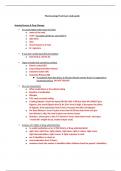
Pharmacology Final Exam study guide Nursing Process & Drug Therapy • In a prescription what must you have: o name of the med o route- (no route call the Dr. and verify it) o date/time o dose o time/frequency of med o Dr. signature • If you don’t understand the prescription: o hold med & call the Dr. • Types of meds that cannot be crushed: o Enteric coated (EC) o Long acting (extended release) o Sustained action (SA) o Sustained Release (SR) ▪ If crushed it loses the effect, it will also dissolve sooner than it is supposed to increasing toxicity. DO NOT CRUSH!! • Do a pre assessment: o What medications is the patient taking o Baseline of medication o Allergies o OTC meds currently taking o If taking Digoxin- check the Apical HR (60-100); if HR less than 60 CANNOT give Digoxin; also check Digoxin level & K+ (if K+ level is high, it decreases the effect of Digoxin; if the potassium level is low, increases the effect of Digoxin) o For Beta Blockers- check if pulse is less than 60 (If less than 60 do not give beta blocker), after the med is given you always Assess o Diuretics- always give in the A.M (check K+ level, electrolyte levels, vital signs *mostly BP, weight the pt, intake/output of pt) • Purpose of 9 rights of drug administration: o to avoid medication error of OD (Safety of drug administration) o right med, right time, right patient, right dose, right to refuse, right route, right documentation, right reason, & right response to med o use 2 identifiers to check pt o read medication level 3 times! o newborn-check the mother’s identifier/older children-check the parent’s identifiers o elderly- 2 identifiers; if confused (do not ask pt for the name) o give med 30 min before or 30 min after the due time (right time) o TID: 3 times/day; BID: 2 times/day; QID: 4 times/day; DO NOT use QD (write the word Daily) • Pharmacokinetics: o What the body does to the drug o Four Principles of Pharmacokinetics: ▪ Absorption (Route) depends on the site: • Parenteral goes 1st because- it bypasses 1st pass effect, so it has a bioavailability of 100%, IV has more effect than oral • Oral: has the 1st pass effect, the bioavailability is 80% • Sublingual: under the tongue because of increase in vascularity bypasses the 1st pass effect 100% bioavailability • Buccal: between the cheeks & the upper/lower molar & rotate, with vascularity you also will bypass the 1st pass effect 100% bioavailability ▪ Distribution- also depends on the site (high/more vascularity = more distribution of the med) • Plasma protein affects distribution of meds (Albumin) • Albumin meds are highly protein bound so it attaches to the receptor & once attached they remain in the bloodstream & the rest of meds are free to go • 2 meds together compete & can cause toxicity ▪ Metabolism AKA (Biotransformation)- the main organ is the Liver • Is the process by which the body inactivates drugs • If you have liver problems- higher chances of toxicity because medication cannot be broken down • Elderly & Newborns are at higher risk due to immature liver ▪ Excretion- the main organ is the Kidney • If patient has renal failure cannot excrete the drugs so higher chances of toxicity to occur; also newborns have immature kidneys so they as well are at higher risk of toxicity
Document information
- Uploaded on
- November 14, 2023
- Number of pages
- 21
- Written in
- 2023/2024
- Type
- Exam (elaborations)
- Contains
- Questions & answers