PHIL 235 Quiz 2 Questions and Answers 2023 with complete solution
QUIZ 2:
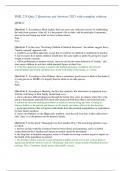
Question 1: According to Mack Lipkin, there are never any sufficient reasons for withholding
the truth from a patient. After all, it is the patient's life at stake, and the principle of autonomy
must in the end trump any belief we have in benevolence.
True
False
Question 2: In the essay "Involving Children in Medical Decisions", the authors suggest that a
"family-centered" approach will:
a. would be an excellent approach, except that it would be too difficult to implement in practice.
b. fail to respect how mature children should have the same rights as adults by giving too much
weight to family concerns.
c. will be problematic in modern society, since no one has the same definition of "family," and
since many children do not have stable parental figures in their lives.
d. is the best approach, because it respects the limited autonomy of children and also the
responsibilities that family members have to the well-being of the family as a whole.
Question 3: According to Alan William, there is sometimes good reason to think of the death of
a young person as MORE of a tragedy than the death of an older person.
True
False
Question 4: According to Hardwig, the fact that a patient's life intertwines in important ways
with the well-being of their family should lead us to:
a. always disclose difficult diagnoses through the family first, since in cultures where this is the
practice the patients generally feel much more protected both from illness and from bad news.
b. rethink the decision-making procedures in medical contexts along the lines of trying to
balance fidelity to the patient and fairness to the family and others effected by the decision.
c. insist upon policies that will protect individuals from the potential manipulation or exploitation
by their family members.
d. renew our emphasis on the Hippocratic tradition, since the real issue here is that a physician's
only "duty" is to the patient, not the patient's family.
Question 5: In the article “Managing Care the Canadian Way,” Pat Armstrong identifies ways
in which:
a. the best system would be a balance between benevolence and autonomy, and so a hybrid
system between the Canadian and American models should be developed!
b. the long lines in hospital emergency rooms in Canada are having a serious negative impact on
the health of the population in general.
c. the attempt to place a private system alongside a public system (a two-tier system) leads to
significant problems (such as cases of “skimming” and a less caring system of medical decision-
making). Thus, Canadians should protect their public system.
QUIZ 2:
Question 1: According to Mack Lipkin, there are never any sufficient reasons for withholding
the truth from a patient. After all, it is the patient's life at stake, and the principle of autonomy
must in the end trump any belief we have in benevolence.
True
False
Question 2: In the essay "Involving Children in Medical Decisions", the authors suggest that a
"family-centered" approach will:
a. would be an excellent approach, except that it would be too difficult to implement in practice.
b. fail to respect how mature children should have the same rights as adults by giving too much
weight to family concerns.
c. will be problematic in modern society, since no one has the same definition of "family," and
since many children do not have stable parental figures in their lives.
d. is the best approach, because it respects the limited autonomy of children and also the
responsibilities that family members have to the well-being of the family as a whole.
Question 3: According to Alan William, there is sometimes good reason to think of the death of
a young person as MORE of a tragedy than the death of an older person.
True
False
Question 4: According to Hardwig, the fact that a patient's life intertwines in important ways
with the well-being of their family should lead us to:
a. always disclose difficult diagnoses through the family first, since in cultures where this is the
practice the patients generally feel much more protected both from illness and from bad news.
b. rethink the decision-making procedures in medical contexts along the lines of trying to
balance fidelity to the patient and fairness to the family and others effected by the decision.
c. insist upon policies that will protect individuals from the potential manipulation or exploitation
by their family members.
d. renew our emphasis on the Hippocratic tradition, since the real issue here is that a physician's
only "duty" is to the patient, not the patient's family.
Question 5: In the article “Managing Care the Canadian Way,” Pat Armstrong identifies ways
in which:
a. the best system would be a balance between benevolence and autonomy, and so a hybrid
system between the Canadian and American models should be developed!
b. the long lines in hospital emergency rooms in Canada are having a serious negative impact on
the health of the population in general.
c. the attempt to place a private system alongside a public system (a two-tier system) leads to
significant problems (such as cases of “skimming” and a less caring system of medical decision-
making). Thus, Canadians should protect their public system.