Economics
Chapter 3: Elasticity
3.1 Elasticity
PRICE E LA S T I C I T Y O F DE M A N D
How responsive demand is to a rise in price.
The responsiveness of demand to a change in price = price elasticity of demand
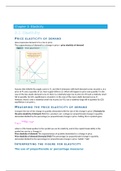
Assume that initially the supply curve is S1, and that it intersects with both demand curves at point a, at a
price of P1 and a quantity of Q1. Now supply shifts to S2. What will happen to price and quantity? In the
case of the less elastic demand curve D, there is a relatively large rise in price (to P2) and a relatively small
fall in quantity (to Q2): equilibrium is at point b. In the case of the more elastic demand curve D′,
however, there is only a relatively small rise in price (to P3), but a relatively large fall in quantity (to Q3):
equilibrium is at point c.
MEASURING T H E P R I C E E LA S T I C I T Y O F DE M A N D
Compare the size of the change in quantity demanded with the size of the change in price Formula for
the price elasticity of demand (PeD) for a product: per- centage (or proportionate) change in quantity
demanded divided by the percentage (or proportionate) change in price. Putting this in symbols gives
%ΔQD / %ΔP
P eD =
where e (the Greek epsilon) is the symbol we use for elasticity, and Δ (the capital Greek delta) is the
symbol we use for a ‘change in’.
Price elasticity of demand The responsiveness of quantity demanded to a change in price.
Price elasticity of demand (formula) (PeD) The percentage (or proportionate) change in quantity
demanded divided by the percentage (or proportionate) change in price: %ΔQD ÷ %ΔP.
INTERPRETING THE FIGURE FOR ELASTICITY
The use of proportionate or percentage measures
, - It allows comparison of changes in two qualitatively different things, which are thus
measured in two different types of unit.
- It is the only sensible way of deciding how big a change in price or quantity is.
The sign (positive or negative)
We divide either a negative figure by a positive figure or the other way around.
The value (greater or less than 1)
Ignore the negative sign‼
Elastic demand (e>1) = where quantity demanded changes by a larger percentage than price. Ignoring the
negative sign, it will have a value greater than 1.
Inelastic demand (e<1) = where a change in a price causes a proportionately smaller change in the
quantity demanded. Ignoring the negative sign, it will have a value less than 1.
Unit elasticity of demand (e=1) = where quantity demanded changes by the same percentage as price.
Ignoring the negative sign, it will have a value equal to 1.
DETERMINANTS O F P R I C E E LA S T I C I T Y O F DE M A N D
- The number and closeness of substitute goods.
- The proportion of income spent on the good.
- The time period.
PRICEE LA S T I C I T Y O F DE M A N D A N D C O N S U ME R
EXPENDITURE
One of the most important applications of price elasticity of demand concerns its relationship with the
total amount of money consumers spend on a product.
Total consumer expenditure on a product (TE) (per period of time) The price of the product multiplied by
the quantity purchased: TE = P × Q.
Total consumer expenditure will be the same as the total revenue (TR) received by firms from the sale of
the product (before any taxes or other deductions).
Total revenue (TR) (per period of time) The total amount received by firms from the sale of a product,
before the deduction of taxes or any other costs. The price multiplied by the quantity sold: TR = P × Q.
Elastic demand
- P rises; Q falls proportionately more; thus TE falls.
- P falls; Q rises proportionately more; thus TE rises.
In other words, total expenditure changes in the same direction as quantity.
Chapter 3: Elasticity
3.1 Elasticity
PRICE E LA S T I C I T Y O F DE M A N D
How responsive demand is to a rise in price.
The responsiveness of demand to a change in price = price elasticity of demand
Assume that initially the supply curve is S1, and that it intersects with both demand curves at point a, at a
price of P1 and a quantity of Q1. Now supply shifts to S2. What will happen to price and quantity? In the
case of the less elastic demand curve D, there is a relatively large rise in price (to P2) and a relatively small
fall in quantity (to Q2): equilibrium is at point b. In the case of the more elastic demand curve D′,
however, there is only a relatively small rise in price (to P3), but a relatively large fall in quantity (to Q3):
equilibrium is at point c.
MEASURING T H E P R I C E E LA S T I C I T Y O F DE M A N D
Compare the size of the change in quantity demanded with the size of the change in price Formula for
the price elasticity of demand (PeD) for a product: per- centage (or proportionate) change in quantity
demanded divided by the percentage (or proportionate) change in price. Putting this in symbols gives
%ΔQD / %ΔP
P eD =
where e (the Greek epsilon) is the symbol we use for elasticity, and Δ (the capital Greek delta) is the
symbol we use for a ‘change in’.
Price elasticity of demand The responsiveness of quantity demanded to a change in price.
Price elasticity of demand (formula) (PeD) The percentage (or proportionate) change in quantity
demanded divided by the percentage (or proportionate) change in price: %ΔQD ÷ %ΔP.
INTERPRETING THE FIGURE FOR ELASTICITY
The use of proportionate or percentage measures
, - It allows comparison of changes in two qualitatively different things, which are thus
measured in two different types of unit.
- It is the only sensible way of deciding how big a change in price or quantity is.
The sign (positive or negative)
We divide either a negative figure by a positive figure or the other way around.
The value (greater or less than 1)
Ignore the negative sign‼
Elastic demand (e>1) = where quantity demanded changes by a larger percentage than price. Ignoring the
negative sign, it will have a value greater than 1.
Inelastic demand (e<1) = where a change in a price causes a proportionately smaller change in the
quantity demanded. Ignoring the negative sign, it will have a value less than 1.
Unit elasticity of demand (e=1) = where quantity demanded changes by the same percentage as price.
Ignoring the negative sign, it will have a value equal to 1.
DETERMINANTS O F P R I C E E LA S T I C I T Y O F DE M A N D
- The number and closeness of substitute goods.
- The proportion of income spent on the good.
- The time period.
PRICEE LA S T I C I T Y O F DE M A N D A N D C O N S U ME R
EXPENDITURE
One of the most important applications of price elasticity of demand concerns its relationship with the
total amount of money consumers spend on a product.
Total consumer expenditure on a product (TE) (per period of time) The price of the product multiplied by
the quantity purchased: TE = P × Q.
Total consumer expenditure will be the same as the total revenue (TR) received by firms from the sale of
the product (before any taxes or other deductions).
Total revenue (TR) (per period of time) The total amount received by firms from the sale of a product,
before the deduction of taxes or any other costs. The price multiplied by the quantity sold: TR = P × Q.
Elastic demand
- P rises; Q falls proportionately more; thus TE falls.
- P falls; Q rises proportionately more; thus TE rises.
In other words, total expenditure changes in the same direction as quantity.