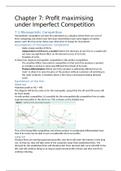
Chapter 7: Profit maximising
under Imperfect Competition
7.1 Monopolistic Competition
Monopolistic competition can best be understood as a situation where there are a lot of
firms competing, but where each firm does nevertheless have some degree of market
power: each firm has some choice over what price to charge for its products.
Assumptions of monopolistic competition
- Quite a large number of firms
Independence (of firms in a market) Where the decisions of one firm in a market will
not have any significant effect on the demand curves of its rivals.
- Freedom of entry
In these two respects monopolistic competition is like perfect competition.
- The situation differs from perfect competition in that each firm produces a product
or provides a service in some way different from those of its rivals.
Product differentiation Where one firm’s product is sufficiently different from its
rivals’ to allow it to raise the price of the product without customers all switching to
the rivals’ products. A situation where a firm faces a downward-sloping demand
curve.
Equilibrium of the firm
Short run
Maximise profit at MC = MR.
The diagram will be the same as for the monopolist, except that the AR and MR curves will
be more elastic.
As with perfect competition, it is possible for the monopolistically competitive firm to make
supernormal profits in the short run. This is shown as the shaded area.
Thus a firm facing little competition and whose product is considerably differentiated from
that of its rivals may be able to earn considerable short-run profits.
Long run
If typical firms are earning supernormal profits, new firms will enter the industry in the long
run. As they do, they will take some of the customers away from established firms. The
demand for the established firms will therefore fall. Their demand (AR) curve will shift to the
left, and will continue doing so as long as supernormal profits remain and thus new firms
continue entering.
, Limitations of the model
- Information may be imperfect
- Given that the firms in the industry produce different products, it is difficult if not
impossible to derive a demand curve for the industry as a whole.
- Firms are likely to differ from each other not only in the product they produce or the
service they offer, but also in their size and cost structure.
- One of the biggest problems with the simple model shown in Figure 7.1 is that it
concentrates on price and output decisions. The profit-maximising firm under
monopolistic competition also has to decide the exact variety of product to produce
and how much to spend on advertising it. This will lead the firm to take part in non-
price competition.
Non-price competition
Non-price competition Competition in terms of product promotion (advertising, packaging,
etc.) or product development.
The major aims of product development are to produce a product that will sell well and that
is different from rivals’ products.
The major aim of advertising is to sell the product. This can be achieved not only by
informing the consumer of the product’s existence and availability, but also by deliberately
trying to persuade consumers to purchase the good.
Product development and advertising not only increase a firm’s demand and hence revenue,
they also involve increased costs.
For any given price and product, the optimal amount of advertising is where the revenue
from additional advertising (MRA) is equal to its cost (MCA). As long as MRA > MCA,
additional advertising will add to profit. But extra amounts spent on advertising are likely to
lead to smaller and smaller increases in sales. Thus MRA falls, until MRA = MCA. At that
point, no further profit can be made. It is at a maximum.
Two problems arise:
▪ The effect of product development and advertising on demand will be di cult for a
firm to forecast.
▪ Product development and advertising are likely to have different effects at different
prices.
Monopolistic competition and the public interest
Comparison with perfect competition
It is often argued that monopolistic competition leads to a less efficient allocation of
resources than perfect competition.
under Imperfect Competition
7.1 Monopolistic Competition
Monopolistic competition can best be understood as a situation where there are a lot of
firms competing, but where each firm does nevertheless have some degree of market
power: each firm has some choice over what price to charge for its products.
Assumptions of monopolistic competition
- Quite a large number of firms
Independence (of firms in a market) Where the decisions of one firm in a market will
not have any significant effect on the demand curves of its rivals.
- Freedom of entry
In these two respects monopolistic competition is like perfect competition.
- The situation differs from perfect competition in that each firm produces a product
or provides a service in some way different from those of its rivals.
Product differentiation Where one firm’s product is sufficiently different from its
rivals’ to allow it to raise the price of the product without customers all switching to
the rivals’ products. A situation where a firm faces a downward-sloping demand
curve.
Equilibrium of the firm
Short run
Maximise profit at MC = MR.
The diagram will be the same as for the monopolist, except that the AR and MR curves will
be more elastic.
As with perfect competition, it is possible for the monopolistically competitive firm to make
supernormal profits in the short run. This is shown as the shaded area.
Thus a firm facing little competition and whose product is considerably differentiated from
that of its rivals may be able to earn considerable short-run profits.
Long run
If typical firms are earning supernormal profits, new firms will enter the industry in the long
run. As they do, they will take some of the customers away from established firms. The
demand for the established firms will therefore fall. Their demand (AR) curve will shift to the
left, and will continue doing so as long as supernormal profits remain and thus new firms
continue entering.
, Limitations of the model
- Information may be imperfect
- Given that the firms in the industry produce different products, it is difficult if not
impossible to derive a demand curve for the industry as a whole.
- Firms are likely to differ from each other not only in the product they produce or the
service they offer, but also in their size and cost structure.
- One of the biggest problems with the simple model shown in Figure 7.1 is that it
concentrates on price and output decisions. The profit-maximising firm under
monopolistic competition also has to decide the exact variety of product to produce
and how much to spend on advertising it. This will lead the firm to take part in non-
price competition.
Non-price competition
Non-price competition Competition in terms of product promotion (advertising, packaging,
etc.) or product development.
The major aims of product development are to produce a product that will sell well and that
is different from rivals’ products.
The major aim of advertising is to sell the product. This can be achieved not only by
informing the consumer of the product’s existence and availability, but also by deliberately
trying to persuade consumers to purchase the good.
Product development and advertising not only increase a firm’s demand and hence revenue,
they also involve increased costs.
For any given price and product, the optimal amount of advertising is where the revenue
from additional advertising (MRA) is equal to its cost (MCA). As long as MRA > MCA,
additional advertising will add to profit. But extra amounts spent on advertising are likely to
lead to smaller and smaller increases in sales. Thus MRA falls, until MRA = MCA. At that
point, no further profit can be made. It is at a maximum.
Two problems arise:
▪ The effect of product development and advertising on demand will be di cult for a
firm to forecast.
▪ Product development and advertising are likely to have different effects at different
prices.
Monopolistic competition and the public interest
Comparison with perfect competition
It is often argued that monopolistic competition leads to a less efficient allocation of
resources than perfect competition.