Samenvatting Operations Management
Vivian Hu I2DESG
Chapter 1: Operations Management
What is Operations Management?
Operations management is the activity of managing the resources that create and deliver services
and products.
Operations Function
The operations function is central to the organization because it creates and delivers services and
products, which is its reason for existing. The operations function is one of the three core functions of
any organization. These are:
- The marketing (including sales) function: Which is responsible for communicating the
organization’s services and products to its markets in order to generate customer requests
- The product/service development function: Which is responsible for coming up with new
and modified services and products in order to generate future customer requests
- The Operations function: Which is responsible for the creation and delivery of services and
product based on customer requests
The input-transformation-output process
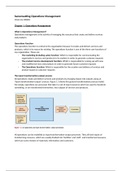
All operations create and deliver services and products by changing inputs into outputs using an
‘input-transformation-output’ process. Figure 1.3 shows this general transformation process model.
Put simply, operations are processes that take in a set of input resources which are used to transform
something, or are transformed themselves, into outputs of services and products.
All operations can be modelled as input-transformation-output processes. They all have inputs of
transforming resouces, which are usually divided into ‘facilities’ and ‘staff’, and transformed resouces,
which are some mixture of materials, information and customers.
,Inputs to the process
One set of inputs to any operation’s processes are transformed resources. These are the resources
that are treated, transformed or converted in the process. They are usually a mixture of the following:
- Materials: operations which process materials could do so to transform their physical
properties.
- Information: operations which process information could do so to transform their
informational properties.
- Customers: operations which process customers might change their physical properties in a
similar way to materials processors.
Transformed resource inputs to a process are materials, information or customers
The other set of inputs to any operations process are transforming resources. These are the resources
which act upon the transformed resources. There are two types which form the ‘building blocks’ of all
operations:
- Facilities: The buildings, equipment, plant and process technology of the operation.
- Staff: The people who operate, maintain, plan and manage the operation.
Outputs from the process
Products and services are different. Products are usually tangible things, whereas services are
activities or processes.
A process perspective can be used at three levels:
- The level of the operation itself
- The level of the supply network
- The level of individual processes
‘Operations’ as a function
Meaning the part of the organization which creates and delivers services and products for the
organization’s external customers.
‘Operations’ as a activity
Meaning the management of the processes within any of the organization’s functions.
Operations processes have different characteristics
Although all operations processes are similar in that they all transform inputs, they do differ in a
number of ways, four of which, known as the four V’s, are particularly important:
- The Volume of their output
- The Variety of their output
- The Variation in the demand for their output
- The degree of Visibility which customers have of the creation of their output
, The Volume dimension
Example: The epitome of high-volume hamburger production is McDonald’s, which serves millions of
burgers around the world every day. Volume has important implications for the way McDonald’s
operations are organized. The first thing you notice is the repeatability of the tasks people are doing
and the systemization of the work where standard procedures are set down specifying how each part
of the job should be carried out.
Now consider a small local cafeteria serving a few ‘short order’ dishes. The range of items on the
menu may be similar to the larger operation, but the volume will be far lower, so the repetition will
also be far lower and the number of staff will be lower and therefore individual staff are likely to
perform a wider range of tasks.
The Variety dimension
A taxi company offers a relatively high-variety service. It is prepared to pick you up from almost
anywhere and drop you off almost anywhere. To offer this variety it must be relatively flexible.
However, the cost per kilometer travelled will be higher for a taxi than for a less customized form of
transport such as a bus service. Although both provide the same basic service (transportation), the
taxi service has a higher variety of routes and times to offer its customers, while the bus service has a
few well-defined routes, with a set schedule.
The Variation dimension
Consider the demand pattern for a successful summer holiday resort hotel. Not surprisingly, more
customers want to stay in summer vacation times than in the middle of winter. At the height of ‘the
season’ the hotel could be full to its capacity. Off-season demand, however, could be a small fraction
of its capacity. Such a marked variation in demand means that the operation must change its capacity
in some way, for example by hiring extra staff for the summer. The hotel must try predict the likely
level of demand.
The Visibility dimension
It means how much of the operation’s activities its customers experience, or how much the operation
is exposed to its customers. For example a retailer could operate as a high visibility ‘bricks and
mortar’, or a lower visibility web-based operation. In the ‘bricks and mortar’, high visibility operation,
customers will directly experience most of its ‘value-adding’ activities. Customers will have a
relatively short waiting tolerance, and may walk out if not served in a reasonable time.
Mixed high-and-low-visibility processes
Some operations have both high-and-low-visibility processes within the same operation. In an airport,
for example, some activities are totally ‘visible’ to its customers, such as information desk answering
people’s queries. These staff operate in what is termed a front-office environment. Other parts of the
airport have little, if any, customer ‘visibility’, such as the baggage handlers. These rarely seen staff
perform the vital but low-contact tasks, in what is called the back-office part of the operation.
Operations and processes can (other things being equal) reduce their costs by increasing volume,
reducing variety, reducing variation, and reducing visibility.
Vivian Hu I2DESG
Chapter 1: Operations Management
What is Operations Management?
Operations management is the activity of managing the resources that create and deliver services
and products.
Operations Function
The operations function is central to the organization because it creates and delivers services and
products, which is its reason for existing. The operations function is one of the three core functions of
any organization. These are:
- The marketing (including sales) function: Which is responsible for communicating the
organization’s services and products to its markets in order to generate customer requests
- The product/service development function: Which is responsible for coming up with new
and modified services and products in order to generate future customer requests
- The Operations function: Which is responsible for the creation and delivery of services and
product based on customer requests
The input-transformation-output process
All operations create and deliver services and products by changing inputs into outputs using an
‘input-transformation-output’ process. Figure 1.3 shows this general transformation process model.
Put simply, operations are processes that take in a set of input resources which are used to transform
something, or are transformed themselves, into outputs of services and products.
All operations can be modelled as input-transformation-output processes. They all have inputs of
transforming resouces, which are usually divided into ‘facilities’ and ‘staff’, and transformed resouces,
which are some mixture of materials, information and customers.
,Inputs to the process
One set of inputs to any operation’s processes are transformed resources. These are the resources
that are treated, transformed or converted in the process. They are usually a mixture of the following:
- Materials: operations which process materials could do so to transform their physical
properties.
- Information: operations which process information could do so to transform their
informational properties.
- Customers: operations which process customers might change their physical properties in a
similar way to materials processors.
Transformed resource inputs to a process are materials, information or customers
The other set of inputs to any operations process are transforming resources. These are the resources
which act upon the transformed resources. There are two types which form the ‘building blocks’ of all
operations:
- Facilities: The buildings, equipment, plant and process technology of the operation.
- Staff: The people who operate, maintain, plan and manage the operation.
Outputs from the process
Products and services are different. Products are usually tangible things, whereas services are
activities or processes.
A process perspective can be used at three levels:
- The level of the operation itself
- The level of the supply network
- The level of individual processes
‘Operations’ as a function
Meaning the part of the organization which creates and delivers services and products for the
organization’s external customers.
‘Operations’ as a activity
Meaning the management of the processes within any of the organization’s functions.
Operations processes have different characteristics
Although all operations processes are similar in that they all transform inputs, they do differ in a
number of ways, four of which, known as the four V’s, are particularly important:
- The Volume of their output
- The Variety of their output
- The Variation in the demand for their output
- The degree of Visibility which customers have of the creation of their output
, The Volume dimension
Example: The epitome of high-volume hamburger production is McDonald’s, which serves millions of
burgers around the world every day. Volume has important implications for the way McDonald’s
operations are organized. The first thing you notice is the repeatability of the tasks people are doing
and the systemization of the work where standard procedures are set down specifying how each part
of the job should be carried out.
Now consider a small local cafeteria serving a few ‘short order’ dishes. The range of items on the
menu may be similar to the larger operation, but the volume will be far lower, so the repetition will
also be far lower and the number of staff will be lower and therefore individual staff are likely to
perform a wider range of tasks.
The Variety dimension
A taxi company offers a relatively high-variety service. It is prepared to pick you up from almost
anywhere and drop you off almost anywhere. To offer this variety it must be relatively flexible.
However, the cost per kilometer travelled will be higher for a taxi than for a less customized form of
transport such as a bus service. Although both provide the same basic service (transportation), the
taxi service has a higher variety of routes and times to offer its customers, while the bus service has a
few well-defined routes, with a set schedule.
The Variation dimension
Consider the demand pattern for a successful summer holiday resort hotel. Not surprisingly, more
customers want to stay in summer vacation times than in the middle of winter. At the height of ‘the
season’ the hotel could be full to its capacity. Off-season demand, however, could be a small fraction
of its capacity. Such a marked variation in demand means that the operation must change its capacity
in some way, for example by hiring extra staff for the summer. The hotel must try predict the likely
level of demand.
The Visibility dimension
It means how much of the operation’s activities its customers experience, or how much the operation
is exposed to its customers. For example a retailer could operate as a high visibility ‘bricks and
mortar’, or a lower visibility web-based operation. In the ‘bricks and mortar’, high visibility operation,
customers will directly experience most of its ‘value-adding’ activities. Customers will have a
relatively short waiting tolerance, and may walk out if not served in a reasonable time.
Mixed high-and-low-visibility processes
Some operations have both high-and-low-visibility processes within the same operation. In an airport,
for example, some activities are totally ‘visible’ to its customers, such as information desk answering
people’s queries. These staff operate in what is termed a front-office environment. Other parts of the
airport have little, if any, customer ‘visibility’, such as the baggage handlers. These rarely seen staff
perform the vital but low-contact tasks, in what is called the back-office part of the operation.
Operations and processes can (other things being equal) reduce their costs by increasing volume,
reducing variety, reducing variation, and reducing visibility.