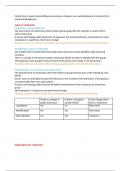
Conformity: a type of social influence involving a change in our social behaviour in order to fit in
and avoid disapproval
Types of conformity
Compliance: group acceptance
The lowest level of conformity which involves going along with the majority in order to fit in
with social norms.
A person will change public behaviour for approval, but private behaviour will remain the same.
Compliance is superficial, short-term change
Example: you’re in a boring conversation that you pretend to enjoy but actually not interested.
Identification: group membership
The middle level of conformity which takes place when the person identifies with the group
members.
There’s a change in the persons public and private beliefs in order to identify with the group.
This behaviour only changes in the presence of the group, the change is not permanent.
Example: while on duty police officers behave appropriately, when off duty they speed.
Internalisation: real acceptance of group norms
The deepest level of conformity where the beliefs of group become part of the individuals own
beliefs.
Occurs when an individual accepts the influence as the content of the behaviour of the group is
consistent with their own value system.
A person will change public and private beliefs and behaviour when in group and away from
group
Internalisation is a long-term and permanent change.
Example: a person whose atheist meets a Buddhist who changes them to Buddhism.
is there a change in Is there a change in Is the change short-
public behaviour? private beliefs term or long-term
compliance Yes no Short term
identification Yes Yes Short term
internalisation yes Yes Long term
Explanations for conformity
and avoid disapproval
Types of conformity
Compliance: group acceptance
The lowest level of conformity which involves going along with the majority in order to fit in
with social norms.
A person will change public behaviour for approval, but private behaviour will remain the same.
Compliance is superficial, short-term change
Example: you’re in a boring conversation that you pretend to enjoy but actually not interested.
Identification: group membership
The middle level of conformity which takes place when the person identifies with the group
members.
There’s a change in the persons public and private beliefs in order to identify with the group.
This behaviour only changes in the presence of the group, the change is not permanent.
Example: while on duty police officers behave appropriately, when off duty they speed.
Internalisation: real acceptance of group norms
The deepest level of conformity where the beliefs of group become part of the individuals own
beliefs.
Occurs when an individual accepts the influence as the content of the behaviour of the group is
consistent with their own value system.
A person will change public and private beliefs and behaviour when in group and away from
group
Internalisation is a long-term and permanent change.
Example: a person whose atheist meets a Buddhist who changes them to Buddhism.
is there a change in Is there a change in Is the change short-
public behaviour? private beliefs term or long-term
compliance Yes no Short term
identification Yes Yes Short term
internalisation yes Yes Long term
Explanations for conformity