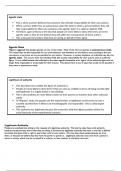
Agentic state
This is when a person believes that someone else will take responsibility for their own actions.
When a person shifts from an autonomous state (the state in which a person believes they will
take responsibility for their own actions) to the agentic state, it is called an Agentic Shift.
Therefore, agency theory is the idea that people are more likely to obey when they are in the
agentic state as they do not believe they will suffer the consequences of those actions.
This is because they believe that they are acting on behalf of their agent.
Legitimacy of authority
This describes how credible the figure of authority is.
People are more likely to obey them if they are seen as credible in terms of being morally right,
and legitimate (i.e. legally based or law abiding).
This is why students are more likely to listen to their parents or teachers than other unknown
adults.
In Milgram’s study, the people saw the experimenter as legitimate as they knew he was a
scientist and therefore is likely to be knowledgeable and responsible - this is called expert
authority.
This authority was legitimate because the researcher held the highest position within the
social hierarchy of the experimental scenario.
This is when a person believes that someone else will take responsibility for their own actions.
When a person shifts from an autonomous state (the state in which a person believes they will
take responsibility for their own actions) to the agentic state, it is called an Agentic Shift.
Therefore, agency theory is the idea that people are more likely to obey when they are in the
agentic state as they do not believe they will suffer the consequences of those actions.
This is because they believe that they are acting on behalf of their agent.
Legitimacy of authority
This describes how credible the figure of authority is.
People are more likely to obey them if they are seen as credible in terms of being morally right,
and legitimate (i.e. legally based or law abiding).
This is why students are more likely to listen to their parents or teachers than other unknown
adults.
In Milgram’s study, the people saw the experimenter as legitimate as they knew he was a
scientist and therefore is likely to be knowledgeable and responsible - this is called expert
authority.
This authority was legitimate because the researcher held the highest position within the
social hierarchy of the experimental scenario.