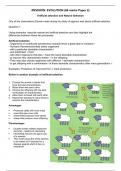
REVISION: EVOLUTION (66 marks Paper 2)
Artificial selection and Natural Selection
One of the observations Darwin made during his study of pigeons was about artificial selection.
Question 1
Using examples, describe natural and artificial selection and also highlight the
differences between these two processes.
Artificial selection
- Organisms of a particular species/any example show a great deal of variation√
- Humans√/farmers/scientists select organisms
- with a particular desirable characteristic√
- and interbreed √ them
- with other organisms that also √ have the same desirable characteristic
- to improve this characteristic further √ in the offspring
- They may also choose organisms with different √ desirable characteristics
- to get offspring with a combination√ of these desirable characteristics after many generations √
Examples: Production of improved fruit √/ meat production
Below is another example of artificial selection
1. Choose the animal or plants that
have the best characteristics
2. Breed them with each other
3. Choose the offspring with the best
combination of characteristics
4. Allow them to breed with each other
5. Repeat the procedure many times to
improve the characteristics
Advantages
Produced cattle with more meat
cows that give more milk
wheat that produces more seeds
sheep that produce more offspring
Disadvantages
Usually closely related organisms
are bred – leading to inbreeding
Inbreeding reduces the gene pool
of a species
This could cause the entire species
to be wiped out if exposed to a
disease against which it has no
resistance
,Natural Selection
Natural selection e.g. Finches √ / or any other example
- Organisms of a particular species (population) shows a great deal of variation√
- Most species produce a large number of offspring
- Some individuals may have characteristics such as small beak size √ that are favourable √
for the environmental conditions
- Others may have characteristics /any example that are unfavourable √
- These offspring compete √ with each other for food, shelter, etc.
- Offspring that have desirable features for obtaining these resources will survive √
- Selective pressure by the environment √ due to competition / changing environmental
conditions
- Organisms with favourable characteristics survive and reproduce √ to pass favourable
characteristics to their offspring √
- while organisms with unfavourable characteristics will die out √
- Over time the whole population will have this favourable trait √
- the gene pool of the population has changed √
VARIATION
Sources of variation
• Mutation
• Meiosis : - independent assortment / crossing – over
• Random mating
• Chance fertilization
, Question 2
Below is a sequence of diagrams (A, B and C) representing the changes
in a population of cactus plants on which bucks feed over a period of time.
A
thorns
B
C
2.1 Which evolutionary process is represented by the above diagrams? (1)
2.2 Using the information in the diagrams A, B and C above to
explain the process mentioned that took place over time. (8)
[9]
Memo
2.1 Natural selection (still the same species – one variation survive) (1)
2.2 population of cactus has variation/with and without thorns
cactus with thorns are not eaten by bucks reproduce and survive
cactus without thorns are eaten by bucks,die out
over time whole population has only cactus with thorns (8)
[9]
Artificial selection and Natural Selection
One of the observations Darwin made during his study of pigeons was about artificial selection.
Question 1
Using examples, describe natural and artificial selection and also highlight the
differences between these two processes.
Artificial selection
- Organisms of a particular species/any example show a great deal of variation√
- Humans√/farmers/scientists select organisms
- with a particular desirable characteristic√
- and interbreed √ them
- with other organisms that also √ have the same desirable characteristic
- to improve this characteristic further √ in the offspring
- They may also choose organisms with different √ desirable characteristics
- to get offspring with a combination√ of these desirable characteristics after many generations √
Examples: Production of improved fruit √/ meat production
Below is another example of artificial selection
1. Choose the animal or plants that
have the best characteristics
2. Breed them with each other
3. Choose the offspring with the best
combination of characteristics
4. Allow them to breed with each other
5. Repeat the procedure many times to
improve the characteristics
Advantages
Produced cattle with more meat
cows that give more milk
wheat that produces more seeds
sheep that produce more offspring
Disadvantages
Usually closely related organisms
are bred – leading to inbreeding
Inbreeding reduces the gene pool
of a species
This could cause the entire species
to be wiped out if exposed to a
disease against which it has no
resistance
,Natural Selection
Natural selection e.g. Finches √ / or any other example
- Organisms of a particular species (population) shows a great deal of variation√
- Most species produce a large number of offspring
- Some individuals may have characteristics such as small beak size √ that are favourable √
for the environmental conditions
- Others may have characteristics /any example that are unfavourable √
- These offspring compete √ with each other for food, shelter, etc.
- Offspring that have desirable features for obtaining these resources will survive √
- Selective pressure by the environment √ due to competition / changing environmental
conditions
- Organisms with favourable characteristics survive and reproduce √ to pass favourable
characteristics to their offspring √
- while organisms with unfavourable characteristics will die out √
- Over time the whole population will have this favourable trait √
- the gene pool of the population has changed √
VARIATION
Sources of variation
• Mutation
• Meiosis : - independent assortment / crossing – over
• Random mating
• Chance fertilization
, Question 2
Below is a sequence of diagrams (A, B and C) representing the changes
in a population of cactus plants on which bucks feed over a period of time.
A
thorns
B
C
2.1 Which evolutionary process is represented by the above diagrams? (1)
2.2 Using the information in the diagrams A, B and C above to
explain the process mentioned that took place over time. (8)
[9]
Memo
2.1 Natural selection (still the same species – one variation survive) (1)
2.2 population of cactus has variation/with and without thorns
cactus with thorns are not eaten by bucks reproduce and survive
cactus without thorns are eaten by bucks,die out
over time whole population has only cactus with thorns (8)
[9]