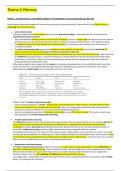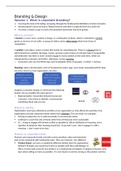
Summary MPI-1 2023/2024.
Summary consists of notes from the lectures, information from the slides and “Media Today” by
Joseph Turow.
CHAPTER 3 – THE BUSINESS OF MEDIA
● Five primary business activities of media
● Audience construction
● Financing models
● Funding when production in already complete
○ Direct sales | License fee | Rentals | Usage fee | Subscriptions | Advertising
Identifying an Audience for Mass Media Content
At the start of radio, there was no standardized and agreed upon way to measure the (invisible)
listening audience. Making the audience visible, audience research: asking listeners to respond
through mailing, telephone surveys, visiting listeners at home, …
“In order to persuade advertisers to buy time on their stations, (broadcasters) rely on audience
research to show how large their audiences is and, more important for many advertisers, who
the audience is”
No matter where it is based, no media business can exist (or continue to take in revenues)
without content that attracts consumers, or audiences—the people to whom mass media firms
are directing their products.
Audiences pose enormous risks as well as great opportunities for success for media
practitioners. To best manage these risks and increase their chances of success, practitioners
must carefully consider the following questions:
1. What should we think about our audience? How should we define our audience?
2. Will the material we are thinking of creating, distributing, or exhibiting to attract that audience
generate adequate revenues?
3. Were the people we thought would be attracted to our products in fact attracted to our
products? Why or why not?
Customer consumes product → decides to (continue being) subscribe(d) → company
acquires information about customer → information is categorized, customer is now
part of the ‘audience’ → what kind of materials will keep bringing this audience
back? → content is updated to fit desired audience’s needs → customer consumes
product → etc
In recent decades, companies have been quite targeted in their audience aims: they try to
appeal to particular segments of society rather than to the population as a whole.
,Audience construction in four broad ways:
● Demographics–age, gender, income, occupation, ethnicity, and race.
● Psychographics : ways of differentiating among people according to their
attitudes, personality types, and motivations. E.g., those who read a
magazine to compare, some who hunt ideas, and some who love luxury – one
of those is most likely to buy products → appeal to those more.
● Lifestyle categories : activities or hobbies like sports or travel that mark people as
different from others in the population at large.
● Behavioral information : tracking online behavior (time spent on site; products viewed;
clicks; etc)
Personalized Targeting: companies are bringing together demographic, psychographic,
lifestyle, and behavioral data regarding individual audience members. That allows executives to
offer their advertisers the ability to reach people who fit particular profiles that may interest them
Creating Content to Attract the Target Audience
A key challenge for mass media firms is knowing what kind of content to present to their target
audiences and how to present it. Although this may seem straightforward, it actually involves
quite a bit of selection, thought, and risk.
Track record: the previous successes or failures of a product, person, or organization
Market research – Research and development (R&D):
departments within companies that explore new ideas and generate new products and services,
systematically investigating potential sources of revenue through surveys, focus groups, or the
analysis of existing data.
Measuring success – Counting sales and audiences is a lot easier than determining why a
media product succeeded or failed
Subgenres of Advertisements
No matter what the medium, advertising practitioners speak about three broad subgenres of
advertisements:
• Informational ads: rely primarily on the recitation of facts about a product and the product’s
features to convince target consumers that it is the right product for them to purchase
• Hard-sell ads: messages that combine information about the product with intense attempts to
get the consumer to purchase it as soon as possible
• Soft-sell ads: aim mostly to create good feelings about the product or service by associating it
with music, personalities, or events that the creators of that product or service feel would appeal
to the target audience
Knowing how to use genres and their formulas to create materials that are popular with carefully
targeted audiences across multiple platforms is a highly valued skill in mass media industries
,Five primary business activities of media
Production • Distribution • Exhibition • Audience research • Finance
Production
A mass media production firm is a company that creates materials for circulation through one or
more mass media vehicles.
A company must consist of administrative personnel and creative personnel
Freelancers, from actors, to book editors, ghost writers, to cinematographers, have reported that
production companies have used this power (the competition among freelancers is extremely
high) to “borrow” innovative ideas discussed in job interviews, force them to work unusually long
hours, and withhold their due credits when the assignment is completed
Creating (mass) media products is a collaborative activity
Distribution
= the delivery of the produced material to the point where it will be shown to its intended
audience
without a distributor, a production firm’s media product would literally go nowhere.
Some people believe that the internet reduces the importance of publication and distribution
because just about anyone can post—that is, distribute—a collection of just about anything
online for very little cost. But putting things on a personal website or even on a backwater page
of a popular distributor such as YouTube or Facebook does not ensure that anyone but your
friends will go to it.
Powerful distributor: a firm that can ensure the media products it carries will end up in the best
locations at the best exhibitors to the best audience
Exhibition
= the activity of presenting mass media materials to audiences for viewing or purchase
Shelf space is the amount of area or time available for presenting products to consumers.
Book distribution firms that rely on stores to present their products to consumers must compete
furiously for shelf space. The distributors that wield the most power are those with products that
the stores need to have because consumers demand them. These distributors have more ability
to negotiate shelf space for new products than do distributors of goods that are not so important
to the stores.
Trade incentives—payments in cash, discounts, or publicity activities that provide a special
reason for an exhibitor to highlight a product—that could influence large stores to carry books.
, It is important to keep in mind that power over production, publication, and distribution is self-
reinforcing: creative personnel with strong track records are attracted to a production-and-
publishing firm, in part because it has powerful distribution. In turn, the company has powerful
distribution, in part because its production and publishing arms attract creative personnel with
strong track records.
Vertical integration: an organization’s control over a media product from production through
distribution to exhibition
Financing media
The cash coming into a mass media firm can be divided into two categories:
• Money to fund new production
• Money to pay for already-completed products
Funding New Productions
1. Taking out a loan – money borrowed from an organization, usually a bank, for a certain
price (a percentage of the loan called an interest rate)
2. Investment banks – companies that arrange to lend millions, even tens and hundreds of
millions, of dollars to companies and that also arrange stock offerings. Some specialize
in specific industries and are well aware of the specific risks.
Stock offerings selling units of ownership in the company, or shares of stock, to organizations
and individuals
Funding When Production Is Already Complete:
Profits: the amount of money brought in by the completed products (the revenues) minus
expenses
Direct sales: Consumer buys product and is free to use it however they want. For example,
college textbooks.
License fee: A person or organization pays the production firm or a separate distributor or
exhibitor for the use of a product, but the producer has ultimate control over the way it is used.
For example, a toy company may pay Warner Bros for the right to use the image of Bugs Bunny
on toy banks for five years.
Rentals: The production firm or a separate distributor or exhibitor charges for the right to employ
(read, view, or hear) a mass media product for a certain period of time and then gets the
product back. For example, with physical DVD rentals.
Usage fee: Usage Fee The amount the producer or the separate distributor or exhibitor charges
for a mass media product is based on the number of times the product is employed. For
Summary consists of notes from the lectures, information from the slides and “Media Today” by
Joseph Turow.
CHAPTER 3 – THE BUSINESS OF MEDIA
● Five primary business activities of media
● Audience construction
● Financing models
● Funding when production in already complete
○ Direct sales | License fee | Rentals | Usage fee | Subscriptions | Advertising
Identifying an Audience for Mass Media Content
At the start of radio, there was no standardized and agreed upon way to measure the (invisible)
listening audience. Making the audience visible, audience research: asking listeners to respond
through mailing, telephone surveys, visiting listeners at home, …
“In order to persuade advertisers to buy time on their stations, (broadcasters) rely on audience
research to show how large their audiences is and, more important for many advertisers, who
the audience is”
No matter where it is based, no media business can exist (or continue to take in revenues)
without content that attracts consumers, or audiences—the people to whom mass media firms
are directing their products.
Audiences pose enormous risks as well as great opportunities for success for media
practitioners. To best manage these risks and increase their chances of success, practitioners
must carefully consider the following questions:
1. What should we think about our audience? How should we define our audience?
2. Will the material we are thinking of creating, distributing, or exhibiting to attract that audience
generate adequate revenues?
3. Were the people we thought would be attracted to our products in fact attracted to our
products? Why or why not?
Customer consumes product → decides to (continue being) subscribe(d) → company
acquires information about customer → information is categorized, customer is now
part of the ‘audience’ → what kind of materials will keep bringing this audience
back? → content is updated to fit desired audience’s needs → customer consumes
product → etc
In recent decades, companies have been quite targeted in their audience aims: they try to
appeal to particular segments of society rather than to the population as a whole.
,Audience construction in four broad ways:
● Demographics–age, gender, income, occupation, ethnicity, and race.
● Psychographics : ways of differentiating among people according to their
attitudes, personality types, and motivations. E.g., those who read a
magazine to compare, some who hunt ideas, and some who love luxury – one
of those is most likely to buy products → appeal to those more.
● Lifestyle categories : activities or hobbies like sports or travel that mark people as
different from others in the population at large.
● Behavioral information : tracking online behavior (time spent on site; products viewed;
clicks; etc)
Personalized Targeting: companies are bringing together demographic, psychographic,
lifestyle, and behavioral data regarding individual audience members. That allows executives to
offer their advertisers the ability to reach people who fit particular profiles that may interest them
Creating Content to Attract the Target Audience
A key challenge for mass media firms is knowing what kind of content to present to their target
audiences and how to present it. Although this may seem straightforward, it actually involves
quite a bit of selection, thought, and risk.
Track record: the previous successes or failures of a product, person, or organization
Market research – Research and development (R&D):
departments within companies that explore new ideas and generate new products and services,
systematically investigating potential sources of revenue through surveys, focus groups, or the
analysis of existing data.
Measuring success – Counting sales and audiences is a lot easier than determining why a
media product succeeded or failed
Subgenres of Advertisements
No matter what the medium, advertising practitioners speak about three broad subgenres of
advertisements:
• Informational ads: rely primarily on the recitation of facts about a product and the product’s
features to convince target consumers that it is the right product for them to purchase
• Hard-sell ads: messages that combine information about the product with intense attempts to
get the consumer to purchase it as soon as possible
• Soft-sell ads: aim mostly to create good feelings about the product or service by associating it
with music, personalities, or events that the creators of that product or service feel would appeal
to the target audience
Knowing how to use genres and their formulas to create materials that are popular with carefully
targeted audiences across multiple platforms is a highly valued skill in mass media industries
,Five primary business activities of media
Production • Distribution • Exhibition • Audience research • Finance
Production
A mass media production firm is a company that creates materials for circulation through one or
more mass media vehicles.
A company must consist of administrative personnel and creative personnel
Freelancers, from actors, to book editors, ghost writers, to cinematographers, have reported that
production companies have used this power (the competition among freelancers is extremely
high) to “borrow” innovative ideas discussed in job interviews, force them to work unusually long
hours, and withhold their due credits when the assignment is completed
Creating (mass) media products is a collaborative activity
Distribution
= the delivery of the produced material to the point where it will be shown to its intended
audience
without a distributor, a production firm’s media product would literally go nowhere.
Some people believe that the internet reduces the importance of publication and distribution
because just about anyone can post—that is, distribute—a collection of just about anything
online for very little cost. But putting things on a personal website or even on a backwater page
of a popular distributor such as YouTube or Facebook does not ensure that anyone but your
friends will go to it.
Powerful distributor: a firm that can ensure the media products it carries will end up in the best
locations at the best exhibitors to the best audience
Exhibition
= the activity of presenting mass media materials to audiences for viewing or purchase
Shelf space is the amount of area or time available for presenting products to consumers.
Book distribution firms that rely on stores to present their products to consumers must compete
furiously for shelf space. The distributors that wield the most power are those with products that
the stores need to have because consumers demand them. These distributors have more ability
to negotiate shelf space for new products than do distributors of goods that are not so important
to the stores.
Trade incentives—payments in cash, discounts, or publicity activities that provide a special
reason for an exhibitor to highlight a product—that could influence large stores to carry books.
, It is important to keep in mind that power over production, publication, and distribution is self-
reinforcing: creative personnel with strong track records are attracted to a production-and-
publishing firm, in part because it has powerful distribution. In turn, the company has powerful
distribution, in part because its production and publishing arms attract creative personnel with
strong track records.
Vertical integration: an organization’s control over a media product from production through
distribution to exhibition
Financing media
The cash coming into a mass media firm can be divided into two categories:
• Money to fund new production
• Money to pay for already-completed products
Funding New Productions
1. Taking out a loan – money borrowed from an organization, usually a bank, for a certain
price (a percentage of the loan called an interest rate)
2. Investment banks – companies that arrange to lend millions, even tens and hundreds of
millions, of dollars to companies and that also arrange stock offerings. Some specialize
in specific industries and are well aware of the specific risks.
Stock offerings selling units of ownership in the company, or shares of stock, to organizations
and individuals
Funding When Production Is Already Complete:
Profits: the amount of money brought in by the completed products (the revenues) minus
expenses
Direct sales: Consumer buys product and is free to use it however they want. For example,
college textbooks.
License fee: A person or organization pays the production firm or a separate distributor or
exhibitor for the use of a product, but the producer has ultimate control over the way it is used.
For example, a toy company may pay Warner Bros for the right to use the image of Bugs Bunny
on toy banks for five years.
Rentals: The production firm or a separate distributor or exhibitor charges for the right to employ
(read, view, or hear) a mass media product for a certain period of time and then gets the
product back. For example, with physical DVD rentals.
Usage fee: Usage Fee The amount the producer or the separate distributor or exhibitor charges
for a mass media product is based on the number of times the product is employed. For