Aromatic Chemistry
27.1 Introduction to arenes:
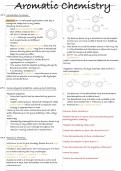
Benzene: an unsaturated hydrocarbon that has a
hexagonal shape and is very stable.
Bonding and structure-
• has a planer hexagonal shape with
each carbon molecule at a 120°
• All the C-C bonds are the same
length, although normally double 1. The electron dense ring is attracted to the electrophile
and single bonds are different (nitronium ion) and so dative bonds to it, breaking
lengths. the ring
• Has a delocalised ring of electrons, from the 4th 2. This bonds to one of the carbon atoms in the ring, the
electron in the p-orbital. They form a delocalised C-H bond breaks and the electrons reform the ring to
electron density above and below the ring which make the compound stable again
keeps the molecule stable. 3. the H+ ion is the leaving group, produces
Thermochemistry evidence of stability- nitobenzene
• the enthaply change fro 1 double bond in Used in explosives and as chemical feedstock for aromatic
cyclohexane is -120KJmol-1 amines
• This means that the expected enthalpy change for
benzene should be -360KJmol-1 Acylation reactions, the acyl chlorides react to form a
• It is actually -208KJmol-1 RCO electrophile.
The difference of 152KJmol-1 shows benzene is more RCOCl + AlCl3 —-> RCO+ + AlCl4-
stable and so requires more energy to add hydrogen
across the double bond.
27.2 Arenes-physical properties, naming and reactivity:
Physical properties 1. The electrons in the delocalised ring are attracted to
• colourless liquid, has the same boiling point as the electrophile and so dative bond
hexane 2. The delocalised ring is broken and unstable so the
• Higher melting point, the planar hexagonal shape carbon atom breaks the C-H bond so it can reform
packs together whilst solid and so requires more 3. Produces an acyl-substituted arene
energy to separate them to melt
Naming, has the main root benzene and will add a Common Exam Questions:
prefix depending on the group added eg. Halo, alkyl,
nitro “Explain benzene in terms of structure,bonding and
Reactivity thermodynamic stability.”
• attacked by electrophiles due to electron dense ring
• The ring is very stable due to the delocalised “Explain the stability of benzene”
electrons and so won’t change throughout the
reaction, mostly substitution mechanisms. “What’s the reaction to form the nitronium ion?”
“Draw the mechanism to form nitrobenzene”
27.3 Reactions of arenes:
“What’s the reaction to form RCO+?”
Will burn in air to give Smokey flames due to a high
carbon:hydrogen ratio. “Draw the mechanism for the acylation of benzene”
Nitration, the substitution of a NO2 group to a H atom
on a carbon leaving the ring unchanged. “Name the arene”
H2SO4 + HNO3 —> H2NO3+ + HSO4-
H2NO3+ —> NO2+ + H2O “What’s the name of the mechanism?”
Sulphuric acid is a stronger acid and so nitric acid
behaves as a base, then dissociates into water and the
nitronium ion.
27.1 Introduction to arenes:
Benzene: an unsaturated hydrocarbon that has a
hexagonal shape and is very stable.
Bonding and structure-
• has a planer hexagonal shape with
each carbon molecule at a 120°
• All the C-C bonds are the same
length, although normally double 1. The electron dense ring is attracted to the electrophile
and single bonds are different (nitronium ion) and so dative bonds to it, breaking
lengths. the ring
• Has a delocalised ring of electrons, from the 4th 2. This bonds to one of the carbon atoms in the ring, the
electron in the p-orbital. They form a delocalised C-H bond breaks and the electrons reform the ring to
electron density above and below the ring which make the compound stable again
keeps the molecule stable. 3. the H+ ion is the leaving group, produces
Thermochemistry evidence of stability- nitobenzene
• the enthaply change fro 1 double bond in Used in explosives and as chemical feedstock for aromatic
cyclohexane is -120KJmol-1 amines
• This means that the expected enthalpy change for
benzene should be -360KJmol-1 Acylation reactions, the acyl chlorides react to form a
• It is actually -208KJmol-1 RCO electrophile.
The difference of 152KJmol-1 shows benzene is more RCOCl + AlCl3 —-> RCO+ + AlCl4-
stable and so requires more energy to add hydrogen
across the double bond.
27.2 Arenes-physical properties, naming and reactivity:
Physical properties 1. The electrons in the delocalised ring are attracted to
• colourless liquid, has the same boiling point as the electrophile and so dative bond
hexane 2. The delocalised ring is broken and unstable so the
• Higher melting point, the planar hexagonal shape carbon atom breaks the C-H bond so it can reform
packs together whilst solid and so requires more 3. Produces an acyl-substituted arene
energy to separate them to melt
Naming, has the main root benzene and will add a Common Exam Questions:
prefix depending on the group added eg. Halo, alkyl,
nitro “Explain benzene in terms of structure,bonding and
Reactivity thermodynamic stability.”
• attacked by electrophiles due to electron dense ring
• The ring is very stable due to the delocalised “Explain the stability of benzene”
electrons and so won’t change throughout the
reaction, mostly substitution mechanisms. “What’s the reaction to form the nitronium ion?”
“Draw the mechanism to form nitrobenzene”
27.3 Reactions of arenes:
“What’s the reaction to form RCO+?”
Will burn in air to give Smokey flames due to a high
carbon:hydrogen ratio. “Draw the mechanism for the acylation of benzene”
Nitration, the substitution of a NO2 group to a H atom
on a carbon leaving the ring unchanged. “Name the arene”
H2SO4 + HNO3 —> H2NO3+ + HSO4-
H2NO3+ —> NO2+ + H2O “What’s the name of the mechanism?”
Sulphuric acid is a stronger acid and so nitric acid
behaves as a base, then dissociates into water and the
nitronium ion.