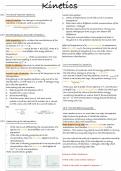
Kinetics
18.1 The rate of chemical reactions: Initial rate method-
1. Series of experiments is carried out at a constant
Rate of reaction: the change in concentration of temperature
reactants or products with a unit of time. 2. Each start with a different initial concentration of the
Rate = Change in concentration reactants / catalyst
Time 3. Between experiments the concentration of only one
species changes per time so you can observe the
18.2 the rate expression and order of reaction: difference
4. Then plot a concentration-time graph and draw a
Rate expression: tells us about the contributions of the tangent at 0, the gradient represents the initial rate.
species that affect the rate of reaction.
In reaction X + Y —-> Z effect of temperature of k, small changes in temperature
The rate expression would be rate = k[X][Y], where k is has a big effect on k, for every increase of 10K the rate of
the rate constant and differs with every reaction / reaction doubles if everything is in 1st order, this is
temperature. because of the effect of temperature on the maxwell-
Found experimentally , if the concentration of Y was Boltzmann distribution.
being used more readily it would have a power to
indicate this, [Y]^2
Order or reaction: the power to which the concentration of 18.4 The Arrhenius equation:
that species is raised in the rate expression. No power =
1st order, power of 2 is 2nd order etc. The fraction of molecules with the energy greater than
Overall order of reaction: the sum of all the powers in the the activation energy is given by e^(-EA/RT)
rate equation. Can also be linked to the rate equation such as:
Everything in the symbol equation may not be in the Easier to calculate with logs, the equation changes to be
rate equation, in that case it is 0 order. A catalyst may lnK = -Ea x 1 + lnA
be in the rate equation. R T
Calculating the rate constant- When you plot a graph of lnK against 1/T, it produces a
1. Rearrange the rate expression for k straight line. -Ea/R is the gradient of the line which you
2. Substitute in your values can use to find the value of the activation energy.
3. Solve accordingly Increasing temperature, means there’ll be more particles
4. Find the units, each [conc.] will have units per 10^10 with the activation energy almost doubling
moldm-3 and the rate will be moldm-3s-1, cancel with every 10K rise.
out the units until left with k’s unit of measure.
Eg.
18.5 The rate determining step:
Most reactions occur in more than one step, the separate
steps to form the products is called the reaction
mechanism, producing many intermediates which give
18.3 Determining the rate equation: information about the mechanism.
Rate determining step: the slowest step in the reaction
• if the rate is not affected by the concentration of a mechanism and therefore determines the rate of the
species it’s 0 order and therefore not in the rate reaction. This means any species involved before or during
expression the rate determining step may be in the rate expression.
• If the rate is directly proportional to the
concentration than its 1st order, appears as [X] in You can look at the order of a reaction to see which would be
rate expression the rate determine step, if the rate depends on many
• If the rate is directly proportional to the square of the concentrations of reactants / catalysts identify which
concentration than it’s 2nd order and appear as equation would satisfy that idea.
[X]^2 in the rate expression.
Rate-concentration graphs-
Common Exam Questions:
“What order is the overall reaction?
“What is the order in respect to element..?”
18.1 The rate of chemical reactions: Initial rate method-
1. Series of experiments is carried out at a constant
Rate of reaction: the change in concentration of temperature
reactants or products with a unit of time. 2. Each start with a different initial concentration of the
Rate = Change in concentration reactants / catalyst
Time 3. Between experiments the concentration of only one
species changes per time so you can observe the
18.2 the rate expression and order of reaction: difference
4. Then plot a concentration-time graph and draw a
Rate expression: tells us about the contributions of the tangent at 0, the gradient represents the initial rate.
species that affect the rate of reaction.
In reaction X + Y —-> Z effect of temperature of k, small changes in temperature
The rate expression would be rate = k[X][Y], where k is has a big effect on k, for every increase of 10K the rate of
the rate constant and differs with every reaction / reaction doubles if everything is in 1st order, this is
temperature. because of the effect of temperature on the maxwell-
Found experimentally , if the concentration of Y was Boltzmann distribution.
being used more readily it would have a power to
indicate this, [Y]^2
Order or reaction: the power to which the concentration of 18.4 The Arrhenius equation:
that species is raised in the rate expression. No power =
1st order, power of 2 is 2nd order etc. The fraction of molecules with the energy greater than
Overall order of reaction: the sum of all the powers in the the activation energy is given by e^(-EA/RT)
rate equation. Can also be linked to the rate equation such as:
Everything in the symbol equation may not be in the Easier to calculate with logs, the equation changes to be
rate equation, in that case it is 0 order. A catalyst may lnK = -Ea x 1 + lnA
be in the rate equation. R T
Calculating the rate constant- When you plot a graph of lnK against 1/T, it produces a
1. Rearrange the rate expression for k straight line. -Ea/R is the gradient of the line which you
2. Substitute in your values can use to find the value of the activation energy.
3. Solve accordingly Increasing temperature, means there’ll be more particles
4. Find the units, each [conc.] will have units per 10^10 with the activation energy almost doubling
moldm-3 and the rate will be moldm-3s-1, cancel with every 10K rise.
out the units until left with k’s unit of measure.
Eg.
18.5 The rate determining step:
Most reactions occur in more than one step, the separate
steps to form the products is called the reaction
mechanism, producing many intermediates which give
18.3 Determining the rate equation: information about the mechanism.
Rate determining step: the slowest step in the reaction
• if the rate is not affected by the concentration of a mechanism and therefore determines the rate of the
species it’s 0 order and therefore not in the rate reaction. This means any species involved before or during
expression the rate determining step may be in the rate expression.
• If the rate is directly proportional to the
concentration than its 1st order, appears as [X] in You can look at the order of a reaction to see which would be
rate expression the rate determine step, if the rate depends on many
• If the rate is directly proportional to the square of the concentrations of reactants / catalysts identify which
concentration than it’s 2nd order and appear as equation would satisfy that idea.
[X]^2 in the rate expression.
Rate-concentration graphs-
Common Exam Questions:
“What order is the overall reaction?
“What is the order in respect to element..?”