

Week 1
1.In which type of tests will differences between individuals be considered as noise?
A) Differential psychology
B) Experimental psychology
C) In both differential and experimental psychology
D) In neither of the two
2. John goes to the eye doctor. He is told his eyesight is -2 in his left eye. This is an example
of:
A) Relative scaling
B) Absolute scaling
C) Relative norming
D) Absolute norming
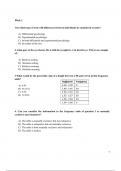
3.What would be the percentile rank of a height between 1.58 and 1.63 m in this frequency
table?
A) 0.93
B) 93.18 %
C) 0.72
D) 72.59%
4. Can you consider the information in the frequency table of question 3 as mutually
exclusive and exhaustive?
A) The table is mutually exclusive but not exhaustive
B) The table is exhaustive but not mutually exclusive
C) The table is both mutually exclusive and exhaustive
D) The table is neither
1
, Week 2
5. What is not an assumption about error in the CTT?
A) The mean error in the population is always 0
B) Errors always cancel each other out completely
C) Errors are uncorrelated with the true scores
D) Errors are uncorrelated with errors in other samples or subjects
6. In which type of reliability estimation test is the Spearman-Brown formula used?
A) The test-retest method
B) The split-half method
C) The alternate forms method
D) In none of the above
7. Which is true?
1. Split- half tests can be used to measure internal consistency
2. Parallelity is more important in alternate form tests than in split-half tests
A) 1 is true, 2 is false
A) 2 is true, 1 is false
B) Both are true
C) Both are false
8. A test to measure motivation in university has a true score variance of 30 and an error
variance of 50. What would be the reliability of the test?
A) 80
B) 37.5
C) 0.375
D) 0.80
2
1.In which type of tests will differences between individuals be considered as noise?
A) Differential psychology
B) Experimental psychology
C) In both differential and experimental psychology
D) In neither of the two
2. John goes to the eye doctor. He is told his eyesight is -2 in his left eye. This is an example
of:
A) Relative scaling
B) Absolute scaling
C) Relative norming
D) Absolute norming
3.What would be the percentile rank of a height between 1.58 and 1.63 m in this frequency
table?
A) 0.93
B) 93.18 %
C) 0.72
D) 72.59%
4. Can you consider the information in the frequency table of question 3 as mutually
exclusive and exhaustive?
A) The table is mutually exclusive but not exhaustive
B) The table is exhaustive but not mutually exclusive
C) The table is both mutually exclusive and exhaustive
D) The table is neither
1
, Week 2
5. What is not an assumption about error in the CTT?
A) The mean error in the population is always 0
B) Errors always cancel each other out completely
C) Errors are uncorrelated with the true scores
D) Errors are uncorrelated with errors in other samples or subjects
6. In which type of reliability estimation test is the Spearman-Brown formula used?
A) The test-retest method
B) The split-half method
C) The alternate forms method
D) In none of the above
7. Which is true?
1. Split- half tests can be used to measure internal consistency
2. Parallelity is more important in alternate form tests than in split-half tests
A) 1 is true, 2 is false
A) 2 is true, 1 is false
B) Both are true
C) Both are false
8. A test to measure motivation in university has a true score variance of 30 and an error
variance of 50. What would be the reliability of the test?
A) 80
B) 37.5
C) 0.375
D) 0.80
2


