Part 3: Cell membrane structure
LO:
2 main types of cells:
• Gain a basic understanding of cell membrane structure
(components how they work together)
2 main types of cells:
1. Prokaryotic cell – does not contain nuclei or any organelles.
e.g. bacteria
2. Eukaryotic cell – does contain a nucleus and organelles. e.g., many of the cells found
in the human body including nerve cells, bone cell, muscle cells, red blood cells, skin
cells etc.
We will be looking into the eukaryotic cells in terms of cell
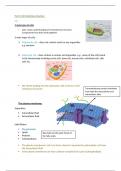
membrane structure Transmembrane protein orientates
from both the extracellular and
intracellular sides.
The plasma membrane:
Separation
Intracellular fluid
Extracellular fluid
Lipid bilayer
Phospholipids
Lipids Blue balls are the polar heads of
Proteins the fatty acids.
Carbohydrates
The plasma membrane’s role is to form a barrier/ separate the extracellular cell from
the intracellular fluid.
In the plasma membrane we have a bilayer comprised of a pair of phospholipids.
, Phospholipids facing outwards and due to the polarity of phosphate groups, the
polar heads facing inwards and fatty acid tails facing inwards – bilayer.
Bilar is roughly around 7 nm. 1 nm is 1 million of a millimetre.
Image of a plasma membrane in an electron microscope, we can see a tri-layer.
The first layer is the phospholipids heads on the extracellular cell.
the second layer is the phospholipids heads in the intracellular cells.
The fatty acids tails inside
Components in the plasma membrane:
Phospholipids.
Polar heads. They are hydrophilic (water-loving) that’s why they form outwards
towards the extracellular and intracellular fluids.
2 non-polar fatty acid tails which face inwards (orientated inwards) as they are
hydrophobic (water-hating).
Lipids are integrated within the plasma membrane; they strengthen and give
structure to the plasma membrane.
Proteins are scattered throughout the plasma membrane and can be attached to
both the extracellular and intracellular sides depending on which way they are
facing.
Carbohydrates within the plasma membrane play a role in terms of cell signalling. If
carbs are attached to lipids, they are glycolipids & if they are attached to a protein,
they are regarded as glycoproteins.
Phospholipids are flexible in terms of orientation; capable of moving left to right and
rotating. They give some flexibility to the cell membrane. So, to compensate for the fluidity
of the phospholipids, the lipids provide some structure & strength.
LO:
2 main types of cells:
• Gain a basic understanding of cell membrane structure
(components how they work together)
2 main types of cells:
1. Prokaryotic cell – does not contain nuclei or any organelles.
e.g. bacteria
2. Eukaryotic cell – does contain a nucleus and organelles. e.g., many of the cells found
in the human body including nerve cells, bone cell, muscle cells, red blood cells, skin
cells etc.
We will be looking into the eukaryotic cells in terms of cell
membrane structure Transmembrane protein orientates
from both the extracellular and
intracellular sides.
The plasma membrane:
Separation
Intracellular fluid
Extracellular fluid
Lipid bilayer
Phospholipids
Lipids Blue balls are the polar heads of
Proteins the fatty acids.
Carbohydrates
The plasma membrane’s role is to form a barrier/ separate the extracellular cell from
the intracellular fluid.
In the plasma membrane we have a bilayer comprised of a pair of phospholipids.
, Phospholipids facing outwards and due to the polarity of phosphate groups, the
polar heads facing inwards and fatty acid tails facing inwards – bilayer.
Bilar is roughly around 7 nm. 1 nm is 1 million of a millimetre.
Image of a plasma membrane in an electron microscope, we can see a tri-layer.
The first layer is the phospholipids heads on the extracellular cell.
the second layer is the phospholipids heads in the intracellular cells.
The fatty acids tails inside
Components in the plasma membrane:
Phospholipids.
Polar heads. They are hydrophilic (water-loving) that’s why they form outwards
towards the extracellular and intracellular fluids.
2 non-polar fatty acid tails which face inwards (orientated inwards) as they are
hydrophobic (water-hating).
Lipids are integrated within the plasma membrane; they strengthen and give
structure to the plasma membrane.
Proteins are scattered throughout the plasma membrane and can be attached to
both the extracellular and intracellular sides depending on which way they are
facing.
Carbohydrates within the plasma membrane play a role in terms of cell signalling. If
carbs are attached to lipids, they are glycolipids & if they are attached to a protein,
they are regarded as glycoproteins.
Phospholipids are flexible in terms of orientation; capable of moving left to right and
rotating. They give some flexibility to the cell membrane. So, to compensate for the fluidity
of the phospholipids, the lipids provide some structure & strength.