Anatomy -> See corresponding documents
Physiology - Overview
- Male Hormones
- Testosterone
- High testosterone -> hair loss on head, hair growth in pubic region, chest
- More FGF stimulation
- DHT (dihydrotestosterone)
- Definition: main androgen
- Formation
- 2 5 alpha reductase: found in stromal cells
- 1 5 alpha reductase: found in peripheral organs (liver, skin)
- Function:
- Bind to nuclear androgen receptor in stromal/epithelial prostate
cells
- Higher affinity than testosterone
- Stimulates transcription of androgen-dependent genes (ie. GFs)
- FGF, TGF b
- FGFs: produced by stromal cells, paracrine regulator androgen-
stimulated epithelial development in embryonic and adulthood
prostatic development
- TGF-b: produced by peripheral organs ; mitogen for fibroblasts,
mesenchymal cells ; inhibits epithelial proliferation
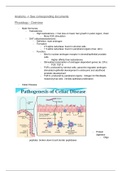
- Celiac Disease
- Protein
digestion
- Oligo
peptides: broken down brush border peptidases
, - Peptides: enter enterocytes via secondary active transport with H+ with a
transmembrane protein
- Amino acid: enter enterocytes via secondary active transport with Na+ or via
facilitated diffusion
- Cytoplasm: cytosolic peptidases with break down remaining peptides
- Adipose tissue
- Take in: androgens
- Produce:
- Leptin
- Adipokines
- Estrogen
- Effects
- Hyperinsulinemia
- Decrease insulin sensitivity
- Decrease IGF-like binding proteins
- Decrease adiponectin
- Decrease in sex-hormone binding proteins
- Diarrhea
- Types
- Osmotic
- Higher osmotic concentration in feces than in serum
- More fluid drawn into colon than reabsorptive capacity
- Linked to malabsorption
- Lactose intolerance
- Gluten intolerance
- Steatorrhea
- Motility
- Stimulated parasympathetically ; inhibited sympathetically
- Segmentation and peristalsis
- Migrating motor complex initiates peristaltic waves of 2ft/90mins in
small intestine
- Regulated by motilin
- Haustral contraction in the colon occur every 30 min
- Slow motility allows for sufficient absorption
- Secretory
- Bloody/inflammatory
- Smooth muscle contraction
- Characteristics: no striations, no orderly sarcomeres, negligible amounts of
troponin, lots of actin compared to myosin
- Thin filaments anchored to dense bodies attached to next filament
network
- Membranes of adjacent cells have gap junctions -> nexus for action
potential = synchronous contraction
- Contraction
- Pacemaker cell -> action potential -> nexus -> smooth muscle
, - In resting muscles: low intracellular Ca2+ and actin and myosin do not
interact
- Phasic: AP opens voltage dependent Ca2+ channels -> influx of Ca2+
down gradient
- Ca2+ binds to calmodulin -> kinase activation on light chain, and
myosin in thick filament -> catalyses phosphorylation of myosin of
myosin (via dephosphorylation of ATP) -> phosphorylated myosin
binds to actin -> ATP split to move across bridges, myofilaments
slide past each other => contraction
- Myosin deactivated by dephosphorylation = ADP phosphorylated
back to ATP
- Acute pancreatitis
- Autodigestion of pancreatic organ by inappropriately activated pancreatic
enzymes
- Activation of trypsin by 3 pathways
, The
GI
Tract
Celiac Disease
1. Definition
- Definition: gluten sensitive enteropathy and nontropical sprue
- Proximal to distal distribution: severity diminishes distally reflecting exposure of
intestinal mucosa to dietary gluten
- Epidemiology
- 1/113 in the US ; increased incidence over 50 years
- Most patients have atypical presentations
- Etiology
- Immune disorder: triggered by environmental agent (gliadin component of gluten)
in genetically predisposed individuals
- Genetic factors: HLA-DQ2 gene loci
- Contributes to > ⅓ of the disease
- Pathophysiology
- Transglutaminase:
- Ubiquitous intracellular enzyme
Physiology - Overview
- Male Hormones
- Testosterone
- High testosterone -> hair loss on head, hair growth in pubic region, chest
- More FGF stimulation
- DHT (dihydrotestosterone)
- Definition: main androgen
- Formation
- 2 5 alpha reductase: found in stromal cells
- 1 5 alpha reductase: found in peripheral organs (liver, skin)
- Function:
- Bind to nuclear androgen receptor in stromal/epithelial prostate
cells
- Higher affinity than testosterone
- Stimulates transcription of androgen-dependent genes (ie. GFs)
- FGF, TGF b
- FGFs: produced by stromal cells, paracrine regulator androgen-
stimulated epithelial development in embryonic and adulthood
prostatic development
- TGF-b: produced by peripheral organs ; mitogen for fibroblasts,
mesenchymal cells ; inhibits epithelial proliferation
- Celiac Disease
- Protein
digestion
- Oligo
peptides: broken down brush border peptidases
, - Peptides: enter enterocytes via secondary active transport with H+ with a
transmembrane protein
- Amino acid: enter enterocytes via secondary active transport with Na+ or via
facilitated diffusion
- Cytoplasm: cytosolic peptidases with break down remaining peptides
- Adipose tissue
- Take in: androgens
- Produce:
- Leptin
- Adipokines
- Estrogen
- Effects
- Hyperinsulinemia
- Decrease insulin sensitivity
- Decrease IGF-like binding proteins
- Decrease adiponectin
- Decrease in sex-hormone binding proteins
- Diarrhea
- Types
- Osmotic
- Higher osmotic concentration in feces than in serum
- More fluid drawn into colon than reabsorptive capacity
- Linked to malabsorption
- Lactose intolerance
- Gluten intolerance
- Steatorrhea
- Motility
- Stimulated parasympathetically ; inhibited sympathetically
- Segmentation and peristalsis
- Migrating motor complex initiates peristaltic waves of 2ft/90mins in
small intestine
- Regulated by motilin
- Haustral contraction in the colon occur every 30 min
- Slow motility allows for sufficient absorption
- Secretory
- Bloody/inflammatory
- Smooth muscle contraction
- Characteristics: no striations, no orderly sarcomeres, negligible amounts of
troponin, lots of actin compared to myosin
- Thin filaments anchored to dense bodies attached to next filament
network
- Membranes of adjacent cells have gap junctions -> nexus for action
potential = synchronous contraction
- Contraction
- Pacemaker cell -> action potential -> nexus -> smooth muscle
, - In resting muscles: low intracellular Ca2+ and actin and myosin do not
interact
- Phasic: AP opens voltage dependent Ca2+ channels -> influx of Ca2+
down gradient
- Ca2+ binds to calmodulin -> kinase activation on light chain, and
myosin in thick filament -> catalyses phosphorylation of myosin of
myosin (via dephosphorylation of ATP) -> phosphorylated myosin
binds to actin -> ATP split to move across bridges, myofilaments
slide past each other => contraction
- Myosin deactivated by dephosphorylation = ADP phosphorylated
back to ATP
- Acute pancreatitis
- Autodigestion of pancreatic organ by inappropriately activated pancreatic
enzymes
- Activation of trypsin by 3 pathways
, The
GI
Tract
Celiac Disease
1. Definition
- Definition: gluten sensitive enteropathy and nontropical sprue
- Proximal to distal distribution: severity diminishes distally reflecting exposure of
intestinal mucosa to dietary gluten
- Epidemiology
- 1/113 in the US ; increased incidence over 50 years
- Most patients have atypical presentations
- Etiology
- Immune disorder: triggered by environmental agent (gliadin component of gluten)
in genetically predisposed individuals
- Genetic factors: HLA-DQ2 gene loci
- Contributes to > ⅓ of the disease
- Pathophysiology
- Transglutaminase:
- Ubiquitous intracellular enzyme