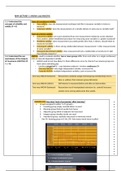
Psychodynamic
Approaches in psychology
The role of the unconscious- our mind Assumes - internal mental processes can be studied using inference, the mind is like a computer
has three layers our pre conscious, Role of schema - beliefs and expectations that affect thoughts and behaviour. Mental shortcut, leads to perceptual
conscious and unconscious errors, developed through experience.
l
Psychosexual stages - oral, anal, Information processing approach, mind is like a computer and can be applied to AI
phallic, latency, genital Neuroscience - scientific study of how brain structures affect mental process. Brain imaging (FMRI), biological
structural model of the personality structures link to mental states.
Id - pleasure principle Scientific methods- reliable, objective data
ego - reality principle Real-world application, AI and eyewitness testimony
Machine reductionism - ignores influence of emotion
superego- morality principle Low ecological validity - artificial stimuli and inference
Defence mechanisms - repression, Soft determinsim
denial and displacement
Evaluation Behaviourist
Humanistic Real world application - new Assumes - only observable behaviour needs to be studies, basic processes are the same in all species
Classical conditioning - Pavlov- research on salivation in dogs. Association of UCS with NS to produce
Free will - people are active agents therapy (psychoanalysis), talking the new CS and CR
and self determining therapies Operant conditioning - Skinner- research of rats and pigeons in Skinner box
Maslow’s hierarchy of needs- 5 Untestable concepts - the
Animal operates the environment + behaviour is shaped through reinforcement and punishment
levels: physiological, safety, love, Social learning theory
unconscious, lack of empirical
self-esteem and self actualisation Assumes - behaviour is learned from experience
evidence
Congruence - personal growth Vicarious reinforcement - observation leads to imitation if behaviour is vicariously
requires congruence between the Psychic determinism - ignores reinforced
self and ideal self free will Mediational processes- attention, retention, motor reproduction and motivation
Counsellors should be genuine, Identification - we are more likely to imitate people we identify with
empathetic and give unconditional
positive regard Evaluation Evaluation
Not reductionist - holsim Well controlled research - behaviour is broken down into stimulus-response units
Lacks empirical evidence
Real-world application - use of token economy systems in prisons and psychiatric
Culturally biased -
institutions
individualism
Environmental determinism - Ignores free will and conscious decision making
Positive approach
Ethical issues - Animal testing used for research
Little practical application
SLT
Cognitive factors - more comprehensive account of learning compared to
behaviourist approach
Biological Underestimates influence of biology
Lab studies - Demand characteristics (bobo doll experiment)
Assumes- the mind and body are one and the
same Real-world application - can account for the development of cultural differences
Thought and behaviour depend on
chemicals
Concordance between DZ and MZ twins
shows genetic basis of psychological Biopsychology
characteristics The nervous system- a specialised network of cells,, fast-acting, electrical and chemical, internal
Genotype and phenotype - genes vs communication system
expression of genes in the environment Central nervous system - brain is divided into hemispheres, cerebral cortex (3mm thick) outer
Natural selection of genes based of layer
spinal cord connects the brain to PNS, reflexes
survival odds are how we’ve evolved
Peripheral nervous system: Automatic nervous system - governs vital functions
Somatic nervous system - muscle movement, sensory information
Evaluation Endocrine system - Glands produce hormones
Hormones are distributed in the bloodstream
Pituitary is the master gland
Real-world application - understanding of Sympathetic arousal - hypothalamus + pituitary -> adrenal gland -> adrenaline
biochemical processes is associated with the Adrenaline leads to increased heart rate, faster breathing, sweating, inhibits digestion
development of psychoactive drugs Parasympathetic state - once a threat has passed the body returns to rest and digests
Sensory neuron- PNS to CNS, long dendrites, short axons
Scientific methods- precise and objective
Relay - sensory to motor or other, short-short
methods e.g scanning techniques like FMRI Motor - CNS to effectors, short-long
Biolocial determinism - oversimplification, Synapse - neurons are separated by a very tiny gap
ignores free will Neurotransmitter released from synaptic vesicle into synapse, taken up by postsynaptic receptor
Natural selection - some claim cannot be site on receiving dendrite
Neurotransmitters have specialist functions
falsifies, fossil records support the theory Adrenaline is excitatory, serotonin is inhibitory
Impulses are “added up”, net effect is excitatory or inhibitory
Approaches in psychology
The role of the unconscious- our mind Assumes - internal mental processes can be studied using inference, the mind is like a computer
has three layers our pre conscious, Role of schema - beliefs and expectations that affect thoughts and behaviour. Mental shortcut, leads to perceptual
conscious and unconscious errors, developed through experience.
l
Psychosexual stages - oral, anal, Information processing approach, mind is like a computer and can be applied to AI
phallic, latency, genital Neuroscience - scientific study of how brain structures affect mental process. Brain imaging (FMRI), biological
structural model of the personality structures link to mental states.
Id - pleasure principle Scientific methods- reliable, objective data
ego - reality principle Real-world application, AI and eyewitness testimony
Machine reductionism - ignores influence of emotion
superego- morality principle Low ecological validity - artificial stimuli and inference
Defence mechanisms - repression, Soft determinsim
denial and displacement
Evaluation Behaviourist
Humanistic Real world application - new Assumes - only observable behaviour needs to be studies, basic processes are the same in all species
Classical conditioning - Pavlov- research on salivation in dogs. Association of UCS with NS to produce
Free will - people are active agents therapy (psychoanalysis), talking the new CS and CR
and self determining therapies Operant conditioning - Skinner- research of rats and pigeons in Skinner box
Maslow’s hierarchy of needs- 5 Untestable concepts - the
Animal operates the environment + behaviour is shaped through reinforcement and punishment
levels: physiological, safety, love, Social learning theory
unconscious, lack of empirical
self-esteem and self actualisation Assumes - behaviour is learned from experience
evidence
Congruence - personal growth Vicarious reinforcement - observation leads to imitation if behaviour is vicariously
requires congruence between the Psychic determinism - ignores reinforced
self and ideal self free will Mediational processes- attention, retention, motor reproduction and motivation
Counsellors should be genuine, Identification - we are more likely to imitate people we identify with
empathetic and give unconditional
positive regard Evaluation Evaluation
Not reductionist - holsim Well controlled research - behaviour is broken down into stimulus-response units
Lacks empirical evidence
Real-world application - use of token economy systems in prisons and psychiatric
Culturally biased -
institutions
individualism
Environmental determinism - Ignores free will and conscious decision making
Positive approach
Ethical issues - Animal testing used for research
Little practical application
SLT
Cognitive factors - more comprehensive account of learning compared to
behaviourist approach
Biological Underestimates influence of biology
Lab studies - Demand characteristics (bobo doll experiment)
Assumes- the mind and body are one and the
same Real-world application - can account for the development of cultural differences
Thought and behaviour depend on
chemicals
Concordance between DZ and MZ twins
shows genetic basis of psychological Biopsychology
characteristics The nervous system- a specialised network of cells,, fast-acting, electrical and chemical, internal
Genotype and phenotype - genes vs communication system
expression of genes in the environment Central nervous system - brain is divided into hemispheres, cerebral cortex (3mm thick) outer
Natural selection of genes based of layer
spinal cord connects the brain to PNS, reflexes
survival odds are how we’ve evolved
Peripheral nervous system: Automatic nervous system - governs vital functions
Somatic nervous system - muscle movement, sensory information
Evaluation Endocrine system - Glands produce hormones
Hormones are distributed in the bloodstream
Pituitary is the master gland
Real-world application - understanding of Sympathetic arousal - hypothalamus + pituitary -> adrenal gland -> adrenaline
biochemical processes is associated with the Adrenaline leads to increased heart rate, faster breathing, sweating, inhibits digestion
development of psychoactive drugs Parasympathetic state - once a threat has passed the body returns to rest and digests
Sensory neuron- PNS to CNS, long dendrites, short axons
Scientific methods- precise and objective
Relay - sensory to motor or other, short-short
methods e.g scanning techniques like FMRI Motor - CNS to effectors, short-long
Biolocial determinism - oversimplification, Synapse - neurons are separated by a very tiny gap
ignores free will Neurotransmitter released from synaptic vesicle into synapse, taken up by postsynaptic receptor
Natural selection - some claim cannot be site on receiving dendrite
Neurotransmitters have specialist functions
falsifies, fossil records support the theory Adrenaline is excitatory, serotonin is inhibitory
Impulses are “added up”, net effect is excitatory or inhibitory