Chapter 20: Postpartum Physiologic Changes Lowdermilk: Maternity & Women’s Health Care, 11th Edition
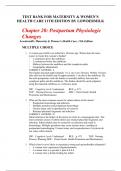
TEST BANK FOR MATERNITY & WOMEN’S HEALTH CARE 11TH EDITION BY LOWDERMILK Chapter 20: Postpartum Physiologic Changes Lowdermilk: Maternity & Women’s Health Care, 11th Edition MULTIPLE CHOICE 1. A woman gave birth to an infant boy 10 hours ago. Where does the nurse expect to locate this woman‘s fundus? a. 1 centimeter above the umbilicus b. 2 centimeters below the umbilicus c. Midway between the umbilicus and the symphysis pubis d. Nonpalpable abdominally CORRECT ANSWER: A The fundus descends approximately 1 to 2 cm every 24 hours. Within 12 hours after delivery the fundus may be approximately 1 cm above the umbilicus. By the sixth postpartum week the fundus is normally halfway between the symphysis pubis and the umbilicus. The fundus should be easily palpated using the maternal umbilicus as a reference point. DIF: Cognitive Level: Understand REF: p. 473 TOP: Nursing Process: Assessment MSC: Client Needs: Health Promotion and Maintenance 2. What are the most common causes for subinvolution of the uterus? a. Postpartum hemorrhage and infection b. Multiple gestation and postpartum hemorrhage c. Uterine tetany and overproduction of oxytocin d. Retained placental fragments and infection CORRECT ANSWER: D Subinvolution is the failure of the uterus to return to a nonpregnant state. The most common causes of subinvolution are retained placental fragments and infection. Subinvolution may be caused by an infection and result in hemorrhage. Multiple gestations may cause uterine atony, resulting in postpartum hemorrhaging. Uterine tetany and overproduction of oxytocin do not cause subinvolution. DIF: Cognitive Level: Understand REF: p. 473 TOP: Nursing Process: Planning MSC: Client Needs: Health Promotion and Maintenance 3. Which client is most likely to experience strong and uncomfortable afterpains? a. A woman who experienced oligohydramnios b. A woman who is a gravida 4, para 4-0-0-4 c. A woman who is bottle-feeding her infant d. A woman whose infant weighed 5 pounds, 3 ounces CORRECT ANSWER: B Afterpains are more common in multiparous women. In a woman who experienced polyhydramnios, afterpains are more noticeable because the uterus was greatly distended. Breastfeeding may cause the afterpains to intensify. In a woman who delivered a large infant, afterpains are more noticeable because the uterus was greatly distended. DIF: Cognitive Level: Understand REF: p. 474 TOP: Nursing Process: Assessment MSC: Client Needs: Health Promotion and Maintenance 4. A woman gave birth to a healthy infant boy 5 days ago. What type of lochia does the nurse expect to find when evaluating this client? a. Lochia rubra b. Lochia sangra c. Lochia alba d. Lochia serosa CORRECT ANSWER: D Lochia serosa, which consists of blood, serum, leukocytes, and tissue debris, generally occurs around day 3 or 4 after childbirth. Lochia rubra consists of blood and decidual and trophoblastic debris. The flow generally lasts 3 to 4 days and pales, becoming pink or brown. Lochia sangra is not a real term. Lochia alba occurs in most women after day 10 and can continue up to 6 weeks after childbirth. DIF: Cognitive Level: Understand REF: p. 474 TOP: Nursing Process: Assessment MSC: Client Needs: Health Promotion and Maintenance 5. Which hormone remains elevated in the immediate postpartum period of the breastfeeding woman? a. Estrogen b. Progesterone c. Prolactin d. Human placental lactogen CORRECT ANSWER: C Prolactin levels in the blood progressively increase throughout pregnancy. In women who breastfeed, prolactin levels remain elevated into the sixth week after birth. Estrogen levels decrease significantly after expulsion of the placenta, reaching their lowest levels 1 week into the postpartum period. Progesterone levels decrease significantly after expulsion of the placenta, reaching their lowest levels 1 week into the postpartum period. Human placental lactogen levels dramatically decrease after expulsion of the placenta. DIF: Cognitive Level: Remember REF: p. 476 TOP: Nursing Process: Assessment MSC: Client Needs: Health Promotion and Maintenance
Written for
- Institution
- Maternity & Women’s Health Care
- Course
- Maternity & Women’s Health Care
Document information
- Uploaded on
- November 1, 2023
- Number of pages
- 11
- Written in
- 2023/2024
- Type
- Exam (elaborations)
- Contains
- Questions & answers
Subjects
-
chapter 20 postpartum physiologic changes
-
lowdermilk maternity womens health care
-
test bank for maternity womens health care
-
11th edition by lowdermilk

Also available in package deal