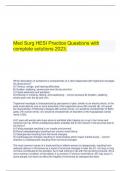
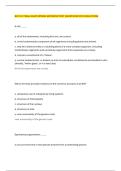
Med Surg HESI Practice Questions with complete solutions 2023.
Med Surg HESI Practice Questions with complete solutions 2023. Which description of symptoms is characteristic of a client diagnosed with trigeminal neuralgia (tic douloureux)? A) Tinnitus, vertigo, and hearing difficulties. B) Sudden, stabbing, severe pain over the lip and chin. C) Facial weakness and paralysis. D) Difficulty in chewing, talking, and swallowing. - correct answers.B) Sudden, stabbing, severe pain over the lip and chin. Trigeminal neuralgia is characterized by paroxysms of pain, similar to an electric shock, in the area innervated by one or more branches of the trigeminal nerve (5th cranial) (B). (A) would be characteristic of Méniére's disease (8th cranial nerve). (C) would be characteristic of Bell's palsy (7th cranial nerve). (D) would be characteristic of disorders of the hypoglossal cranial nerve (12th). A 67-year-old woman who lives alone is admitted after tripping on a rug in her home and fractures her hip. Which predisposing factor probably led to the fracture in the proximal end of her femur? A) Failing eyesight resulting in an unsafe environment. B) Renal osteodystrophy resulting from chronic renal failure. C) Osteoporosis resulting from hormonal changes. D) Cardiovascular changes resulting in small strokes which impair mental acuity. - correct answers.C) Osteoporosis resulting from hormonal changes. The most common cause of a fractured hip in elderly women is osteoporosis, resulting from reduced calcium in the bones as a result of hormonal changes in later life (C). (A) may or may not have contributed to the accident, but it had nothing to do with the hip being involved. (B) is not a common condition of the elderly; it is common in chronic renal failure. (D) may occur in some people, but does not affect the fragility of the bones as osteoporosis does. The nurse is assisting a client out of bed for the first time after surgery. What action should the nurse do first? A) Place a chair at a right angle to the bedside. B) Encourage deep breathing prior to standing. C) Help the client to sit and dangle legs on the side of the bed. D) Allow the client to sit with the bed in a high Fowler's position. - correct answers.D) Allow the client to sit with the bed in a high Fowler's position. The first step is to raise the head of the bed to a high Fowler's position (D), which allow venous return to compensate from lying flat and vasodilating effects of perioperative drugs. (A, B, and C) are implemented after (D). A 20-year-old female client calls the nurse to report a lump she found in her breast. Which response is the best for the nurse to provide? A) Check it again in one month, and if it is still there schedule an appointment. B) Most lumps are benign, but it is always best to come in for an examination. C) Try not to worry too much about it, because usually, most lumps are benign. D) If you are in your menstrual period it is not a good time to check for lumps. - correct answers.B) Most lumps are benign, but it is always best to come in for an examination. (B) provides the best response because it addresses the client's anxiety most effectively and encourages prompt and immediate action for a potential problem. (A) postpones treatment if the lump is malignant, and does not relieve the client's anxiety. (C and D) provide false reassurance and do not help relieve anxiety. A female client is brought to the clinic by her daughter for a flu shot. She has lost significant weight since the last visit. She has poor personal hygiene and inadequate clothing for the weather. The client states that she lives alone and denies problems or concerns. What action should the nurse implement? A) Notify social services immediately of suspected elderly abuse. B) Discuss the need for mental health counseling with the daughter. C) Explain to the client that she needs to take better - correct answers.D) Collect further data to determine whether self-neglect is occurring. Changes in weight and hygiene may be indicators of self-neglect or neglect by family members. Further assessment is needed (D) before notifying social services (A) or discussing a need for counseling (B). Until further information is obtained, explanations about the client's needs are premature (C). A client is admitted to the medical intensive care unit with a diagnosis of myocardial infarction. The client's history indicates the infarction occurred ten hours ago. Which laboratory test result should the nurse expect this client to exhibit? A) Elevated LDH. B) Elevated serum amylase. C) Elevated CK-MB. D) Elevated hematocrit. - correct answers.C) Elevated CK-MB. The cardiac isoenzyme CK-MB (C) is the most sensitive and most reliable indicator of myocardial damage of all the cardiac enzymes. It peaks within 12 to 20 hours after myocardial infarction (MI). (A) is a cardiac enzyme that peaks around 48 hours after an MI. (B) is expected with acute pancreatitis. (D) would be expected in a client with a fluid volume deficit, which is not a typical finding in MI. A splint is prescribed for nighttime use by a client with rheumatoid arthritis. Which statement by the nurse provides the most accurate explanation for use of the splints? A) Prevention of deformities. B) Avoidance of joint trauma. C) Relief of joint inflammation. D) Improvement in joint strength. - correct answers.A) Prevention of deformities. Splints may be used at night by clients with rheumatoid arthritis to prevent deformities (A) caused by muscle spasms and contractures. Splints are not used for (B). (C) is usually treated with medications, particularly those classified as non-steroidal antiinflammatory drugs (NSAIDs). For (D), a prescribed exercise program is indicated. The nurse should be correct in withholding a dose of digoxin in a client with congestive heart failure without specific instruction from the healthcare provider if the client's A) serum digoxin level is 1.5. B) blood pressure is 104/68. C) serum potassium level is 3. D) apical pulse is 68/min. - correct answers.C) serum potassium level is 3. Hypokalemia (C) can precipitate digitalis toxicity in persons receiving digoxin which will increase the chance of dangerous dysrhythmias (normal potassium level is 3.5 to 5.5 mEq/L). The therapeutic range for digoxin is 0.8 to 2 ng/ml (toxic levels= >2 ng/ml); (A) is within this range. (B) would not warrant the nurse withholding the digoxin. The nurse should withhold the digoxin if the apical pulse is less than 60/min (D). During CPR, when attempting to ventilate a client's lungs, the nurse notes that the chest is not moving. What action should the nurse take first? A) Use a laryngoscope to check for a foreign body lodged in the esophagus. B) Reposition the head to validate that the head is in the proper position to open the airway. C) Turn the client to the side and administer three back blows. D) Perform a finger sweep of the mouth to remove any vomitus. - correct answers.B) Reposition the head to validate that the head is in the proper position to open the airway. The most frequent cause of inadequate aeration of the client's lungs during CPR is improper positioning of the head resulting in occlusion of the airway (B). A foreign body can occlude the airway, but this is not common unless choking preceded the cardiac emergency, and (A, C and D) should not be the nurse's first action. Despite several eye surgeries, a 78-year-old client who lives alone has persistent vision problems. The visiting nurse is discussing painting the house with the client. The nurse suggests that the edge of the steps should be painted which color? A) Black. B) White. C) Light green. D) Medium yellow. - correct answers.D) Medium yellow. Yellow is the easiest for a person with failing vision to see (D). (A) will be almost impossible to see at night because the shadows of the steps will be too difficult to determine, and would pose a safety hazard. (B) is very hard to see with a glare from the sun and it could hurt the eyes in the daytime to look at them. (C) is a pastel color and is difficult for elderly clients to see. The nurse is assessing a client with bacterial meningitis. Which assessment finding indicates the client may have developed septic emboli?
Geschreven voor
- Instelling
- Med Surg HESI Practice
- Vak
- Med Surg HESI Practice
Documentinformatie
- Geüpload op
- 31 oktober 2023
- Aantal pagina's
- 34
- Geschreven in
- 2023/2024
- Type
- Tentamen (uitwerkingen)
- Bevat
- Vragen en antwoorden
Onderwerpen
-
med surg hesi practice questions

Ook beschikbaar in voordeelbundel