KEY SITES
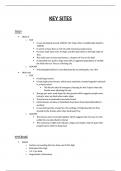
TROY
TROY VI
o FOR
It was developed around 1250 BC; the Trojan War is traditionally dated to
1200 BC
It seems to have been a rich city with numerous large houses
Its stone walls were over 7m high, and the Iliad refers to the high walls of
Troy
The walls seem to have had towers, a feature of Troy in the Iliad
It extended over quite a huge area with a suggested population of 10,000;
the Iliad refers to Troy as a thriving city
o AGAINST
Archaeologists believe it was destroyed by an earthquake, not a fire
TROY VIIa
o FOR
It had large towers
It had single-story houses, which were relatively crowded together and built
in a short period
This fits the idea of emergency housing for the Trojans when the
Greeks were attacking the city
Storage jars were sunk deep into the ground which suggests people were
trying to store up food when under siege
Three bronze arrowheads have been found
Partial human remains of individuals have been found (possibly killed in
warfare)
It was destroyed by a large fire; the writings of Virgil describe the fires
started by the Greeks when they destroyed Troy
o AGAINST
The houses were crammed together which suggests the city was not rich,
unlike the one described by Homer
The sunken jars might not indicate a siege, but simply a lack of space that
people had in which to keep food
MYCENAE
WALLS
o Section surrounding the Lion Gate was 8.25m high
o Estimated 12m high
o 5.5-7.5m thick
o Huge blocks of limestone
TROY
TROY VI
o FOR
It was developed around 1250 BC; the Trojan War is traditionally dated to
1200 BC
It seems to have been a rich city with numerous large houses
Its stone walls were over 7m high, and the Iliad refers to the high walls of
Troy
The walls seem to have had towers, a feature of Troy in the Iliad
It extended over quite a huge area with a suggested population of 10,000;
the Iliad refers to Troy as a thriving city
o AGAINST
Archaeologists believe it was destroyed by an earthquake, not a fire
TROY VIIa
o FOR
It had large towers
It had single-story houses, which were relatively crowded together and built
in a short period
This fits the idea of emergency housing for the Trojans when the
Greeks were attacking the city
Storage jars were sunk deep into the ground which suggests people were
trying to store up food when under siege
Three bronze arrowheads have been found
Partial human remains of individuals have been found (possibly killed in
warfare)
It was destroyed by a large fire; the writings of Virgil describe the fires
started by the Greeks when they destroyed Troy
o AGAINST
The houses were crammed together which suggests the city was not rich,
unlike the one described by Homer
The sunken jars might not indicate a siege, but simply a lack of space that
people had in which to keep food
MYCENAE
WALLS
o Section surrounding the Lion Gate was 8.25m high
o Estimated 12m high
o 5.5-7.5m thick
o Huge blocks of limestone