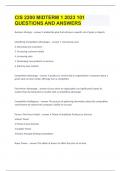
CIS 2200 MIDTERM 1 2023| 101 QUESTIONS AND ANSWERS|GUARANTEED SUCCESS
Business Strategy: A leadership plan that achieves a specific set of goals or objects. Identifying Competitive Advantages: 1. Decreasing costs 2. Attracting new costumers 3. Increasing customer loyalty 4. Increasing sales 5. Developing new products or services 6. Entering new markets Competitive Advantage: A product or service that an organization's costumers place a great value on than similar offerings from a competitor. First-Mover Advantage: Occurs when an organization can significantly impact its market share by being first to market with a competitive advantage. Competitive Intelligence: The process of gathering information about the competitive environment to improve the company's ability to succeed. Porter's Five Force Model: • Threat of Substitute Products or Services • Buyer Power • Threat of new Entrants • Supplier Power • Rivalry Amongst Existing Competitors Buyer Power: The ability of buyers to affect the price of an item. Switching Cost: Is manipulating costs that make customers reluctant to switch to another product or service. Loyalty Program: Rewards customers based on the amount of business they do with a particular organization. Supplier Power: The suppliers' ability to influence the prices they charge for supplies. Threat of Substitute Products or Services: Is high when there are many alternatives to a product or service and low when there are few alternatives. Threat of New Entrance: High when it is easy for new competitors to enter a market and low when there are significant entry barriers. Entry Barrier: A features of a product or service that customers have come to expect and entering competitors must offer the same for survival. Rivalry Among Existing Competitors: High when competition is fierce in a market and low when competitors are more complacent. Product Differentiation: Occurs when a company develops unique differences in its products or services with the intent to influence demand. Business Process: A standardized set of activities that accomplish a specific task, such as a specific process. Value Chain Analysis: Views a firm as a series of business processes that each add value to the product or service. Primary Value Activities: • Inbound Logistics • Operations • Outbound Logistics • Marketing and Sales • Service Inbound Logistics: Acquires raw materials and resources, and distributes. Operations: Transforms raw materials or inputs into goods and services. Outbound Logistics: Distributes goods and services to customers. Service: Provides customer support. Support Value Activities: • Firm infrastructure • Human resource management • Technology development • Procurement Firm Infrastructure: Includes the company format or departmental structures, environment, and systems. Human Resource Management: Provides employee training, hiring, and compensation. Technology Development: Applies MIS to processes to ass value. Procurement: Purchases inputs such as raw materials, resources, equipment, and supplies. Business Process: A standardized set of activities that accomplish a specific task, such as processing a customer's order. Business Process Reengineering (BPR): The analysis and redesign of workflow within and between enterprises. Supply Chain Management (SCM): The management of information flows between and among activities in a supply chain to maximize total supply chain effectiveness and profitability. Five Basic Supply Chain Activities: 1. Plan 2. Source 3. Make 4. Deliver 5. Return Plan: Prepare to manage all resources required to meet demand. Source: Build relationships within suppliers to produce raw materials. Make: Manufacture products and create production schedules. Deliver: Plan for transportations of goods to costumers. Return: Support costumers and product returns. Customer Relationship Management (CRM): Involves managing all aspects of a customer's relationship with an organization to increase customer loyalty and retention and an organization's profitability. Evolution of CRM: • Reporting • Analyzing • Predicting Reporting: Customer identification, asking what happened. Analyzing: Is customer segmentation, asking why it happened. Predicting: Customer prediction, asking what will happen Enterprise Resource Planning (ERP): Integrates all departments and functions throughout an organization into a single IT system so that employees can make decisions by viewing enterprisewide information on all business operations. Project: A temporary activity a company undertakes to create a unique product, service, or result. Metrics: Measurement that evaluate results to determine whether a project is meeting its goals. Critical Success Factors (CSF's): The crucial steps companies make to perform to achieve their goals and objects and implement strategies. Key Performance Indicators (KPIs): The quantifiable metrics a company uses to evaluate progress toward critical success factors. Efficiency MIS Metric: Measures the performance of the MIS system itself including throughput, speed, and availability. Effectiveness MIS Metric: Measures the impact MIS ha on business processes and activities including customer satisfaction, conversion rates, and sell-through increases. Benchmarks: Baseline values the system seeks to attain. Benchmarking: A process of continuously measuring system results, comparing those results to optimal system performance, and identifying steps and procedures to improve system performance. Security: Is an issue for any organization offering products or services over the Internet. Website Metrics: • Abandoned registrations • Abandoned shopping carts • Click-through • Conversion rate • Cost-per-thousand • Page exposures • Total hits • Unique visitors Supply Chain Management Metrics: • Back order • Customer order promised cycle time • Customer order actual cycle time • Inventory replenishment cycle time • Inventory turnover Customer Relationship Management Metrics: Customer relationship management metrics measure user satisfaction and interaction and includes: • Sales metrics • Service metrics • Marketing metrics Role in the Supply Chain: • Planning and Control Supply Chain Integration • Information Integration • Business Process Integration Planning and Control Supply Chain Integration: Supply chain planning, collaborative product development & integrated demand and supply management. Information Integration: Inventory visibility, performance metrics, event monitoring, business intelligence, scorecards & dashboards. Business Process Integration: Collaborative logistics, commerce web sites, vendor-managed inventory & private exchange. Supply Chain Visibility: The ability to view all areas up and down the supply chain.
Written for
- Institution
-
Baruch College
- Course
-
CIS 2200
Document information
- Uploaded on
- October 25, 2023
- Number of pages
- 12
- Written in
- 2023/2024
- Type
- Exam (elaborations)
- Contains
- Questions & answers
Subjects

Also available in package deal