APM PMQ Exam 7th Ed Questions With Correct Answers
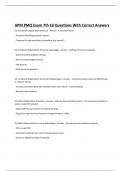
(1) Functional Organisation Structure - Answer - Functional teams - Primarily BAU/Deparmental Projects - Common for orgs providing std products (e.g. manuf.) (1) Functional Organisation Structure Advantages - Answer - Staff gain technical expertise - Good functional problem solving - Peer learning straight forward - Job Security - Clear career progression (1) Functional Organisation Structure Disadvantages - Answer - Corporate projects become difficult due to "Siloed" nature - Functions prioritise their own functions work over others - inward looking - Remote from customer (1) Matrix Organisation Structure - Answer - Still may have functional teams - but temporary functional teams created for projects - Draw staff from permanent functional postings - Typical for orgs that have frequent change initiatives + BAU (1) Matrix Organisation Structure Advantages - Answer - Shared resources between projects - PM is single POC - Consistent methods and rules for project governance - Access to additional SQEP if required (1) Matrix Organisation Structure Disadvantages - Answer - Complex Communication - Due reporting lines (PM and Line manager) - Disproportionate of time reporting rather than producing - Resource conflicts and divided loyalties - Overloaded team members - Recourses need to be negotiated - Preference may be ring-fenced, internal (functional) (1) Organisational Breakdown Strucutre (OBS) - Answer - Describes the structure of the delivering organisation that can then be matched to work-packages in the WBS - Combining a WBS and OBS can inform a RAM (Responsiblity Asignment Matrix) (1) Responsibility Assignment Martix (RAM) - Answer - Defines boundaries of cross-functional teams - Derived from WBS and OBS - May be required, or similar, for RFP, etc response - May be called a RACI matrix (1) Project Manager Responsibilites - Answer Manage project to ensure succesful delivery 1. planning what work needs to be done, when and who's going to do it; 2. looking at the risks involved in a particular project and managing these risks; 3. making sure the work is done to the right standard; 4. motivating the team of people involved in the project; 5. co-ordinating work done by different people; 6. making sure the project is running on time and to budget; 7. dealing with changes to the project as and when necessary; 8. making sure the project delivers the expected outcomes and benefits; (1) PM vs Project Sponsor - Answer 1. Sponsor owns business case, whereas PM contribute to business case but is mainly responsible for delivery of its stated outputs (which are capable of achieving its stated benefits) 2. Sponsor focussed on realising benefits, whereas project manager focuses on the delivery of the project outputs. 3. Sponsor champions & supports the project, whereas PM responsible for managing the project 4. Sponsor reports to corporate management, whereas PM reports to Sponsor and Project Board (1) Project Sponsor Responsibilities - Answer 1. Business leader and decision maker. 2. Primary risk taker. 3. Able to work across functional boundaries. 4. Project champion. 5. Must have, and be prepared to commit time. 6. Enough experience to see that project is managed efficiently. 7. Maintains a continuous dialogue with PM. 8. Capable of addressing stakeholder interests. 9. Responsible for benefits identification and realisation. 10. Owns the business case. 11. Provides the funding. 12. Reports to corporate management (1) PM vs Sponsor @ stages - Answer Concept phase: sponsor creates business case, PM when appointed supports this. Sponsor secures corporate agreement & budget to proceed. Definition phase: PM produces PMP (with project team). Sponsor agrees this. Deployment phase: PM manages the project, monitors, reports progress, risks & issues to Sponsor. Sponsor chairs project board, makes decisions inc. proceeding at milestones; supports PM. Transition phase: PM produces closure report. Sponsor signs off closure, takes over responsibility for adoption & benefits realisation. (1) Project "Users" - Answer - provide the requirements - may act as subject matter expert - conduct UAT - use the deliverable//output. (1) Project "Members" - Answer - perform project tasks - report on progress - identify risks. (1) Proiect "Steering group/board" - Answer - guide the project - review project reports - authorise business case - authorise changes (1) Product "Owner" - Answer - acts as on-site customer for iterative or agile projects - iteration planning - accepts incremental delivery. (1) PMO Functions - Answer 1. Provides document templates 2. Training (advice, training needs analysis, course lists) 3. Mentoring & coaching 4. Facilitating workshops 5. Note taking 6. Administration 7. Configuration management 8. Maintains standards 9. Auditing 10. Line management for PM (1) Embedded PMO - Answer - dedicated to single project - for larger projects requiring lots of support - Integral part of project team, providing range of services - Supports people, performance & systems, with processes being managed at programme/portfolio level Benefits: high level of dedicated support to project, close communications, releases PM to manage the project. (1) Central PMO - Answer - Supports several corporate projects - Supports people, performance, systems & processes Benefits: flexible and effective in supporting a large number of small projects. (1) Hub and Spoke PMO - Answer - In large organisations, the central/hub PMO supports corporate portfolio, with spoke PMO's supporting different departments' projects - Supports people & performance, with processes & systems managed at programme/portfolio level Benefits: effective for managing information and processes. (1) PMO Benefits (General) - Answer 1. Single source of information, supports communication. 2. Can support multiple projects, economies of scale. 3. Quality assurance, defining quality standards & ensuring used. 4. Corporate standards, ensures used. 5. Specialist skills developed by PMO staff inc. software tools, allowing PM's to focus on management. (1) Governance - Answer - framework of authority & accountability - defines & controls outputs, outcomes & benefits. (1) Governance Concepts - Answer 1. Portfolio direction and alignment 2. Programme and Project sponsorship 3. Change and Project Management Capability 4. Transparency and Assurance 5. Culture and Ethics (inc. professional standards & behaviours) (1) Governance Principles - Answer 1. Board responsible for governance of project management (GoPM) 2. Roles and responsibilities clearly defined 3. Application throughout the lifecycle 4. Relationship between business strategy and portfolio 5. Clear plans with decision points 6. Effective delegation of decision making 7. Business case validity 8. Independent scrutiny planned and implemented 9. Clearly defined reporting and escalation 10. Open and honest reviews and culture of improvement 11.Appropriate engagement of stakeholders 12. Use of delegated responsibilities: clarifies roles and increases efficiency 13. Use of processes and procedures: standardises methods of working 14. Use of regulations: ensures conformance to standards and policies, facilitates full disclosure and reporting. (1) Governanace Layers - Answer 1. corporate (vision, mission, strategy); 2. BAU (operations); 3. Business Change (projects, programmes). (1) Governanance Benefits - Answer 1. Link to strategic direction: for projects/programmes/portfolios 2. Clear ownership & leadership, using RACI. 3. Effective stakeholder engagement, through clear accountability, use of stakeholder analysis. 4. Project & risk management through use of policies & procedures. 5. Consideration of long term value through linking to strategy. 6. Can be audited, giving management team assurance, and ability to correct & improve. 7. standardises methods of working 8. clarifies roles and increases efficiency 9. ensures conformance to standards and policies, facilitates full disclosure and reporting. (1) Project Methodologies - Answer - support good governance - provide structure - processes - rules - templates (1) Project Methodologies Benefits - Answer - can be audited - standard processes & terminology easier to understand & communicate about - enables training & project champions - selling point (2) Linear Project Lifecycle - Answer 1. Concept 2. Definition 3. Deployment 4. Transition Sequential stages: Suitable for more structured projects (2) Extended Projct Lifecycle - Answer 1. Concept 2. Definition 3. Deployment 4. Transition 5. Adoption 6. Benefits Realisation These run in parallel with first part of Operations/BAU stage. (2) Iterative Project Lifecycle - Answer 1. Pre-project 2. Feasibility & Foundations 3. Evolutionary development 4. Deployment 5. Post-project Life cycles composed of several iterations, which repeat one or more of the phases before proceeding to the next one. Iterative approaches can only proceed when user feedback is available to be used as the basis for initiating new cycles of development, refinement and improvement. Beneficial for evolving objectives or solutions. (2) Hybrid Project Lifecycles - Answer Typically fuse together elements to create a new model or approach. For example, utilising iterative or agile methods for early requirements gathering, where the uncertainty is greatest, and following it up with incremental or sequential processes to formalise deployment. (2) Incremental Project Lifecycle - Answer A lifecycle where the target state is achieved through a staged series of smaller changes. (2) Evoloutionary Project Lifecycle - Answer A lifecycle where deployment entails a number of major transitions, each based on user feedback from the preceding (2) Why are projects structured as phases in a linear life cycle? - Answer 1. Appropriate focus on the work which is current. 2. Enables high level planning first, then detailed planning for each stage when more is known. 2. Helps resource allocation across the project. 3. Facilitates management control by reviews of each phase. 4. Enables payment by stages. (2) Project Lifecycle vs Extended - Answer A project life cycle contains the phases up to handover and closure, whereas an extended life cycle goes beyond the handover and closure phase encompassing the benefits realisation phase. Within the project life cycle accountability for the output is handed over to the end user or client, whereas in the extended life cycle accountability for adoption of the output stays within the project until the change is fully embedded. (2) Decision Gates - Answer 1. Determines whether project should proceed or not; major decision point for senior management; decisions are: approve continuation of the project, refocus the project or cancel it. 2. Funding next stage agreed. By breaking down project into stages, funding commitment is only made in smaller amounts, limits risk 3. Assurance that project is on track and next stage ready to start. (2) Audits - Answer Undertaken by group outside the project team, e.g. Project Office, Internal auditors, External auditors 1. Used to provide objective evaluation and assessment of the management of the project 2. provides assurance that project is being managed well, enables corrective action & lessons learned for future projects. (2) Post Project Review - Answer Part of handover, before closeout 1. Used to assess "did we do it right?" 2. Evaluate against success criteria; determines what went well, what went badly, what could be done differently, inc. processes and any tools or techniques used, for lessons learned 3. Recognises individual and team performances; and gives the opportunity to celebrate the project's success. (2) Benefits Realisation Review - Answer Undertaken some time after the products are in use; perhaps more than one; responsibility of the sponsor 1. Encourages users to engage with outputs and realise expected outcomes 2. Confirms whether the planned benefits & any unexpected benefits been realised; prompts corrective action if not. 3. Identifies any problems caused by the new products; so these may be addressed and lessons learned. (2) Reasons for Early Project Closure - Answer 1. Major issues encountered: 2. External environment changed: 3. Funds withdrawn / no longer aligned to business strategy: 4. Business case invalid (3) Projects vs BAU - Answer Projects: 1. Temporary, time-bounded, have start & end points. 2. Unique, or have elements of uniqueness. 3. Deliver outputs, which typically bring about change in the organisation or for customers. 4. Capital funded. 5. Project teams are temporary, and typically draw on a range of specialist skills. 6. Risk aware, but mitigate only high priority risks, accept others. BAU: 1. Repetitive operations, not unique. 2. Use process management techniques to maximise efficiency of repetitive tasks. 3. Use the outputs from projects to deliver outcomes and benefits. 4. Revenue funded. 5. Use a limited range of functional skills. 6. Risk averse, aim to minimise risks. (3) Project Management vs Programme Management vs Portfolio Management - Answer Projects: 1. A single, unique plan to deliver specific changes. 2. Delivers outputs, but not necessarily outcomes & benefits before handed over to BAU. Programmes: A group of projects, plus BAU, with related benefits & aligned to overall business strategy. Portfolios: A group of projects, programmes and BAU, managed at corporate/organisation or department level, prioritised/selected and continually reviewed. (3) The relationship between programmes, projects and strategic change - Answer Standalone projects: should have a clear purpose, which relates to the organisation's strategic objectives, and is stated in the project brief/ charter. Programmes: are larger, encompassing multiple projects, and are longer term; and focussed on fulfilling the strategic vision Portfolios: are also larger scale, and focussed on strategic change but also prioritisation & value for money (4) Where programme management may be appropriate - Answer 1. Scope not fully defined. 2. Higher amount of uncertainty. 3.Complex set of dependencies and outputs. Benefits: 1. Timeframes: longer 5-7 yr. timeframe to deliver strategic change, review planned projects within this. 2. Infrastructure: can deliver infrastructure projects which have no direct benefit but support the whole programme. 3. Benefits management: outcomes delivered & benefits realised within the life of the programme. 4. Manages inter-project dependencies & shared resources. 5. Enable more focus on change management. (4) Barriers to communication - Answer 1. Sender and receiver having different perceptions, 2. Level of education, 3. Region of experience, 4. Personality and interests, 5. "Deaf ear" to unfamiliar or boring topics, 6. Attitudes, emotions and prejudices, 7. Receiver hearing what he wants to hear, 8. Receiver evaluates the source before accepting the communication, 9. Words meaning different things to different people (4) Ways to improve communication - Answer 1. Obtain feedback, 2. Establish multiple communication channels, 3. Use face to face if possible, 4. Find out how sensitive the receiver is to your communication, 5. Communicate at the proper time, 6. Use simple language, 7. Say it in different ways (4) Sources of Conflict - Answer 1. priorities (concept-definition), 2. procedures (concept-definition), 3. technical opinions (definition-transition), 4. staff resources, 5. cost , 6. schedules (definition-development), 7. personalities/team dynamics (throughout). Conflict often arises because team members do not understand something, they don't know how to operate as a team, or there may be behavioural, cultural differences or value differences. (4) Conflict Management - Answer PM needs to engage, plan, negotiate, and choose behaviour strategy (Kilmann model) Conflict Management Process 1. Diagnose 2. Discuss 3. Achieve ownership 4. Agree solution 5. Implement solution 6. Remove (from the team) / Exit (from the organisation) (4) Conflict Managemement Approach - Answer Approaches (Thomas Kilmann): When managing conflict there are five ways to behave, according to the Thomas-Kilmann model, which is based on two axes of 'concern for own point of view' versus 'concern for others point of view'. (4) Negotiation - Answer Discussion aimed at reaching agreement. e.g. agreeing estimates, bidding for resources, agreeing schedules/timescales, getting funding; negotiating contract terms; procedures, standards/quality. (4) Negotiation Types - Answer Approach: 1. Formal (e.g. contracts) 2. Informal (e.g. with colleagues). Techniques: 3. Collaborative (win-win, principled approach) 4. Competitive (win-lose, positional) negotiation.
Written for
- Institution
- APM PMQ
- Course
- APM PMQ
Document information
- Uploaded on
- October 25, 2023
- Number of pages
- 49
- Written in
- 2023/2024
- Type
- Exam (elaborations)
- Contains
- Questions & answers
Subjects
- apm pmq stuvia
-
apm pmq exam 7th ed questions with correct answers
-
1 functional organisation structure functional
-
1 functional organisation structure advantages

Also available in package deal