

People, Health and Place
06-09-2023
Lectures recorded and kept for 7 days.
How do places affect population health?
Examples:
Cholera outbreak in Yemen, 2017. (water and during civil war, shared amenities)
Zika virus spread in Brazil, end of 2014. (mosquito, tropical climate + bed nets + ventilation)
Covid 7 milli dead. Origin from one region and spread around the globe. (migration and mobility of
society, the higher the more cases. Following the rules or not. Being outside a lot, ventilation.)
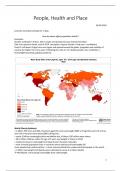
Overweight becoming a global pandemic.
World Obesity Epidemic
› In 2016, 39% men and 40% of women aged 18+ were overweight (BMI ≥ 25 kg/m2) and 11% of men
and 15% of women were obese (BMI ≥30 kg/m2).
› nearly 2 billion overweight adults worldwide and, of these, 650 million were obese
› 38.2 million children under the age of 5 were overweight or obese in 2016
› marked increase in overweight and obesity over the past 4 decades
› most of world population lives in countries where obesity and overweight kill
more people than undernutrition -> more overnourished than undernourished people in the world.
› In 2010, overweight and obesity were estimated to cause 3·4 million deaths
→ Worldwide, more people overweight than underweight.
1
,Adolescent pregnancies
› Ca. 12 million girls, aged 15-19 years, and 770.00 <15 years give birth each year in developing
regions.
› Complications during pregnancy and childbirth are leading cause of death for 15-19 year-old girls
globally.
› Every year, some 3.9 million girls aged 15-19 years undergo unsafe abortions.
› Adolescent mothers (ages 10-19 years) face higher risks of pregnancy complications than women
aged 20 to 24 years.
› Children of adolescent mothers exhibit higher risks of school underperformance, late life health etc.
Cultural and religious norms. Child marriages. Education and employment opportunities. Access to
contraceptives and facilities.
Dementia and Alzheimer’s disease
› Worldwide around 55 million people with dementia, additional 10 million new cases every year.
› Alzheimer's disease accounts for 60-70% of dementia cases.
› Risk of Alzheimer’s disease can be reduced: risk factors are lack of exercise, smoking, depression
and poor education.
› Dementia is one of the major causes of disability and dependency among older people worldwide.
› Dementia has physical, psychological, social, and economical impact on carers, families and society.
Links between geography and health
› Example cholera: importance of sanitation, housing, health care facilities and trained medical staff
› Example Zika: housing situation, income, climate change, migration/mobility
› Example COVID 19: age, socioeconomic status, health behaviors, public prevention
› Example Adolescent pregnancies: education, cultural beliefs, poverty
› Example nutrition: health behavior, education, income
› Example Alzheimer: care provision, family arrangements, aging, health behaviors
2
,Intermediate Summary I
› Place, health and population are highly interlinked:
› Place can determine health risks (e.g. infectious diseases, external shocks)
› Population structures/ dynamics determine health risks and place characteristics (e.g. Alzheimer’s,
Zika, Covid 19)
› Health can determine population dynamics and development (e.g. fertility, infectious and
noninfectious diseases)
Micro and macro level relationships, the dual link between health and geography
Micro and macro level
› Micro level
- Relates to individuals = individual level
- Specific diseases or disabilities by persons (caused by individual characteristics or behaviors)
- e.g. health of an individual is affected by an agent that causes a certain condition/disease
› Macro level
- Relates to populations (cities, regions, countries) = population level
- Aggregated information of (individual) health (causes of death in population, cases of covid)
- e.g. (sub-) population health is affected by physical or social environment
Individual factors can explain the patterns in populations.
› Important to understand patterns of health and population dynamics and to design interventions.
› Risk factors and determinants can be clustered on the macro and/ or micro level.
› Change in micro and/ or macro level determinants can lead to individual and population level
outcomes.
Coleman’s Bathtub
3
, › Stylized Scheme to show the relationship between macro and micro level phenomena.
› Also used to show the determinants of social change and applied from various disciplines for
different phenomena (criminology, sociology, economics, epidemiology).
› Link 1 and 2 concern micro level processes, e.g. how institutions, social organization, environment in
general affect individual outcomes or how individual behaviors affect individual outcomes.
› Link 3 and 4 concern macro level processes, e.g. change in environment over time, effect of
individual behaviors on macro level outcomes.
Built; hospitals, sewers etc. increase in life expectancy.
Dual link geography & health
› Spatial differences in health
› Global differences in health, e.g. sub-Saharan Africa vs Europe;
› Comparison of disease rates in regions; e.g. Eastern vs Western Europe
› Specifics of locations, e.g. slum areas
› Within-country variation, e.g. urban-rural differences
› Where you live affects your health
› Where you live affects the health care you get
› Spread of diseases
› Mobility/migration and health
› Role of place on health (therapeutic landscapes; to heal or develop)
› Also: influence of health on place (e.g. selection, migration, health behaviors etc.)
Intermediary Summary II
› Health, population dynamics and place are interlinked on the macro and/ or the micro level.
› Changes on each level can determine micro and/ or macro level outcomes and conditions.
› The dual link between geography, health and place refers to mutual influences that determine
macro and micro level conditions and outcomes.
4
06-09-2023
Lectures recorded and kept for 7 days.
How do places affect population health?
Examples:
Cholera outbreak in Yemen, 2017. (water and during civil war, shared amenities)
Zika virus spread in Brazil, end of 2014. (mosquito, tropical climate + bed nets + ventilation)
Covid 7 milli dead. Origin from one region and spread around the globe. (migration and mobility of
society, the higher the more cases. Following the rules or not. Being outside a lot, ventilation.)
Overweight becoming a global pandemic.
World Obesity Epidemic
› In 2016, 39% men and 40% of women aged 18+ were overweight (BMI ≥ 25 kg/m2) and 11% of men
and 15% of women were obese (BMI ≥30 kg/m2).
› nearly 2 billion overweight adults worldwide and, of these, 650 million were obese
› 38.2 million children under the age of 5 were overweight or obese in 2016
› marked increase in overweight and obesity over the past 4 decades
› most of world population lives in countries where obesity and overweight kill
more people than undernutrition -> more overnourished than undernourished people in the world.
› In 2010, overweight and obesity were estimated to cause 3·4 million deaths
→ Worldwide, more people overweight than underweight.
1
,Adolescent pregnancies
› Ca. 12 million girls, aged 15-19 years, and 770.00 <15 years give birth each year in developing
regions.
› Complications during pregnancy and childbirth are leading cause of death for 15-19 year-old girls
globally.
› Every year, some 3.9 million girls aged 15-19 years undergo unsafe abortions.
› Adolescent mothers (ages 10-19 years) face higher risks of pregnancy complications than women
aged 20 to 24 years.
› Children of adolescent mothers exhibit higher risks of school underperformance, late life health etc.
Cultural and religious norms. Child marriages. Education and employment opportunities. Access to
contraceptives and facilities.
Dementia and Alzheimer’s disease
› Worldwide around 55 million people with dementia, additional 10 million new cases every year.
› Alzheimer's disease accounts for 60-70% of dementia cases.
› Risk of Alzheimer’s disease can be reduced: risk factors are lack of exercise, smoking, depression
and poor education.
› Dementia is one of the major causes of disability and dependency among older people worldwide.
› Dementia has physical, psychological, social, and economical impact on carers, families and society.
Links between geography and health
› Example cholera: importance of sanitation, housing, health care facilities and trained medical staff
› Example Zika: housing situation, income, climate change, migration/mobility
› Example COVID 19: age, socioeconomic status, health behaviors, public prevention
› Example Adolescent pregnancies: education, cultural beliefs, poverty
› Example nutrition: health behavior, education, income
› Example Alzheimer: care provision, family arrangements, aging, health behaviors
2
,Intermediate Summary I
› Place, health and population are highly interlinked:
› Place can determine health risks (e.g. infectious diseases, external shocks)
› Population structures/ dynamics determine health risks and place characteristics (e.g. Alzheimer’s,
Zika, Covid 19)
› Health can determine population dynamics and development (e.g. fertility, infectious and
noninfectious diseases)
Micro and macro level relationships, the dual link between health and geography
Micro and macro level
› Micro level
- Relates to individuals = individual level
- Specific diseases or disabilities by persons (caused by individual characteristics or behaviors)
- e.g. health of an individual is affected by an agent that causes a certain condition/disease
› Macro level
- Relates to populations (cities, regions, countries) = population level
- Aggregated information of (individual) health (causes of death in population, cases of covid)
- e.g. (sub-) population health is affected by physical or social environment
Individual factors can explain the patterns in populations.
› Important to understand patterns of health and population dynamics and to design interventions.
› Risk factors and determinants can be clustered on the macro and/ or micro level.
› Change in micro and/ or macro level determinants can lead to individual and population level
outcomes.
Coleman’s Bathtub
3
, › Stylized Scheme to show the relationship between macro and micro level phenomena.
› Also used to show the determinants of social change and applied from various disciplines for
different phenomena (criminology, sociology, economics, epidemiology).
› Link 1 and 2 concern micro level processes, e.g. how institutions, social organization, environment in
general affect individual outcomes or how individual behaviors affect individual outcomes.
› Link 3 and 4 concern macro level processes, e.g. change in environment over time, effect of
individual behaviors on macro level outcomes.
Built; hospitals, sewers etc. increase in life expectancy.
Dual link geography & health
› Spatial differences in health
› Global differences in health, e.g. sub-Saharan Africa vs Europe;
› Comparison of disease rates in regions; e.g. Eastern vs Western Europe
› Specifics of locations, e.g. slum areas
› Within-country variation, e.g. urban-rural differences
› Where you live affects your health
› Where you live affects the health care you get
› Spread of diseases
› Mobility/migration and health
› Role of place on health (therapeutic landscapes; to heal or develop)
› Also: influence of health on place (e.g. selection, migration, health behaviors etc.)
Intermediary Summary II
› Health, population dynamics and place are interlinked on the macro and/ or the micro level.
› Changes on each level can determine micro and/ or macro level outcomes and conditions.
› The dual link between geography, health and place refers to mutual influences that determine
macro and micro level conditions and outcomes.
4


