BIOL202 Week 7 Lab 7; Differential and Biochemical Test
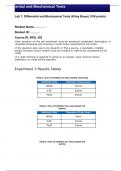
Each question on the lab worksheet must be answered completely, thoroughly, in complete sentences and correctly in order to be considered for full credit If the question asks you to do research or find a source, a reputable, credible and/or scholarly source citation must be included in order to be considered for full credit If a math formula is required to arrive to an answer, work must be shown otherwise, no credit will be awarded Experiment 3 Results Tables Table 3: Zone of Inhibition for Skin Sample (10 points) Table 4: Zone of Inhibition for Local Sample (10 points) Table 5: Zone of Inhibition for Yeast Sample (10 points) Experiment 3 Post-Lab Questions 1. Table 6 outlines interpretive standards of antibiotic resistance based on the size of inhibition zones. For example, many bacterial species that are resistant to Kanamycin have an inhibition zone of 13 mm or smaller. Of course, inhibition zones may also be affected by the antibiotic concentration present within the disk. Use Table 6 to determine whether the microbial samples you tested are sensitive (S), moderately resistant (MR), or resistant (R) to each of the antibiotic disks. Remember, you will not know the exact species of bacteria on your “Skin” and “Local” plates. The table is a guide to compare your results to a standard. Describe the details of each of your sample plates growth morphology, the diameter of the zones for each antibiotic and whether or not they were sensitive (S), moderately sensitive (MR) or resistant (R) based on the zones you observed (20 points) 2. Is the bacterial lawn sampled from your skin more resistant to one antibiotic than the others? What about the local sample? The yeast sample? Use the detailed results from Question 1 to support your answer. (10 points) 3. What is the significance of the size of the zone of inhibition with respect to the microbe samples growth on the plates? (10 points) . 4. Research and describe the relationship between the minimum inhibitory concentration (MIC) and the zone of inhibition. Determine the MIC and the effectiveness of the antibiotics used in your experiments. Note, disk potencies are listed per antibiotic in the Materials section before the experimental procedures. (20 points) 5. Use a reputable internet source to determine and describe which cellular component in the bacterial cell is targeted by each of the antibiotics used in this experiment. (10points).
Written for
- Institution
-
American Public University
- Course
-
BIOL202 (BIOL202)
Document information
- Uploaded on
- October 25, 2023
- Number of pages
- 8
- Written in
- 2023/2024
- Type
- Other
- Person
- Unknown

Also available in package deal