Glaucoom 1.2 deel 1
Glaucoom definitie: beschadiging van de oogzenuw (papil) door een relatief te hoge
oogdruk(>21 mmHg).
Curve van Gauss: top is het gemiddelde (15 mmHg)
Te hoge oogdruk: > 30 mmHg
Maar glaucoom kan ook andere oorzaken hebben:
- aanleg: familie, ras, myopie
- leeftijd
- hart- en vaatziekten, diabetes
met geen risicofactoren 30 mmHg aanhouden
met risicofactoren de 30 mmHg bijstellen (bv dan maximaal 20 mmHg)
anatomie en fysiologie:
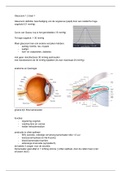
groene lijn: flow kamerwater
functies:
- regulering oogdruk
- voeding lens en cornea
- helder refractiemedium
productie in ciliair epitheel
- 90% secretie, volledige verversing kamerwater elke 1,5 uur
- koolzuuranhydrase en Na-K-pomp
- bloed-kamerwater barrière
- adrenerge innervatie (sympatisch)
de laatste 3 zorgen voor de secretie.
Kamerwater gaat altijd in 1 richting stroma cilliar epitheel, door de cellen heen (nier
ertussen door).
, Als mensen glaucoom hebben d.m.v een hoge oogdruk zijn er verschillende
behandelmethodes die de productie van kamerwater remmen.
Ook wordt de productie van kamerwater geremd door:
- lichamelijke inspanning
- onderkoeling
- narcose
- marihuana
afvloed kamerwater:
- trabeculum: 60%, druk-gestuurd
- uveoscleraal: 40%, constant, druk-onafhankelijk
trabeculum (kanaal van schlemm)
Een soort van zeef die bestaat uit allemaal cellen hier zit extracellulaire matrix omheen. Als
de weerstand in het trabekelsysteem toeneemt is er minder afvloed dus een hogere oogdruk.
(dit kan ook komen door een ontsteking, corticosteroïde etc)
Afvloed bevordering:
Verschillende soorten medicijnen.
- Invloed op trabekelsysteem (wordt bijna nooit gebruikt)
- Via uveoscleraal
Samenvattend:
- kamerwater productie in achterste oogkamer door actieve secretie van ciliair epitheel
- flow via pupil naar voren
- kamerwater afvloed in voorste oogkamer via trabeculum (druk-afhankelijk) en
uveoscleraal (constant)
- bepaalt de oogdruk
De papil (bij glaucoom):
Verlies van retinale gangioncellen en hun axonen leidt tot verdunning van:
- retinale zenuwvezellaag (NFL = nerve fibre layer)
- papil (excavatie: CD-ratio = cup disk ratio)
- n. opticus
- chiasma
Glaucoom definitie: beschadiging van de oogzenuw (papil) door een relatief te hoge
oogdruk(>21 mmHg).
Curve van Gauss: top is het gemiddelde (15 mmHg)
Te hoge oogdruk: > 30 mmHg
Maar glaucoom kan ook andere oorzaken hebben:
- aanleg: familie, ras, myopie
- leeftijd
- hart- en vaatziekten, diabetes
met geen risicofactoren 30 mmHg aanhouden
met risicofactoren de 30 mmHg bijstellen (bv dan maximaal 20 mmHg)
anatomie en fysiologie:
groene lijn: flow kamerwater
functies:
- regulering oogdruk
- voeding lens en cornea
- helder refractiemedium
productie in ciliair epitheel
- 90% secretie, volledige verversing kamerwater elke 1,5 uur
- koolzuuranhydrase en Na-K-pomp
- bloed-kamerwater barrière
- adrenerge innervatie (sympatisch)
de laatste 3 zorgen voor de secretie.
Kamerwater gaat altijd in 1 richting stroma cilliar epitheel, door de cellen heen (nier
ertussen door).
, Als mensen glaucoom hebben d.m.v een hoge oogdruk zijn er verschillende
behandelmethodes die de productie van kamerwater remmen.
Ook wordt de productie van kamerwater geremd door:
- lichamelijke inspanning
- onderkoeling
- narcose
- marihuana
afvloed kamerwater:
- trabeculum: 60%, druk-gestuurd
- uveoscleraal: 40%, constant, druk-onafhankelijk
trabeculum (kanaal van schlemm)
Een soort van zeef die bestaat uit allemaal cellen hier zit extracellulaire matrix omheen. Als
de weerstand in het trabekelsysteem toeneemt is er minder afvloed dus een hogere oogdruk.
(dit kan ook komen door een ontsteking, corticosteroïde etc)
Afvloed bevordering:
Verschillende soorten medicijnen.
- Invloed op trabekelsysteem (wordt bijna nooit gebruikt)
- Via uveoscleraal
Samenvattend:
- kamerwater productie in achterste oogkamer door actieve secretie van ciliair epitheel
- flow via pupil naar voren
- kamerwater afvloed in voorste oogkamer via trabeculum (druk-afhankelijk) en
uveoscleraal (constant)
- bepaalt de oogdruk
De papil (bij glaucoom):
Verlies van retinale gangioncellen en hun axonen leidt tot verdunning van:
- retinale zenuwvezellaag (NFL = nerve fibre layer)
- papil (excavatie: CD-ratio = cup disk ratio)
- n. opticus
- chiasma