Chronic Condition and Dual Special Needs Plans assessment. UHC -2021 Certification verified to pass
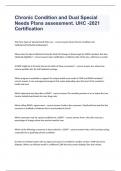
Chronic Condition and Dual Special Needs Plans assessment. UHC -2021 CertificationThe three types of Special Needs Plans are: - correct answer Dual, Chronic Condition and Institutional/Institutional-Equivalent. When does the Special Election Period for Dual/LIS Change in Status begin for DSNP members that lose Medicaid eligibility? - correct answer Upon notification or effective date of the loss, whichever is earlier A DSNP might be in the best interest of which of these consumers? - correct answer Joe, whose low income qualifies him for full Medicaid coverage Which program is available to support the unique health care needs of CSNP and DSNP members? - correct answer A care management program that varies depending upon the level of the member's health risk level Which statement best describes a DSNP? - correct answer The monthly premium is at or below the Low Income Subsidy benchmark to cover drug costs When selling DSNPs, agents must: - correct answer Confirm the consumer's Medicaid level and that the consumer is entitled to Medicare Part A and enrolled in Part B Which consumer may be a good candidate for a DSNP? - correct answer Anne, who does not pay a percentage of charges when she receives medical care Which of the following consumers is best suited for a CSNP? - correct answer Mary, who has been seeing a specialist for a qualifying chronic condition On May 10, Michael meets with an agent and says he is enrolled in another carrier's CSNP due to his diabetes. When can Michael enroll in a different CSNP that also covers diabetes (his only chronic condition), assuming he has not moved out of his current plan's service area? - correct answer He can enroll anytime using the SEP-Special Need/Chronic Which is a service provided to a CSNP or DSNP member placed in the low to moderate care management risk level? - correct answer Ongoing reassessment of risk level for status changes What is the purpose of the Chronic Condition Verification form? - correct answer It authorizes the plan to contact the provider identified on the form in order to verify chronic conditions Which statement is true about the Medicaid program? - correct answer Benefits vary from state to state. Which statement is true of DSNP members? - correct answer Members who are QMB+ or are Full Dual-Eligible are not required to pay copayments for Medicare-covered services obtained from a DSNP in-network provider. How long do plans using the CSNP pre-enrollment verification process have to verify the qualifying chronic condition until they must deny the enrollment request? - correct answer Within 21 days of the request for additional information. By the end of the month in which the enrollment request is made. Within 21 days of the request for additional information or the end of the month in which the enrollment request is made (whichever is longer). Within 7 days of the request for additional information. Lucille is no longer eligible for her state Medicaid program and has lost her eligibility for the DSNP in which she is enrolled. What is her responsibility for cost sharing? - correct answer All, such as premiums, deductibles, copayments, and coinsurance Only deductibles and copayments Only Part A premiums No change occurs during the grace period
Written for
- Institution
- UHC Certification
- Course
- UHC Certification
Document information
- Uploaded on
- October 20, 2023
- Number of pages
- 2
- Written in
- 2023/2024
- Type
- Exam (elaborations)
- Contains
- Questions & answers
Subjects
-
chronic condition and dual special needs plans ass

Document also available in package deal