NURS 660 Psychopharm Exam 3 | 200+ Questions and Answers | Maryville University | Already Graded A+
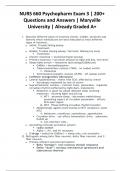
1. Describe different types of insomnia (initial, middle, terminal) and identify which medications are best indicated to treat different types of insomnia. o Initial: Trouble falling asleep • Treatment: o Middle: Trouble staying asleep; Terminal: Waking too early • Treatment: o Chronic insomnia = excessive/hyper-arousal o Primary insomnia = too much arousal at night and day, not tired. o Sleep/wake switch = histamine (activating)/GABA(rest) • GABAa + benzodiazepines • Tuberomammilary nucleus (TMN) – on (wake) switch 1. Histamine • Ventrolateral preoptic nucleus (VLPO) – off (sleep) switch o Caffeine antagonizes adenosine o Lateral hypothalamus – works with SCN, affected by orexin • Narcolepsy explained by lack of orexin o Suprachiasmatic nucleus = internal clock, pacemaker, regulates circadian rhythm (affected by light dark, melatonin) • Melatonin is good for phase delayed sleep (evening melatonin – morning light) and jet lag 1. MT1 – promote sleep – decreases wakefulness promoting aspect of circadian pacemaker – affects SCN alert signal 2. MT2 – Phase shifting circadian rhythm location • Melatonergic agents work mostly on MT1 receptors, some MT2 1. Melatonin, ramelteon, tasimelteon, agomelatine • Circadian drive – can affect homeostatic drive – adenosine builds up 1. Can interfere with… o Ascending reticular activation system – • radio switch • Alpha 1, M1, and H1 receptors o Z-drugs = selective GABAa1 - sleep only, not anxiolytic 2. Distinguish among beta fiber neurons, delta fiber neurons, and Cfiber neurons. o Primary afferent neurons/nociceptors: • Beta “benign”: non noxious stimuli response • Delta “dual”: noxious mechanical (pressure) and subnoxious thermal
Document information
- Uploaded on
- October 18, 2023
- Number of pages
- 24
- Written in
- 2023/2024
- Type
- Exam (elaborations)
- Contains
- Questions & answers