Hoofdstuk 9: NGS
➢ Sanger sequencing: what we had before NGS
♥ Introduced in 1977
♥ A template is denatured to form single strands, and extended with a polymerase in the presence of dideoxynucleotides
(ddNTPs) that cause chain termination.
♥ Typical read lengths are up to 800 base pairs. For the sequencing of Craig Venter’s genome (2007; first whole genome
of an individual), Sanger sequencing was employed because of its relatively long read lengths.
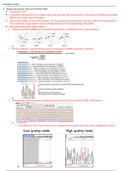
♥ DNA sequencing by the Sanger method
♪ Dideoxynucleotides (ddNTPs)( -OH of dNTP is replaced by -H of ddNTP at the 2’ ribose position)
❖
♪ Primer elongation, chain termination upon incorporation of ddNTP, separation, detection
❖
♪ View genomic DNA (here from the beta globin locus) from the Trace Archive at NCBI: FASTA format
❖
• Each DNA base in the Trace Archive has an associated base quality score (best scores highlighted in yellow)
, ➢ Next-generation sequencing
♥ Technologies:
♪
♪ Illumina
❖ Disadvantage:
• Short read length (~150 bases)
❖ Advantages:
• Very fast
• Low cost per base
• Large throughput; up to 1 gigabase/experiment
• Short read length makes it appropriate for resequencing
• No need for gel electrophoresis
• High accuracy
• All four bases are present at each cycle, with sequential addition of dNTPs.
This allows homopolymers to be accurately read.
❖ Sequencing by Illumina technology
•
➢ Sanger sequencing: what we had before NGS
♥ Introduced in 1977
♥ A template is denatured to form single strands, and extended with a polymerase in the presence of dideoxynucleotides
(ddNTPs) that cause chain termination.
♥ Typical read lengths are up to 800 base pairs. For the sequencing of Craig Venter’s genome (2007; first whole genome
of an individual), Sanger sequencing was employed because of its relatively long read lengths.
♥ DNA sequencing by the Sanger method
♪ Dideoxynucleotides (ddNTPs)( -OH of dNTP is replaced by -H of ddNTP at the 2’ ribose position)
❖
♪ Primer elongation, chain termination upon incorporation of ddNTP, separation, detection
❖
♪ View genomic DNA (here from the beta globin locus) from the Trace Archive at NCBI: FASTA format
❖
• Each DNA base in the Trace Archive has an associated base quality score (best scores highlighted in yellow)
, ➢ Next-generation sequencing
♥ Technologies:
♪
♪ Illumina
❖ Disadvantage:
• Short read length (~150 bases)
❖ Advantages:
• Very fast
• Low cost per base
• Large throughput; up to 1 gigabase/experiment
• Short read length makes it appropriate for resequencing
• No need for gel electrophoresis
• High accuracy
• All four bases are present at each cycle, with sequential addition of dNTPs.
This allows homopolymers to be accurately read.
❖ Sequencing by Illumina technology
•