
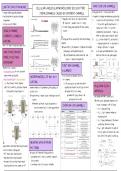
LIMITATIONS OF HH-MODEL CELLULAR & MOLECULAR NEUROSCIENCE (DE SCHUTTER): FUNCTION ION CHANNELS
> single channel gating complex FIRING DYNAMICS CAUSED BY DIFFERENT CHANNELS firing pattern N -> interaction ≠ IC
> inactivation not purely voltage- + depends strongly on membrane potential:
dependent > thalamic cells: burst or transfer mode I. IA: give current injection at -55mV
> not all current Ohmic → transfer = awake / burst = sleep -> A current rapidly inactivates ->
> B-stem: deep polarization AP that slowly repeat at -75mV -> A current
SINGLE CHANNEL recover completely inactivated -> takes a
CURRENTS: COMPLEX while to spike: gives delay in spike
≠ firing patterns caused by interaction many II. IL,C & h in bursting N: IL activates IC
GATING channel -> repolarization cell -> activate Ih
Na+ & K+ have totally ≠ properties → have HVA & LVA channels = high/low threshold -> brings cell back -> repeat
INACTIVATION NOT (nowadays wrong nomenclature) III. IM & spike accommodation: if you
→ each channel has whole bunch of sub- block IM then cell can spike again
PURELY VOLTAGE- types -> many firing options
DEPENDENT
channels has 2 gates:
FIRST NEW CHANNEL:
> activation gate: in rest closed & A-CURRENT
opens when activated MODERN MODELS OF Na+ & K+ first discovered channel after HH
> inactivation gate: cytoplasmatic = K+ channel
ball that floats in/out channel GATING = LVA: activates at low threshold +
→ !!! first need to activate channel modern models of Vandenberg & Bezanilla: ≠ rapidly inactivates by A-type current BUILDING BLOCK
to be able to inactivate it for Na+ & K+ → allows N to fire slowly APPROACH
→ each ion has 1 open state & multiple closed → when AP stops there’s de- you begin with HH & spike fast
states activation A-current → then start adding ≠ channels: will
→ models are hard: statistically most result in changes in AP & firing:
correct model, but it’s not guaranteed
OVERVIEW ION CHANNELS
> +IA = delayed firing
to be correct > +ICa = Ca2+ channel: enhances
repolarization
> +IT = binary behaviour: the lower
potential, the more firing
>+IAHP = get cumulative response:
in first spikes it doesn’t do a lot,
but after few spikes it adds up
NEURONS HAVE ≠ FIRING
experiment confirmed that inactivation
is due to ball in cytoplasm: PATTERNS
> WT: have clear inactivation ≠ types of N have ≠ firing patterns:
> ball deleted: no inactivation > pyramidal cells = most studied: regular &
> mutant, but lose ball: have weak burst mode
inactivation, but not same as WT > cerebellar cells: fire faster & higher
, Ih MORE IN DETAIL Ca2+ CHELATORS ACTION POTENTIAL
= hyperpolarizing active channel: = molecules that bind Ca2+
PROPAGATION
> reversal potential = -35mV → most popular ones: EGTA & BAPTA
→ when you voltage clamp at ≠ → affinity the same, but binding speed ORIGIN OF AP
levels you can see that the ≠: BAPTA faster where AP originated: axon, axon segment,
more depolarized cell is, the axon initial segment, nodes of Ranvier,...?
more Ih is activated → Stuart & Sakmann investigated this
> spike interval slowly activates
→ AP originates in begin axon & back-
Ih & brings channel out of hyper-
propagate into dendrite
polarization
> recently specific Ih blockers
discovered
Ca2+ ACTIVATED Ca2+ METABOLISM IN N
K+ CHANNELS Ca2+ !!!! signalling molecule: in N very controlled
→ [Ca2+] very low: specialised Ca-buffers
bind free Ca2+ & put in intracellular Ca2+
stores (=mitochondria & ER)
→ 2 ways to release Ca2+:
> IP3-R: activated by metabotropic
glutamate R (so via synaptic signals)
> RyR = ryanodine R
→ also pumps: PCMA & SERCA -> ATP-
dependent exchange of Na+ & Ca2+
> single channel gating complex FIRING DYNAMICS CAUSED BY DIFFERENT CHANNELS firing pattern N -> interaction ≠ IC
> inactivation not purely voltage- + depends strongly on membrane potential:
dependent > thalamic cells: burst or transfer mode I. IA: give current injection at -55mV
> not all current Ohmic → transfer = awake / burst = sleep -> A current rapidly inactivates ->
> B-stem: deep polarization AP that slowly repeat at -75mV -> A current
SINGLE CHANNEL recover completely inactivated -> takes a
CURRENTS: COMPLEX while to spike: gives delay in spike
≠ firing patterns caused by interaction many II. IL,C & h in bursting N: IL activates IC
GATING channel -> repolarization cell -> activate Ih
Na+ & K+ have totally ≠ properties → have HVA & LVA channels = high/low threshold -> brings cell back -> repeat
INACTIVATION NOT (nowadays wrong nomenclature) III. IM & spike accommodation: if you
→ each channel has whole bunch of sub- block IM then cell can spike again
PURELY VOLTAGE- types -> many firing options
DEPENDENT
channels has 2 gates:
FIRST NEW CHANNEL:
> activation gate: in rest closed & A-CURRENT
opens when activated MODERN MODELS OF Na+ & K+ first discovered channel after HH
> inactivation gate: cytoplasmatic = K+ channel
ball that floats in/out channel GATING = LVA: activates at low threshold +
→ !!! first need to activate channel modern models of Vandenberg & Bezanilla: ≠ rapidly inactivates by A-type current BUILDING BLOCK
to be able to inactivate it for Na+ & K+ → allows N to fire slowly APPROACH
→ each ion has 1 open state & multiple closed → when AP stops there’s de- you begin with HH & spike fast
states activation A-current → then start adding ≠ channels: will
→ models are hard: statistically most result in changes in AP & firing:
correct model, but it’s not guaranteed
OVERVIEW ION CHANNELS
> +IA = delayed firing
to be correct > +ICa = Ca2+ channel: enhances
repolarization
> +IT = binary behaviour: the lower
potential, the more firing
>+IAHP = get cumulative response:
in first spikes it doesn’t do a lot,
but after few spikes it adds up
NEURONS HAVE ≠ FIRING
experiment confirmed that inactivation
is due to ball in cytoplasm: PATTERNS
> WT: have clear inactivation ≠ types of N have ≠ firing patterns:
> ball deleted: no inactivation > pyramidal cells = most studied: regular &
> mutant, but lose ball: have weak burst mode
inactivation, but not same as WT > cerebellar cells: fire faster & higher
, Ih MORE IN DETAIL Ca2+ CHELATORS ACTION POTENTIAL
= hyperpolarizing active channel: = molecules that bind Ca2+
PROPAGATION
> reversal potential = -35mV → most popular ones: EGTA & BAPTA
→ when you voltage clamp at ≠ → affinity the same, but binding speed ORIGIN OF AP
levels you can see that the ≠: BAPTA faster where AP originated: axon, axon segment,
more depolarized cell is, the axon initial segment, nodes of Ranvier,...?
more Ih is activated → Stuart & Sakmann investigated this
> spike interval slowly activates
→ AP originates in begin axon & back-
Ih & brings channel out of hyper-
propagate into dendrite
polarization
> recently specific Ih blockers
discovered
Ca2+ ACTIVATED Ca2+ METABOLISM IN N
K+ CHANNELS Ca2+ !!!! signalling molecule: in N very controlled
→ [Ca2+] very low: specialised Ca-buffers
bind free Ca2+ & put in intracellular Ca2+
stores (=mitochondria & ER)
→ 2 ways to release Ca2+:
> IP3-R: activated by metabotropic
glutamate R (so via synaptic signals)
> RyR = ryanodine R
→ also pumps: PCMA & SERCA -> ATP-
dependent exchange of Na+ & Ca2+


