FUNDAMENTALS OF NURSING EXAM GUIDE
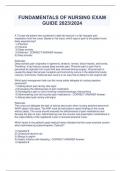
FUNDAMENTALS OF NURSING EXAM GUIDE A 73-year-old patient who sustained a right hip fracture in a fall requests pain medication from the nurse. Based on his injury, which type of pain is this patient most likely experiencing? 1) Phantom 2) Visceral 3) Deep somatic 4) Referred - CORRECT ANSWER-Answer: 3) Deep somatic Rationale: Deep somatic pain originates in ligaments, tendons, nerves, blood vessels, and bones. Therefore, a hip fracture causes deep somatic pain. Phantom pain is pain that is perceived to originate from a part that was removed during surgery. Visceral pain is caused by deep internal pain receptors and commonly occurs in the abdominal cavity, cranium, and thorax. Referred pain occurs in an area that is distant to the original site. Which pain management task can the nurse safely delegate to nursing assistive personnel? 1) Asking about pain during vital signs 2) Evaluating the effectiveness of pain medication 3) Developing a plan of care involving nonpharmacologic interventions 4) Administering over-the-counter pain medications - CORRECT ANSWER-Answer: 1) Asking about pain during vital signs Rationale: The nurse can delegate the task of asking about pain when nursing assistive personnel (NAP) obtain vital signs. The NAP must be instructed to report findings to the nurse without delay. The nurse should evaluate the effectiveness of pain medications and develop the plan of care. Administering over-the-counter and prescription medications is the responsibility of the registered nurse or licensed practical nurse. Which factor in the patient's past medical history dictates that the nurse exercise caution when administering acetaminophen (Tylenol)? 1) Hepatitis B 2) Occasional alcohol use 3) Allergy to aspirin 4) Gastric irritation with bleeding - CORRECT ANSWER-Answer: 1) Hepatitis B Rationale: Even in recommended doses, acetaminophen can cause severe hepatotoxicity in patients with liver disease, such as hepatitis B. Patients who consume alcohol regularly should also use acetaminophen cautiously. Those allergic to aspirin or other nonsteroidal anti-inflammatory drugs (NSAIDs) can use acetaminophen safely. Acetaminophen rarely causes gastrointestinal (GI) problems; therefore, it can be used for those with a history of gastric irritation and bleeding. Which action should the nurse take before administering morphine 4.0 mg intravenously to a patient complaining of incisional pain? 1) Assess the patient's incision. 2) Clarify the order with the prescriber. 3) Assess the patient's respiratory status. 4) Monitor the patient's heart rate. - CORRECT ANSWER-Answer: 3) Assess the patient's respiratory status. Rationale: Before administering an opioid analgesic, such as morphine, the nurse should assess the patient's respiratory status because opioid analgesics can cause respiratory depression. It is not necessary to clarify the order with the physician because morphine 4 mg IV is an appropriate dose. It is not necessary to monitor the patient's heart rate. Which action should the nurse take when preparing patient-controlled analgesia for a postoperative patient? 1) Caution the patient to limit the number of times he presses the dosing button. 2) Ask another nurse to double-check the setup before patient use. 3) Instruct the patient to administer a dose only when experiencing pain. 4) Provide clear, simple instructions for dosing if the patient is cognitively impaired. - CORRECT ANSWER-Answer: 2) Ask another nurse to double-check the setup before patient use. Rationale: As a safeguard to reduce the risk for dosing errors, the nurse should request another nurse to double-check the setup before patient use. The nurse should reassure the patient that the pump has a lockout feature that prevents him from overdosing even if he continues to push the dose administration button. The nurse should also instruct the patient to administer a dose before potentially painful activities, such as walking. Patient-controlled analgesia is contraindicated for those who are cognitively impaired. The nurse administers codeine sulfate 30 mg orally to a patient who underwent craniotomy 3 days ago for a brain tumor. How soon after administration should the nurse reassess the patient's pain? 1) Immediately 2) In 10 minutes 3) In 15 minutes 4) In 60 minutes - CORRECT ANSWER-Answer: 4) In 60 minutes Rationale: Codeine administered by the oral route reaches peak concentration in 60 minutes; therefore, the nurse should reassess the patient's pain 60 minutes after administration. The nurse should reassess pain after 10 minutes when administering codeine by the intramuscular or subcutaneous routes. Drugs administered by the intravenous (IV) route are effective almost immediately; however, codeine is not recommended for IV administration. Which nonsteroidal anti-inflammatory drug might be administered to inhibit platelet aggregation in a patient at risk for thrombophlebitis? 1) Ibuprofen (Motrin) 2) Celecoxib (Celebrex) 3) Aspirin (Ecotrin) 4) Indomethacin (Indocin) - CORRECT ANSWER-Answer: 3) Aspirin (Ecotrin) Rationale: Aspirin is a unique NSAID that inhibits platelet aggregation. Low-dose aspirin therapy is commonly administered to decrease the risk of thrombophlebitis, myocardial infarction, and stroke. Ibuprofen, celecoxib, and indomethacin are NSAIDs, but they do not inhibit platelet aggregation. A client who is receiving epidural analgesia complains of nausea and loss of motor function in his legs. The nurse obtains his blood pressure and notes a drop in his blood pressure from the previous reading. Which complication is the patient most likely experiencing? 1) Infection at the catheter insertion site 2) Side effect of the epidural analgesic 3) Epidural catheter migration 4) Spinal cord damage - CORRECT ANSWER-Answer: 3) Epidural catheter migration Rationale: The patient is exhibiting signs of epidural catheter migration, which include nausea, a decrease in blood pressure, and loss of motor function without an identifiable cause. Signs of infection at the catheter site include redness, swelling, and drainage. Loss of motor function is not a typical side effect associated with epidural analgesics. These are common signs of catheter migration, not spinal cord damage. Which of the following clients is experiencing an abnormal change in vital signs? A client whose (select all that apply): 1) Blood pressure (BP) was 132/80 mm Hg sitting and is 120/60 mm Hg upon standing 2) Rectal temperature is 97.9°F in the morning and 99.2°F in the evening 3) Heart rate was 76 before eating and is 60 after eating 4) Respiratory rate was 14 when standing and is 22 after walking - CORRECT ANSWER-Answer: 1) Blood pressure (BP) was 132/80 mm Hg sitting and is 120/60 mm Hg upon standing 3) Heart rate was 76 before eating and is 60 after eating Rationale: The BP change is abnormal; a BP change greater than 10 mm Hg may indicate postural hypotension. The change in heart rate is abnormal; heart rate usually increases slightly after eating rather than decreasing. The temperatures are within normal range for the rectal route, and temperature increases throughout the day. It is normal to have an increased respiratory rate after exercise. The nurse assesses clients' breath sounds. Which one requires immediate medical attention? A client who has: 1) Crackles 2) Rhonchi 3) Stridor 4) Wheezes - CORRECT ANSWER-Answer: 3) Stridor Rationale: Stridor is a sign of respiratory distress, possibly airway obstruction. Crackles and rhonchi indicate fluid in the lung; wheezes are caused by narrowing of the airway. Crackles, rhonchi, and wheezes indicate respiratory illness and are potentially serious but do not necessarily indicate respiratory distress that requires immediate medical attention. The nurse assesses the client's pedal pulses as having a pulse volume of 1 on a scale of 0 to 3. Based on this assessment finding, it would be important for the nurse to also assess the: 1) Pulse deficit 2) Blood pressure 3) Apical pulse 4) Pulse pressure - CORRECT ANSWER-Answer: 2) Blood pressure Rationale: If the leg pulses are weak, the nurse should assess the blood pressure in order to further explore the reason for the low pulse volume. If the blood pressure is low, then a low pulse volume would be expected. The pulse deficit is the difference between the apical and radial pulse. The apical pulse would not be helpful to assess peripheral circulation. The pulse pressure is the difference between the systolic and diastolic pressures. Which of the following clients has indications of orthostatic hypotension? A client whose blood pressure is: 1) 118/68 when standing and 110/72 when lying down 2) 140/80, HR 82 bpm when sitting and 136/76, HR 98 bpm when standing 3) 126/72 lying down and 133/80 when sitting, and reports shortness of breath 4) 146/88 when lying down and 130/78 when standing, and reports feeling dizzy - CORRECT ANSWER-Answer: 4) 146/88 when lying down and 130/78 when standing, and reports feeling dizzy Rationale: Orthostatic hypotension is a drop of 10 mm Hg or more in blood pressure upon moving to a standing position, with complaints of feeling dizzy and/or faint. A client who has experienced prolonged exposure to the cold is admitted to the hospital. Which method of taking a temperature would be most appropriate for this client? 1) Axillary with an electronic thermometer 2) Oral with a glass thermometer 3) Rectal with an electronic thermometer 4) Tympanic with an infrared thermometer - CORRECT ANSWER-Answer: 3) Rectal with an electronic thermometer Rationale: The rectal route is the most accurate for assessing core temperature, especially when it is critical to get an accurate temperature. Therefore, in this situation it is preferred. Temperature is a particularly relevant data point for this client with hypothermia as it indicates the patient's baseline status and response to treatment. The electronic thermometer is safer than glass and is relatively accurate. Mercury thermometers are no longer used in the hospital setting. The accuracy of tympanic thermometers is debatable. Which of the following clients would have the most difficulty maintaining thermoregulation? 1) Young child playing soccer during the summer 2) Middle-aged adult snow skiing 3) Young adult playing golf on a hot day 4) Older adult raking leaves on a cold day - CORRECT ANSWER-Answer: 4) Older adult raking leaves on a cold day Rationale: Older adults have more difficulty maintaining body heat because of their slower metabolism, loss of subcutaneous fat, and decreased vasomotor control. Which of the following clients should have an apical pulse taken? A client who is: 1) Febrile and has a radial pulse of 100 bpm 2) A runner who has a radial pulse of 62 bpm 3) An infant with no history of cardiac defect 4) An elderly adult who is taking antianxiety medication - CORRECT ANSWER-Answer: 3) An infant with no history of cardiac defect Rationale: An apical pulse should be taken if the radial pulse is weak and/or irregular, if the rate is <60 or >100, if the patient is on cardiac medications, or when assessing children up to 3 years. It is difficult to palpate a peripheral pulse on infants and young children. Which situation requires intrapersonal communication? 1) Staff meetings 2) Positive self-talk 3) Shift report 4) Wound care committee meeting - CORRECT ANSWER-Answer: 2) Positive self-talk Rationale: The nurse engaging in positive self-talk is using intrapersonal communication— conscious internal dialogue. Staff meetings, shift report, and a committee meeting are all examples of group or interpersonal communication. The nurse suspects that a patient is being physically abused at home. What is the best environment in which to discuss the possibility of abusive events? 1) The patient's shared semiprivate room 2) The hallway outside the patient's room 3) An empty corner at the nurse's station 4) A conference room at the end of the hall - CORRECT ANSWER-Answer: 4) A conference room at the end of the hall Rationale: The best environment in which to discuss sensitive matters is a quiet room where conversation can occur in private, particularly when the space is nonthreatening. The patient might be distracted if conversation takes place in a room where others (e.g.,
Geschreven voor
- Instelling
- FUNDAMENTALS OF NURSING
- Vak
- FUNDAMENTALS OF NURSING
Documentinformatie
- Geüpload op
- 11 oktober 2023
- Aantal pagina's
- 27
- Geschreven in
- 2023/2024
- Type
- Tentamen (uitwerkingen)
- Bevat
- Vragen en antwoorden
Onderwerpen
-
fundamentals of nursing exam guide
-
a 73 year old patient who sustained a right hip fr
-
which nonsteroidal anti inflammatory drug might be
-
which of the following clients would have the most

Ook beschikbaar in voordeelbundel