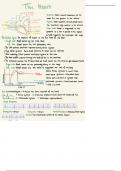
Carotid arteries
Diastole Heart relaxes chambers of
·
Aorta
the
:
,
venava heart fill ,
low
pressure in the arteries
Pulmonary vein
sino-atrial pulmonarytery
Systole Heart Chambers contract , blood leaves
·
:
node left atrium
Right
atrium
Atrio-ventricular
in the arteries
mode semilunar
value
I
the chambers ,
high pressure
atrioventricular left ventricle
Fetal heart Blood oxygenated
-
value
is in the
· :
Bundle of his
Rightentricle Purhyne tissue
e
septum
Purkyne fibers
placenta so a hole is present in the
septum
blood and lungs
so bypasses the ventricles
The Cardiac Cycle :
The sequence of'events in one full beat of the heart
1 .
Right side
:
Blood enters by the vena cava
Left side :
Blood enters by the
pulmonary vein
The SAN produces electrical impulses causing atrial
.
2 ,
systole
3 .
High atrial
pressure forces blood past the Ar values into the ventricles
↳
Non-conducting fibers prevent ventricular systole at this time
The AU conducts impulses through the bundle of his to the ventricles .
s The ventricles contract the Ar values shut and blood leaves via the arteries semilunar values
.
, , past
Right side Blood leaves via the
pulmonary artery the lungs to
:
Left side
:
Blood leaves via the aorta to oxygenate the rest of the
body
When Atrial
~
pressure is lower than
·
- semilunar
sure ventricular pressure sAuvalve Closes
- ·
When aortic pressure is
greater than
E trial pressure
centricular
pressure semi-lunar value closese
Ar value ventricular
-
Ar value
CloseS
·
opens
pressure
vice versa
time /S
ECG Electrocardiagram- shows the basic rhythm of the heat
:
R
down the
·- of
T
P Atrial G : Electrical impulses traver bundle his
systole
:
as R-s Ventricular
systole T Ventricular
repolarisation
: :
-
Heart Problems :
Bradycardia <60kpm Tachycardia: 120bpm Atrial fibrillation Abnormal heart
rhythm
: :
Ectopic Extra heartbeats outside of
:
the normal
rhythm
Diastole Heart relaxes chambers of
·
Aorta
the
:
,
venava heart fill ,
low
pressure in the arteries
Pulmonary vein
sino-atrial pulmonarytery
Systole Heart Chambers contract , blood leaves
·
:
node left atrium
Right
atrium
Atrio-ventricular
in the arteries
mode semilunar
value
I
the chambers ,
high pressure
atrioventricular left ventricle
Fetal heart Blood oxygenated
-
value
is in the
· :
Bundle of his
Rightentricle Purhyne tissue
e
septum
Purkyne fibers
placenta so a hole is present in the
septum
blood and lungs
so bypasses the ventricles
The Cardiac Cycle :
The sequence of'events in one full beat of the heart
1 .
Right side
:
Blood enters by the vena cava
Left side :
Blood enters by the
pulmonary vein
The SAN produces electrical impulses causing atrial
.
2 ,
systole
3 .
High atrial
pressure forces blood past the Ar values into the ventricles
↳
Non-conducting fibers prevent ventricular systole at this time
The AU conducts impulses through the bundle of his to the ventricles .
s The ventricles contract the Ar values shut and blood leaves via the arteries semilunar values
.
, , past
Right side Blood leaves via the
pulmonary artery the lungs to
:
Left side
:
Blood leaves via the aorta to oxygenate the rest of the
body
When Atrial
~
pressure is lower than
·
- semilunar
sure ventricular pressure sAuvalve Closes
- ·
When aortic pressure is
greater than
E trial pressure
centricular
pressure semi-lunar value closese
Ar value ventricular
-
Ar value
CloseS
·
opens
pressure
vice versa
time /S
ECG Electrocardiagram- shows the basic rhythm of the heat
:
R
down the
·- of
T
P Atrial G : Electrical impulses traver bundle his
systole
:
as R-s Ventricular
systole T Ventricular
repolarisation
: :
-
Heart Problems :
Bradycardia <60kpm Tachycardia: 120bpm Atrial fibrillation Abnormal heart
rhythm
: :
Ectopic Extra heartbeats outside of
:
the normal
rhythm