Next Generation Sequencing Exam Questions And Answers 100% Correct
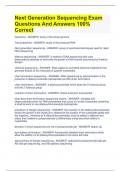
Next Generation Sequencing Exam Questions And Answers 100% Correct Genomics - ANSWER- study of the whole genome Transcriptomics - ANSWER- study of the produced RNA Next generation sequencing - ANSWER- group of automated techniques used for rapid DNA sequencing dideoxy sequencing - ANSWER- a method of DNA sequencing that uses dideoxyribonucleotides to terminate the growth of DNA strands discovered by Fredrick Sanger chemical sequencing - ANSWER- DNA subject to controlled chemical treatments that generate breaks of the molecules at specific nucleotides chain termination sequencing - ANSWER- DNA sequencing by polymerization in the presence of dideoxynucleotide triphosphate as DNA chain terminators chain terminators - ANSWER- a dideoxynucleotide which lacks the 3' hydroxyl group and the 2' hydroxyl group insertion of chain terminators - ANSWER- strand extension is prevented what does chain termination sequencing require - ANSWER- template and oligonucleotide primer for DNA polymerase and a pool of normal nucleotides containing a small amount of one dideoxyribonucleoside triphosphate procedure of Sanger sequencing - ANSWER- the insertion of the dideoxyribonucleotode blocks the growth of the molecule to determine the position of the nucleotide added with the fragment., therefore all 4 dideoxiribonucleotides must be added in different test tubes, then loaded on polyacrylamide to differentiate molecules which differs in nucleotides direction in which sequences are red on polyacramide gel - ANSWER- bottom up dye dideoxy terminators - ANSWER- fluorescently labelled chain terminators which allow the addition of all dideoxyribonucleotides to the same test tube advancement of Sanger sequencing - ANSWER- radioactive polyacrylamide slab gel, AB slab gel sequencing, and AB capillary sequencing Next generation sequencing - ANSWER- group of automated techniques used for rapid DNA sequencing limits of next generation sequencing - ANSWER- only one fragment is sequenced at a time, it is time consuming, and costly overcoming limits of next generation sequencing - ANSWER- parallelization and volume miniaturization parallelization - ANSWER- sequencing millions of molecules in the same reaction to increase efficiency volume miniaturization - ANSWER- the use of less reagent to make sequencing cheaper first step of both Sanger and next generation sequencing - ANSWER- fragmentation classic sequencing amplification - ANSWER- a single molecule of DNA is amplified either by cloning into bacterial cells or by performing PCR reactions next generation sequencing application - ANSWER- an array of amplified molecules can be sequenced simultaneously either by using sequence specific primers covering the entire sequence of the genome or by fragmenting the genome to which adaptors are added allowing the amplification by the same primers POLONY - ANSWER- Polymerase Colony, which is a PCR technique in which the template is a single molecule and all the produced molecules are kept together to form a cluster of clonal molecules all deriving from the same template PCR in next generation sequencing - ANSWER- performed on a solid solution rather than liquid. DNA is attached to beads or immobilized in slides, which are then amplified and sequenced work flow of next generation sequencing - ANSWER- library preparation, clonal amplification, sequencing, and DNA analysis library preparation - ANSWER- DNA fragmentation and in vitro adaptor ligation Clonal Amplification - ANSWER- emulsion PCR or bridge PCR micro-emulsion PCR - ANSWER- adding biotinylated DNA oligonucleotides with Biotin molecules to streptavin coated beats, then adding a template and reagent in the emulsion mixture, causing each droplet to contain a bead and DNA template. Then, PCR is performed in the droplets leading to the production of colony PCR. When breaking the emulsion, all the products are attached to bead
Document information
- Uploaded on
- October 9, 2023
- Number of pages
- 6
- Written in
- 2023/2024
- Type
- Exam (elaborations)
- Contains
- Questions & answers