Quality & Safety
of Healthcare
GW4007MV
S537735 - Thomas van Waesberge
14th October 2022 – December 2022
,Lecture 1
1.1 Introducing Quality & Safety
Why is it important?
- Very relevant in times of crisis – but just as important in everyday work
o Politics, unprecedented, facemask, social distancing, new difficulties
o When restrictions are not followed new restrictions are made corona pass
o How can we think about this work in general?
o How we can intervene?
- Meanwhile …
o Patient care may be substandard, unsafe, fragmented, variable, costly
o Efforts to improve Q&S are marginally on the agenda of healthcare organizations
o Existing power structures and hierarchies prevent quality improvement (QI)
heroism among medical specialists
o Instruments for QI are poorly understood
o Demographic changes, aging population, rise of co-morbidities…
How can we define it?
- Institute of Medicine:
o Six dimensions:
Effectiveness Provided care must improve health
Efficiency Provided care must improve health in the most efficient way,
maximizing the quality of care wherever possible
Equity Everyone should receive the same level of care based on their
individual needs
Patient centeredness Meet the needs of patients and their preferences,
but also about education and support for patients
Safety It should do no harm
Timeliness
(IoM, 2001)
The dimensions can conflict with each other
o Definition: “the degree to which health services for individuals and populations
increase the likelihood of desired health outcomes and are consistent with current
professional knowledge” (IoM, 2013)
Relative and dynamic definition of quality
Different people desire different things
Current professional knowledge shows that this definition is
dynamic
- World Health Organization (WHO)
o Same criteria as IoM
- Dutch Quality, Complaints & Disputes Act (Wkkgz):
o Same criteria as IoM, but replaces ‘Equity’ with ‘Transparency’
Q&S in practice
- What is out there?
o Many instruments for Q&S available, think of:
Clinical guidelines – evidence based interventions of which intervention is
effective for which diagnosis
, Accreditation bodies – external committees that assess the care in
organizations
Performance indicators – like waiting times or turnover rates
(Information) technologies – patient portals, medication dispensers etc.
Patient participation tools
Etc.
o However, Q&S are human accomplishments:
We need to take into account the work that people do!
- What problems do we encounter?
o Explanations that are often given for lacking quality and safety:
Instruments are badly implemented
Evidence of how instruments work is lacking
Interactions between instruments and contexts of use are unclear
Interaction between instruments is unclear
- What makes it hard to research?
o Practical limitations:
Research is often focused on ‘simple’ interventions in ‘complex’ environments
Local insights rarely universally applicable
There’s still a lot we don’t know about the environment of health care
o Different views on what is important:
Healthcare professionals, managers, policy makers tend to focus on
instruments, tools, structures…
They often ignore practices of quality and safety
- What characteristics can we discern?
o Q&S are multi-layered:
Interactions between macro, meso and micro levels of care
o Q&S are dynamic:
Changes at each level have consequences for quality instruments (ex.:
changing use of guidelines through time)
Interactions between instruments, organizations, laws and protocols, etc.
o Q&S are emergent:
Q&S emerge from care practices; they are not inherent properties of care
Consequences of interventions are unpredictable
- What should we do?
o Reflexive and contextual approaches
Look at processes instead of a static picture of healthcare
o Less top-down focus on implementing interventions
More opportunities for bottom-up
o More focus on making healthcare resilient
About preventive
In short
- Huge and complex challenge!
- Dynamic definitions
- Many different instruments
- Effects are poorly understood
- Multi-layered, dynamic, emergent
, 1.2 ‘Organizing for Quality’ framework
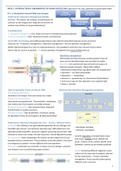
Six challenges
- Analytical framework
- New view of how to look at quality & safety in healthcare
- Outer context macro level
- Inner context meso level of an organization
Structural challenge
- Challenge around structuring, planning and coordinating quality efforts (Bate et al.)
o Structuring, planning and coordinating are written in an active way, instead of
structure, plan and coordination
o Good structures are essential for organizing quality effort; e.g. strategies, information
sharing, coordination, dedicated teams
o However, too much focus on structure can lead to bureaucratization, fragmentation
and decoupling
Cultural challenge
- Challenge of giving quality a shared, collective meaning, value and significance within the
organization (Bate et al.)
o Collective meaning: are we talking the same about culture in the organization
o Culture is crucial for sustaining change and for processes of sense-making.
Examples: culture of reflexivity, culture of innovation, culture of openness and sharing
o However, there are also dysfunctional cultures (think of clan-culture, bullying, etc.)
of Healthcare
GW4007MV
S537735 - Thomas van Waesberge
14th October 2022 – December 2022
,Lecture 1
1.1 Introducing Quality & Safety
Why is it important?
- Very relevant in times of crisis – but just as important in everyday work
o Politics, unprecedented, facemask, social distancing, new difficulties
o When restrictions are not followed new restrictions are made corona pass
o How can we think about this work in general?
o How we can intervene?
- Meanwhile …
o Patient care may be substandard, unsafe, fragmented, variable, costly
o Efforts to improve Q&S are marginally on the agenda of healthcare organizations
o Existing power structures and hierarchies prevent quality improvement (QI)
heroism among medical specialists
o Instruments for QI are poorly understood
o Demographic changes, aging population, rise of co-morbidities…
How can we define it?
- Institute of Medicine:
o Six dimensions:
Effectiveness Provided care must improve health
Efficiency Provided care must improve health in the most efficient way,
maximizing the quality of care wherever possible
Equity Everyone should receive the same level of care based on their
individual needs
Patient centeredness Meet the needs of patients and their preferences,
but also about education and support for patients
Safety It should do no harm
Timeliness
(IoM, 2001)
The dimensions can conflict with each other
o Definition: “the degree to which health services for individuals and populations
increase the likelihood of desired health outcomes and are consistent with current
professional knowledge” (IoM, 2013)
Relative and dynamic definition of quality
Different people desire different things
Current professional knowledge shows that this definition is
dynamic
- World Health Organization (WHO)
o Same criteria as IoM
- Dutch Quality, Complaints & Disputes Act (Wkkgz):
o Same criteria as IoM, but replaces ‘Equity’ with ‘Transparency’
Q&S in practice
- What is out there?
o Many instruments for Q&S available, think of:
Clinical guidelines – evidence based interventions of which intervention is
effective for which diagnosis
, Accreditation bodies – external committees that assess the care in
organizations
Performance indicators – like waiting times or turnover rates
(Information) technologies – patient portals, medication dispensers etc.
Patient participation tools
Etc.
o However, Q&S are human accomplishments:
We need to take into account the work that people do!
- What problems do we encounter?
o Explanations that are often given for lacking quality and safety:
Instruments are badly implemented
Evidence of how instruments work is lacking
Interactions between instruments and contexts of use are unclear
Interaction between instruments is unclear
- What makes it hard to research?
o Practical limitations:
Research is often focused on ‘simple’ interventions in ‘complex’ environments
Local insights rarely universally applicable
There’s still a lot we don’t know about the environment of health care
o Different views on what is important:
Healthcare professionals, managers, policy makers tend to focus on
instruments, tools, structures…
They often ignore practices of quality and safety
- What characteristics can we discern?
o Q&S are multi-layered:
Interactions between macro, meso and micro levels of care
o Q&S are dynamic:
Changes at each level have consequences for quality instruments (ex.:
changing use of guidelines through time)
Interactions between instruments, organizations, laws and protocols, etc.
o Q&S are emergent:
Q&S emerge from care practices; they are not inherent properties of care
Consequences of interventions are unpredictable
- What should we do?
o Reflexive and contextual approaches
Look at processes instead of a static picture of healthcare
o Less top-down focus on implementing interventions
More opportunities for bottom-up
o More focus on making healthcare resilient
About preventive
In short
- Huge and complex challenge!
- Dynamic definitions
- Many different instruments
- Effects are poorly understood
- Multi-layered, dynamic, emergent
, 1.2 ‘Organizing for Quality’ framework
Six challenges
- Analytical framework
- New view of how to look at quality & safety in healthcare
- Outer context macro level
- Inner context meso level of an organization
Structural challenge
- Challenge around structuring, planning and coordinating quality efforts (Bate et al.)
o Structuring, planning and coordinating are written in an active way, instead of
structure, plan and coordination
o Good structures are essential for organizing quality effort; e.g. strategies, information
sharing, coordination, dedicated teams
o However, too much focus on structure can lead to bureaucratization, fragmentation
and decoupling
Cultural challenge
- Challenge of giving quality a shared, collective meaning, value and significance within the
organization (Bate et al.)
o Collective meaning: are we talking the same about culture in the organization
o Culture is crucial for sustaining change and for processes of sense-making.
Examples: culture of reflexivity, culture of innovation, culture of openness and sharing
o However, there are also dysfunctional cultures (think of clan-culture, bullying, etc.)