Thema 5 – the individual within the group
[Kassin]
Chapter 8 (319-328)
Triplett’s article: the presence of another rider releases the competitive instinct, which increases
nervous energy and enhances performance -> later his studies proves mixed.
Zajonc: the prescence of others increases arousal, which can affect performance in different
ways, depending on the task at hand.
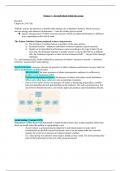
The Zajonc Solution (Zajonc proposed a three-step process):
1) The presence of another person or member of the same species.
2) Increased arousal – enhances individuals dominant response (quick reaction).
3) Quality of an individual’s performance varies according to the type of task. On an
easy task, the dominant response is usually correct or successful. But on a difficult
task, the dominant response is often incorrect/unsuccessfulb -> can get better through
repetition.
Ex.: just learning to play violin (unfamiliar), prescence of others= increase in arousal -> dominant
response= unsuccessful violin playing.
Social facilitation: a process whereby the presence of others enhances performance on easy tasks but
affects performance on difficult tasks.
- Mere presence: the mere presence of others (unresponsive audience) is sufficient to
produce social facilitation effect.
- Evaluation apprehension theory: the presence of others will reduce social facilitation
effects only when those others are seen as potential evaluators.
- Distraction-conflict theory: the presence of others is distracting and produces conflict
between attending the task and attending to the audience. Not only social presence, but
any form of distraction (noice, movement, light) can produce social facilitation effects).
Social loafing – Latane (1979)
Ringelmann (1880) discovered that people’s output declined when they worked together rather than
alone on simple tasks like pulling a rope/pushing a cart.
- Social loafing: a group-produced reduction in individual output on tasks where
contributions are pooled (sociaal lui) (komt vaker voor bij mannen dan bij vrouwen)
(minder bij vrouwen en mensen uit collectivistische cultuur).
- Ex.: when group was asked to cheer/clap as loudly as they could. The noise produced by
each of them decreased as the size of the group increased.
, Het verschil tussen het Ringelmann-effect en sociale loafing:
Ringelmann-effect (touwtje trekken):
Dit gaat over het idee dat mensen soms minder hard werken als ze deel uitmaken van een
groep in vergelijking met wanneer ze alleen werken. Ze denken misschien dat anderen hun
werk wel zullen doen.
Sociale Loafing:
Dit verwijst naar het gedrag waarbij mensen minder moeite doen in een groepstaak omdat ze
zich minder gemotiveerd voelen. Ze kunnen denken dat hun bijdrage niet echt nodig is of dat
niemand op hen let.
- Kort gezegd, het Ringelmann-effect gaat over minder fysieke inspanning in een groep,
terwijl sociale loafing draait om verminderde motivatie en inspanning in een groep. Bij
Ringelmann gaat het ook om hoe groter de groep wordt, dan ontstaat het effect.
Collective effort model: individuals will exert effort on a collective task to the degree that they think
their individual efforts will be important, relevant and meaningful for achieving outcomes that they
value.
- They may even engage in social compensation: by increasing their efforts on collective
tasks to try to compensate for the anticipated social loafing or poor performance of other
group members.
Culture:
- Was found that social loafing was less prevalent among women than among men and less
prevalent among people from East Asian collectivist cultures than among people from
Western individualist cultures.
- If someone in the group violates a norm of hard work, however, people form collectivist
cultures may take more offense.
Deindividuation
The loss of a person’s sense of individuality and the reduction of normal constraints against
deviant behavior. Loss of own indentiteit and confirms with the group.
- Zimbardo (1969) observed that arousal, anonymity and reduced feelings of individual
responsibility together contribute to deinviduation.
- > ex.: sports fans after a game (riot)
- > arousal: teams victory
- > anonymity: the thousands of celebrating fans
- > responsibility: these factors, along with alcohol consumption during the game= reduced
feelings of responsibility.
According to Prentice-Dunn & Rogers (1982, 1983), two types of environmental cues (accountability
and attentional cues) make deviant behavior more likely to occur.
- Accountability cues affect the individual’s cost-reward calculations (less likely to be
caught and punished – mask/crowd) (short-term) (confrontatie (spiegel in casino) met de
situaties – meer verantwoordelijkheid).
- Attentional cues focus a person’s attention away from the self. Individual attends less to
internal standards of conduct, reacts more to the immediate situation, and is less sensitive
to long-term consequences of behavior (gokken, denkt niet na over lange termijn
gevolgen).
[Kassin]
Chapter 8 (319-328)
Triplett’s article: the presence of another rider releases the competitive instinct, which increases
nervous energy and enhances performance -> later his studies proves mixed.
Zajonc: the prescence of others increases arousal, which can affect performance in different
ways, depending on the task at hand.
The Zajonc Solution (Zajonc proposed a three-step process):
1) The presence of another person or member of the same species.
2) Increased arousal – enhances individuals dominant response (quick reaction).
3) Quality of an individual’s performance varies according to the type of task. On an
easy task, the dominant response is usually correct or successful. But on a difficult
task, the dominant response is often incorrect/unsuccessfulb -> can get better through
repetition.
Ex.: just learning to play violin (unfamiliar), prescence of others= increase in arousal -> dominant
response= unsuccessful violin playing.
Social facilitation: a process whereby the presence of others enhances performance on easy tasks but
affects performance on difficult tasks.
- Mere presence: the mere presence of others (unresponsive audience) is sufficient to
produce social facilitation effect.
- Evaluation apprehension theory: the presence of others will reduce social facilitation
effects only when those others are seen as potential evaluators.
- Distraction-conflict theory: the presence of others is distracting and produces conflict
between attending the task and attending to the audience. Not only social presence, but
any form of distraction (noice, movement, light) can produce social facilitation effects).
Social loafing – Latane (1979)
Ringelmann (1880) discovered that people’s output declined when they worked together rather than
alone on simple tasks like pulling a rope/pushing a cart.
- Social loafing: a group-produced reduction in individual output on tasks where
contributions are pooled (sociaal lui) (komt vaker voor bij mannen dan bij vrouwen)
(minder bij vrouwen en mensen uit collectivistische cultuur).
- Ex.: when group was asked to cheer/clap as loudly as they could. The noise produced by
each of them decreased as the size of the group increased.
, Het verschil tussen het Ringelmann-effect en sociale loafing:
Ringelmann-effect (touwtje trekken):
Dit gaat over het idee dat mensen soms minder hard werken als ze deel uitmaken van een
groep in vergelijking met wanneer ze alleen werken. Ze denken misschien dat anderen hun
werk wel zullen doen.
Sociale Loafing:
Dit verwijst naar het gedrag waarbij mensen minder moeite doen in een groepstaak omdat ze
zich minder gemotiveerd voelen. Ze kunnen denken dat hun bijdrage niet echt nodig is of dat
niemand op hen let.
- Kort gezegd, het Ringelmann-effect gaat over minder fysieke inspanning in een groep,
terwijl sociale loafing draait om verminderde motivatie en inspanning in een groep. Bij
Ringelmann gaat het ook om hoe groter de groep wordt, dan ontstaat het effect.
Collective effort model: individuals will exert effort on a collective task to the degree that they think
their individual efforts will be important, relevant and meaningful for achieving outcomes that they
value.
- They may even engage in social compensation: by increasing their efforts on collective
tasks to try to compensate for the anticipated social loafing or poor performance of other
group members.
Culture:
- Was found that social loafing was less prevalent among women than among men and less
prevalent among people from East Asian collectivist cultures than among people from
Western individualist cultures.
- If someone in the group violates a norm of hard work, however, people form collectivist
cultures may take more offense.
Deindividuation
The loss of a person’s sense of individuality and the reduction of normal constraints against
deviant behavior. Loss of own indentiteit and confirms with the group.
- Zimbardo (1969) observed that arousal, anonymity and reduced feelings of individual
responsibility together contribute to deinviduation.
- > ex.: sports fans after a game (riot)
- > arousal: teams victory
- > anonymity: the thousands of celebrating fans
- > responsibility: these factors, along with alcohol consumption during the game= reduced
feelings of responsibility.
According to Prentice-Dunn & Rogers (1982, 1983), two types of environmental cues (accountability
and attentional cues) make deviant behavior more likely to occur.
- Accountability cues affect the individual’s cost-reward calculations (less likely to be
caught and punished – mask/crowd) (short-term) (confrontatie (spiegel in casino) met de
situaties – meer verantwoordelijkheid).
- Attentional cues focus a person’s attention away from the self. Individual attends less to
internal standards of conduct, reacts more to the immediate situation, and is less sensitive
to long-term consequences of behavior (gokken, denkt niet na over lange termijn
gevolgen).